Jackson County stretches across 471.2 square miles of Appalachian foothills along the Ohio River, between Parkersburg and Point Pleasant. Homes in Ravenswood, Ripley and Cottageville sit on land that local descriptions call rolling and hilly, with large flat bottoms along the Ohio River, Big Mill Creek and Big Sandy Creek. Plenty of houses here are on sloped lots with more than one level and steps outside the door.
Much of the county's older housing dates to its farming and river-town days, after settlement began in May 1796 and Ripley became the county seat in 1831. Many of these long-owned homes were built well before modern accessibility codes. That often means a stepped entry and a second floor reached only by an interior staircase, which is exactly where a stair lift can help someone keep living at home.
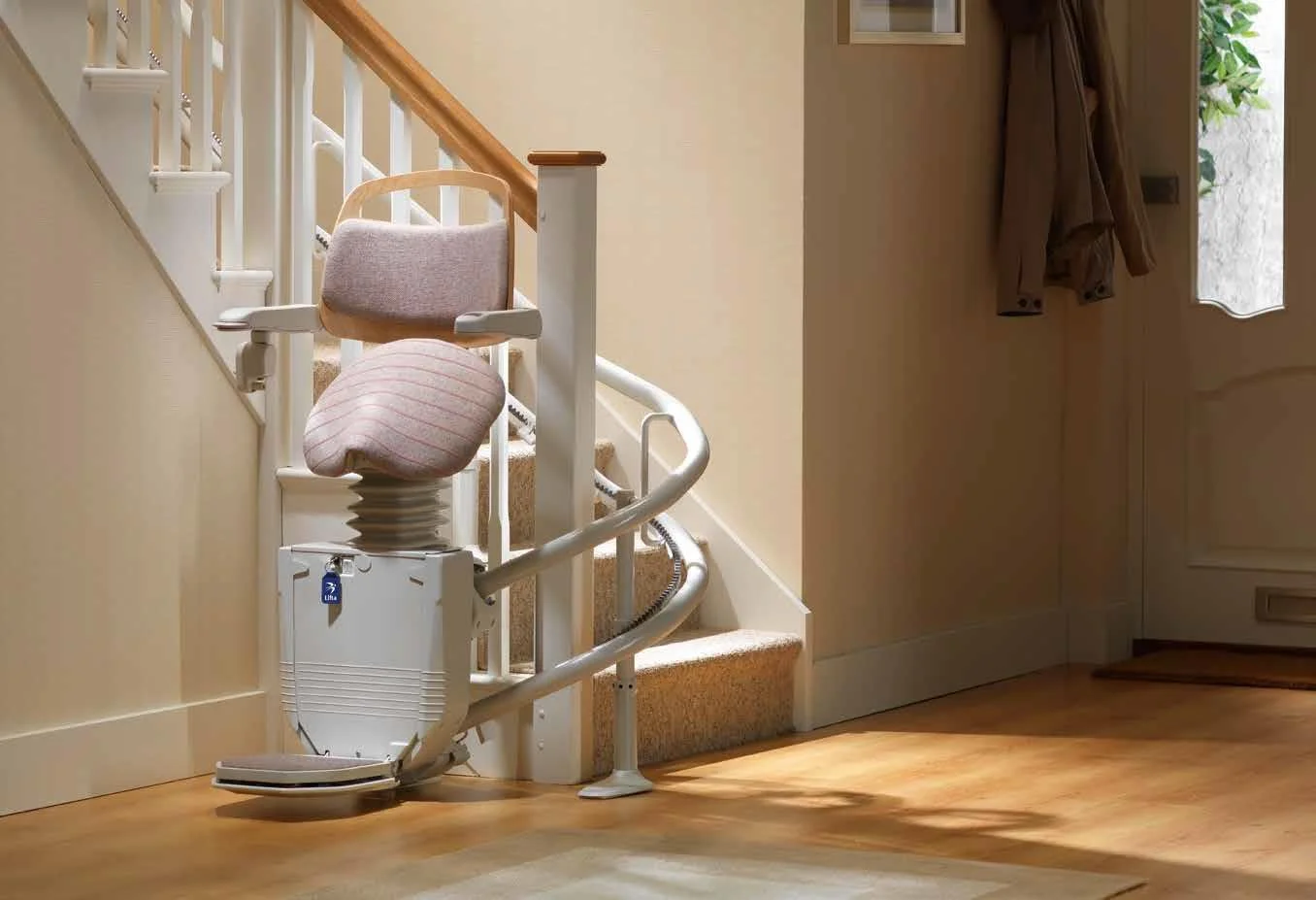
In a house built in the 19th or early 20th century, the bedrooms and the only full bathroom are often upstairs. If that interior staircase runs in one straight flight, a straight stair lift is usually the simplest fit. It mounts to the stair treads, not the wall, so the old plaster stays put.
Older staircases are sometimes narrow or have a turn or landing partway up. A turn means a curved lift built to the shape of that staircase. We measure every step before recommending one or the other.
Split-level homes are common in Jackson County, and they put short flights between each level. Depending on which floors a person needs to reach, that can mean one curved lift or a lift on just the flight that matters most.
On a sloped lot, the hardest climb is often outside: steps from the driveway up to the porch or front door. An outdoor stair lift is built for weather and can handle those exterior steps. Where someone uses a wheelchair, a platform lift may be the better answer, since a seated stair lift requires the rider to transfer onto the chair.
Townhouses and walk-up apartments also turn up here. If you rent, talk with the property owner before planning any installation.
About 18.9% of Jackson County residents are 65 or older, and 63.1% of households own their homes. For homeowners who have lived in the same house for decades, adapting the stairs is often more practical than moving.
Veterans should know up front that one common VA grant, HISA, does not pay for stair glides, so it helps to look at the other options below before counting on VA money.
No program on this page names stair lifts as a covered item, so treat every one as worth a phone call, not a guarantee. Several cover home modifications in general, and a caseworker can tell you whether a lift fits within that.
For people who may qualify for Medicaid, the West Virginia Aged and Disabled Waiver (ADW) covers home modifications as an Environmental Accessibility Adaptation. For seniors 60 and older who may not qualify for Medicaid, the Aging Well, Safe at Home Initiative is the program to ask about. Rural homeowners with very low income can look at USDA Section 504 repair loans and grants.
A good first call is the Jackson County Commission on Aging, Inc. at (304) 372-2406, which can refer you to the right state program. The statewide West Virginia Technology-Related Assistance Revolving Loan Fund is another name to ask about. Veterans can reach the West Virginia Department of Veterans Assistance - Spencer Benefits Office at (304) 927-0980.
A Medicaid home and community-based waiver for people 65 and older, or 18 to 64 with an SSA-determined physical disability, who need nursing facility level of care, with income up to $2,982/month and assets limited to $2,000 single or $3,000 couple. It covers home modifications, but stair lifts are not named; slots are limited, a physician must first submit a Medical Necessity Evaluation Request (MNER), and you can call (866) 767-1575.
A state program for people 60 or older who need home modifications or accessibility devices to live more independently, including those who may not qualify for Medicaid. Stair lifts are not named on the source, so confirm coverage by calling (866) 981-2372 or starting with the Jackson County Commission on Aging.
A lifetime VA grant of $6,800 for service-connected disabilities or $2,000 for other eligible disabilities, used for entrance access, bathroom access, kitchen changes and related plumbing or electrical work. It does not cover stair lifts: the source explicitly excludes porch lifts and stair glides.
Grants for veterans with qualifying severe service-connected disabilities who own or plan to own the home, up to $126,526 for SAH or $25,350 for SHA on a permanent home in FY2026. The VA lists ramps and widened doorways as examples and does not mention stair lifts, so a caseworker needs to confirm any lift in the adaptation plan.
Loans up to $20,000 at 1% over 20 years, and grants up to $7,500 for homeowners 62 and older, with a combined maximum of $27,500, for very-low-income rural homeowners. Jackson County is served by USDA Rural Development, but the source does not name stair lifts, so coverage is not confirmed.
A nonprofit serving people with disabilities in a 16-county area that includes Jackson County, offering home modifications, ramps, bathroom changes and assistive device installation for those who meet income guidelines. Stair lifts are not named and there is a waiting list; call (304) 965-0376 and ask for Community Living Services.
The county's senior agency, offering meals and transportation for residents 60 and older, including medical trips to Charleston, Parkersburg, Spencer and Point Pleasant. It does not list a stair lift program but serves as the local referral point to the ADW waiver and state home modification help; call (304) 372-2406.
The regional agency on aging for 11 West Virginia counties, including Jackson, that refers residents to the WV BoSS Home Modification and Accessibility Program and the ADW waiver. It names no stair lift program itself; call (304) 720-6858.
Older adults
1900 Kanawha Blvd. East, Charleston, 25305
Veterans
216 Market Street Suite 301, Spencer, 25276
The West Virginia Aged and Disabled Waiver (ADW) covers home modifications, but the source does not name stair lifts. Eligibility requires nursing facility level of care, income up to $2,982/month and limited assets, and slots are limited. Call (866) 767-1575 to ask.
Yes, the Aging Well, Safe at Home Initiative is meant for people 60 and older who need home modifications but may not qualify for Medicaid. Stair lifts are not named, so ask directly at (866) 981-2372 or through the Jackson County Commission on Aging at (304) 372-2406.
No. The HISA source explicitly excludes stair glides and porch lifts. Veterans with severe service-connected disabilities can ask about SAH or SHA grants, and the Spencer Benefits Office is at (304) 927-0980.
Split-levels often have several short flights, which may call for a curved lift or a lift on just the flight you use most. If the hard part is the steps from the driveway to the door, an outdoor lift or a platform lift may fit better. A measurement visit settles it.
Jackson County is served by USDA Rural Development, and Section 504 offers loans up to $20,000 and grants up to $7,500 for homeowners 62 and older with very low income. The program funds repairs that remove health or safety hazards, but stair lifts are not named, so confirm before applying.
Tell us about the stairs in your home and we will explain which lift fits, what it costs and how installation works.
