From St. Johnsbury and Lyndonville to Hardwick, Danville and Peacham, Caledonia County is spread thin across the Northeast Kingdom, at about 46.6 residents per square mile. Many of the homes here are old farmhouses and village houses from the county's 19th-century stone-industry years, when Ryegate's granite quarries on Blue Mountain and Waterford's slate quarries were busy.
Those older houses often still have their original staircases, and they tend to be narrow and steep. That is one of the most common reasons families in towns like Barnet, Burke, Groton and Sheffield start asking about a stair lift. This page walks through how local homes and terrain affect the choice, and which programs may help with the cost.
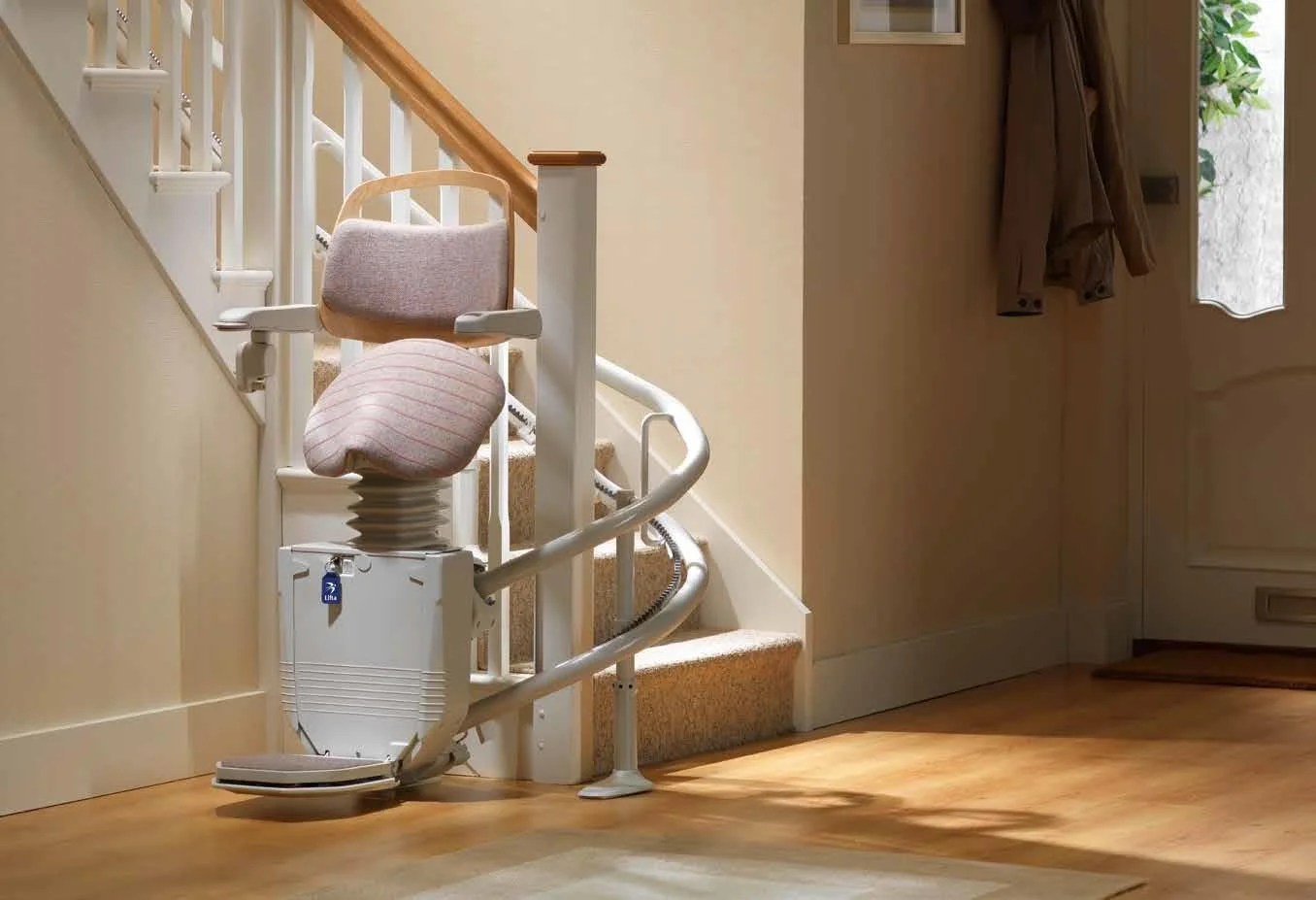
A narrow, steep staircase in an old farmhouse is usually still a good fit for a lift. If the stairs run in one straight flight with no turns or landings, a straight rail is the simplest and least costly option.
Stairs that wind, turn at a landing or curve partway up need a curved rail built to the shape of that staircase. We measure in person so the rail follows your stairs and leaves room for others to walk past the folded seat.
Not every home in the county is a farmhouse. Single-family and detached houses make up much of the area, but there are also split-level homes, townhouses and walk-up apartments.
Split-level homes often have several short runs of stairs, so it helps to decide which flight matters most for daily life, such as the one to the bedroom or bathroom. In a walk-up apartment, the landlord has to approve a permanent installation, while homeowners can go ahead on their own.
The county covers about 658 square miles, with the Connecticut River along its southeast edge and the Passumpsic River draining the northern towns. There are roughly twenty lakes and ponds, and a serious flood in July 2008 led to a federal disaster declaration.
Wet, uneven ground around rural single-family homes can make outdoor ramps hard to use. If the trouble starts at the porch or entry steps, an outdoor-rated lift is worth talking through alongside the indoor staircase.
Roughly 77.5% of households own their home, so most families can install a permanent lift without asking anyone's permission.
Veteran status matters here, because one VA grant names stair lifts directly while another excludes them. That is covered in the next section and in the program list below.
The median household income in the county was about $69,970 in 2024, and many jobs are in health care, education and retail. With budgets tight, financing or a reconditioned straight rail is a common route for St. Johnsbury-area seniors.
Of the programs listed below, only the VA Specially Adapted Housing (SAH) Grant names stair lifts as covered. The VA HISA grant excludes stair glides. The others fund home modifications or accessibility work but do not mention stair lifts, so call and ask before counting on them.
A good first call is the NEK Council on Aging at 481 Summer St., Suite 101, St. Johnsbury, (802) 748-5182. They can refer you case by case to modification funding.
A state Medicaid waiver for Vermonters 65+ or with a qualifying physical disability who meet nursing-home level of care and financial limits; it covers home modifications like ramps, grab bars and doorway widening, but stair lifts are not listed. Call (800) 479-6151.
The Area Agency on Aging for older adults (typically 60+) and caregivers in Caledonia, Orleans and Essex counties, based in St. Johnsbury; it has no dedicated stair lift grant but refers callers to modification funding. Call (800) 642-5119.
A statewide grant for low-income Vermonters with a permanent physical disability that funds ramps, entrances and bathroom accessibility; stair lifts are not listed and a long waitlist is reported. Call (802) 224-1807.
A fund for physically disabled Vermont residents at or below 80% of HUD area median income, covering independence-related items case by case; stair lifts are not named among its examples. Call (802) 229-0501.
Low-interest loans with possible grant help for homeowners in Caledonia, Orleans or Essex County at or below 80% of area median income; it covers accessibility improvements, though stair lifts are not named. Call (802) 535-3555.
Federal repair loans up to $40,000 at 1% and grants up to $10,000 for homeowners 62+ with very low income in eligible rural areas; accessibility items like ramps are covered, but stair lifts are not named. Call (603) 223-6035.
A VA grant of up to $6,800 or $2,000 lifetime for medically necessary home access changes; it explicitly excludes stair glides, so it does not cover stair lifts. Call (802) 295-9363.
A VA grant of up to $109,986 for FY2026 for veterans with certain permanent service-connected disabilities, and it names stair lifts between floors as covered. Call (800) 230-7201.
A VA grant of up to $25,350 for FY2026 for veterans with qualifying service-connected disabilities, covering adaptations like ramps and entry stair modifications; stair lifts are not specifically named. Call (800) 230-7201.
Older adults
481 Summer St., Suite 101, St. Johnsbury, 05819
Veterans
789 Vermont National Guard Road, Colchester, 05446
Often, yes. Narrow, steep original staircases are common in older Vermont homes and are a frequent reason people look at lifts. A straight flight takes a straight rail, while turns or landings need a curved rail, and an in-home measurement settles which one fits.
The program covers home modifications such as ramps, grab bars and doorway widening, but stair lifts are not named, so coverage is not confirmed. Services are approved case by case, and you can call (800) 479-6151 to ask.
The NEK Council on Aging serves adults typically 60 and older. The VCIL Home Access Program and Sue Williams Freedom Fund are based on physical disability rather than age, though neither names stair lifts.
The VA Specially Adapted Housing (SAH) Grant names stair lifts as covered for veterans with qualifying permanent service-connected disabilities. The HISA grant excludes stair glides. Vermont Veterans Outreach can be reached at (802) 338-4324.
A permanent lift in a rental needs the landlord's approval before installation. Homeowners do not need that step, which is one reason most stair lift buyers here own their home.
The NEK Council on Aging is at 481 Summer St., Suite 101, St. Johnsbury, phone (802) 748-5182. Their helpline at (800) 642-5119 can refer you to programs like VCIL, RuralEdge and Choices for Care.
Tell us about the stairs in your home and we will explain which lift fits, what it costs and how installation works.
