Lee County covers 634 square miles of central Texas prairie between Houston and Austin, and the 2020 Census counts it as 99.9% rural. Most people live outside Giddings proper, on farm and ranch land or in and around Lexington. That means many homes here sit on their own lot, often with a raised entry or a set of front-porch steps.
Those steps are usually where trouble starts. The older farmhouses and ranch-style homes common in this part of Texas were often built off the ground, and split-level homes add short flights inside. This page walks through which kind of stair lift fits those layouts and which programs Lee County residents can call about paying for one.
The housing here is mostly single-family homes and detached houses, with a lot of ranch-style and split-level designs. A one-story ranch home may have no indoor stairs at all, but the front or back entry can still have several steps up to the porch. For that, an outdoor stair lift built for weather exposure is the usual answer.
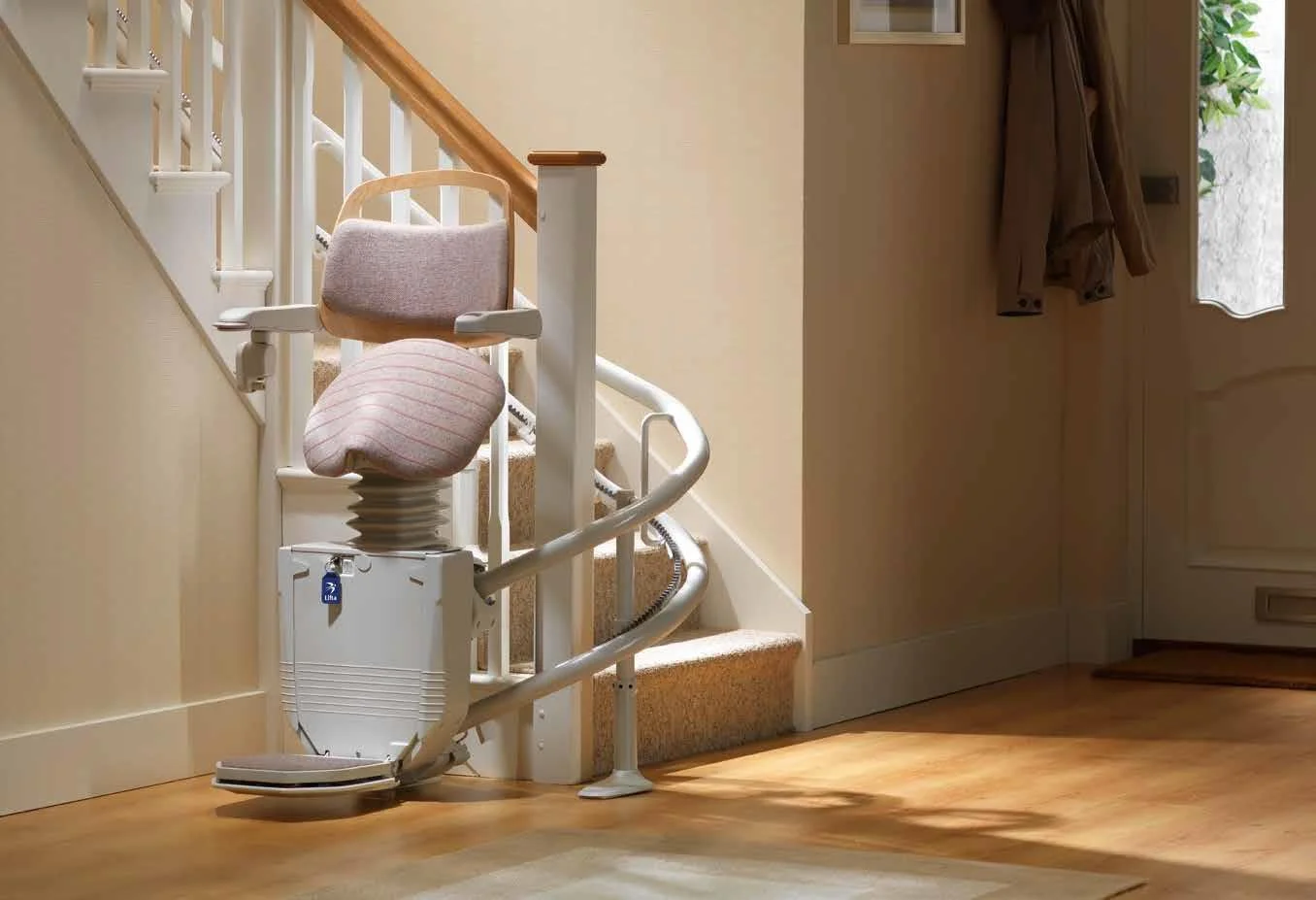
Split-level homes are different. They tend to have short flights between levels, sometimes more than one. If each flight is straight, a straight stair lift on each run works well. If the stairs turn at a landing, a curved rail is needed, and that rail is made to fit the exact shape of your staircase.
Many older homes in Giddings and the surrounding countryside were built with raised entries typical of their era. An outdoor stair lift can run along those exterior steps so a person rides up to the door instead of climbing.
When someone uses a wheelchair, a seat on a rail may not be enough. A platform lift or a ramp can be the better fit for an entry. The flat prairie ground here often leaves room in the yard for a ramp, and the Texas Ramp Project serves Lee County for exactly that kind of exterior access.
About 19.3% of county residents are 65 or older, and 60.9% own their homes. Owning the house matters, because it makes permanent changes like a mounted rail simpler to plan.
If that includes someone in your family, it is worth talking with the Lee County Veterans Service Officer at the Lee County Courthouse Annex, 898 East Richmond, Suite 104B, in Giddings. The office phone is (979) 540-2733.
Because so much of Lee County is rural, families often drive a long way to reach medical providers, equipment installers or the Area Agency on Aging offices in Austin. Planning ahead helps. Have stair measurements, photos of the entry and a list of questions ready before any visit or phone call.
Ask any installer whether they come out to rural addresses and how service calls work at your location. A stair lift is a machine with a motor and battery, so knowing who will service it later is part of the decision.
Most programs that serve Lee County do not name stair lifts directly. Some cover home modifications or accessibility changes in general, and a stair lift may or may not qualify. The safest approach is to call and ask about a stair lift by name before you sign anything.
A good first call is the Area Agency on Aging of the Capital Area, which serves adults 60 and older in Lee County and can screen for STAR+PLUS and other waiver services. For rural homeowners with very low income, USDA Section 504 repair loans and grants are worth asking about. Veterans should know the VA HISA grant does not cover stair glides, though other VA grants may apply in some cases.
Texas also has statewide programs you can ask about by name, including the Amy Young Barrier Removal Program (AYBR) and the Community Living Assistance and Support Services (CLASS) Waiver. Each program is listed below with what its source says about coverage.
A Texas Medicaid waiver benefit with a $7,500 lifetime limit per member, plus up to $300/year after that for repairs or added modifications; it lists ramps, grab-bars and bathroom changes, but stair lifts are not named and elevators cannot be approved. Members enrolled in STAR+PLUS with the HCBS waiver should ask their service coordinator whether a stair lift can go in their individual service plan.
Offers information and referral, benefits counseling, caregiver support and care coordination for adults 60+ and people with disabilities in Lee County; it does not name a stair lift fund. Call (512) 916-6053 to ask about current in-home accessibility help and waiver screening.
Very-low-income rural homeowners can borrow up to $40,000 at 1% fixed interest, and homeowners 62+ who cannot repay a loan may get grants up to $10,000; accessibility changes are covered, but stair lifts are not named specifically. Call (254) 742-9700 to ask whether a stair lift would qualify.
A lifetime VA grant of up to $6,800 or $2,000, depending on disability status, for medically necessary alterations prescribed by a VA provider. Stair glides are explicitly excluded, so this grant does not cover stair lifts; call (800) 827-1000 with questions.
Grants for veterans with specific severe service-connected disabilities, up to $126,526 for SAH and $25,350 for SHA (FY2026), to buy, build or adapt a home. Stair lifts are not named on the source page, so call (800) 827-1000 to ask whether one can be part of an approved adaptation plan.
A nonprofit that provides advocacy, independent living skills training, peer counseling and referral to people with disabilities of any age, serving Lee County through purchased services; no stair lift program is named. Call (512) 832-6349 to confirm what is available for Lee County residents.
A volunteer nonprofit that builds wheelchair ramps for Texans with mobility disabilities, and Lee County is in its service area. It does not provide stair lifts, but can help with exterior entry access; call (214) 558-0339.
Funds energy-efficiency work like insulation, air sealing and HVAC repair for low-income Lee County households, and it does not cover accessibility changes or stair lifts. You can call (979) 540-2980 to ask whether the agency has any separate minor home repair funding.
State-administered home repair, rehabilitation and accessibility modification funds for owner-occupied homes with household income below 80% of area median income, reported at up to $45,000 per household. Stair lifts are not named, and Lee County residents typically apply through a regional or state-administered HOME program.
Older adults
6800 Burleson Road, Bldg. 301, Suite 165, Austin, 78744
Veterans
Lee County Courthouse Annex 898 East Richmond - Suite 104B, Giddings, 78942
Yes. An outdoor stair lift can run along exterior entry steps, which are common on older farmhouses and ranch-style homes here. If the person uses a wheelchair, a ramp or platform lift may fit better, and the Texas Ramp Project serves Lee County.
Not through the HISA grant, which explicitly excludes stair glides. The SAH and SHA grants do not name stair lifts either way, so a qualifying veteran should call (800) 827-1000 or the Lee County Veterans Service Officer at (979) 540-2733 to ask.
The USDA Section 504 grant requires the applicant to be 62 or older, but the 504 repair loan does not carry that age rule. ARCIL serves people with disabilities of any age, and the Area Agency on Aging of the Capital Area serves people with disabilities and their caregivers as well as adults 60 and older.
The STAR+PLUS HCBS waiver covers minor home modifications up to a $7,500 lifetime limit, but its list does not name stair lifts. If you are enrolled, ask your service coordinator whether one can be added to your individual service plan.
The Area Agency on Aging of the Capital Area at (512) 916-6053 is a good starting point for adults 60 and older. It can point you to current accessibility help and screen for waiver services.
Tell us about the stairs in your home and we will explain which lift fits, what it costs and how installation works.
