From Beaumont and Port Arthur down to Fannett, Hamshire and Taylor Landing, a lot of Jefferson County homes were built up off the ground. Flood rules here push living space above predicted flood levels, so many older houses sit on pier-and-beam foundations with a flight of steps just to reach the front door.
Those entry steps are often the first thing that stops an older homeowner from coming and going on their own. This page covers which kind of stair lift fits the homes we see across the county's 13 towns, what the local land and weather mean for an install, and which agencies and programs are worth a phone call when it comes to paying.
Jefferson County sits in a FEMA-mapped flood-risk zone. One look at sampled Beaumont parcels found 16% inside Special Flood Hazard Areas, with zones X, AE and VE all present. Homes in zones A, AE, AH and AO have to meet base-flood-elevation standards, which usually means a raised foundation or pier-and-beam system.
For a stair lift, that changes where the problem is. In many houses the hard climb is not inside at all but the run of steps from the yard to the porch. An outdoor stair lift on those entry steps can matter more than anything installed indoors.
When the steps are too short or too awkward for a rail, or a wheelchair user needs to get up, a vertical platform lift or a ramp may be the better answer. We look at the step count, the landing size and the space at the bottom before suggesting one or the other.
Split-level homes are common here, and they usually mean several short flights instead of one long one. Each short flight can often take its own straight stair lift, which keeps the cost lower than a single rail that bends around corners.
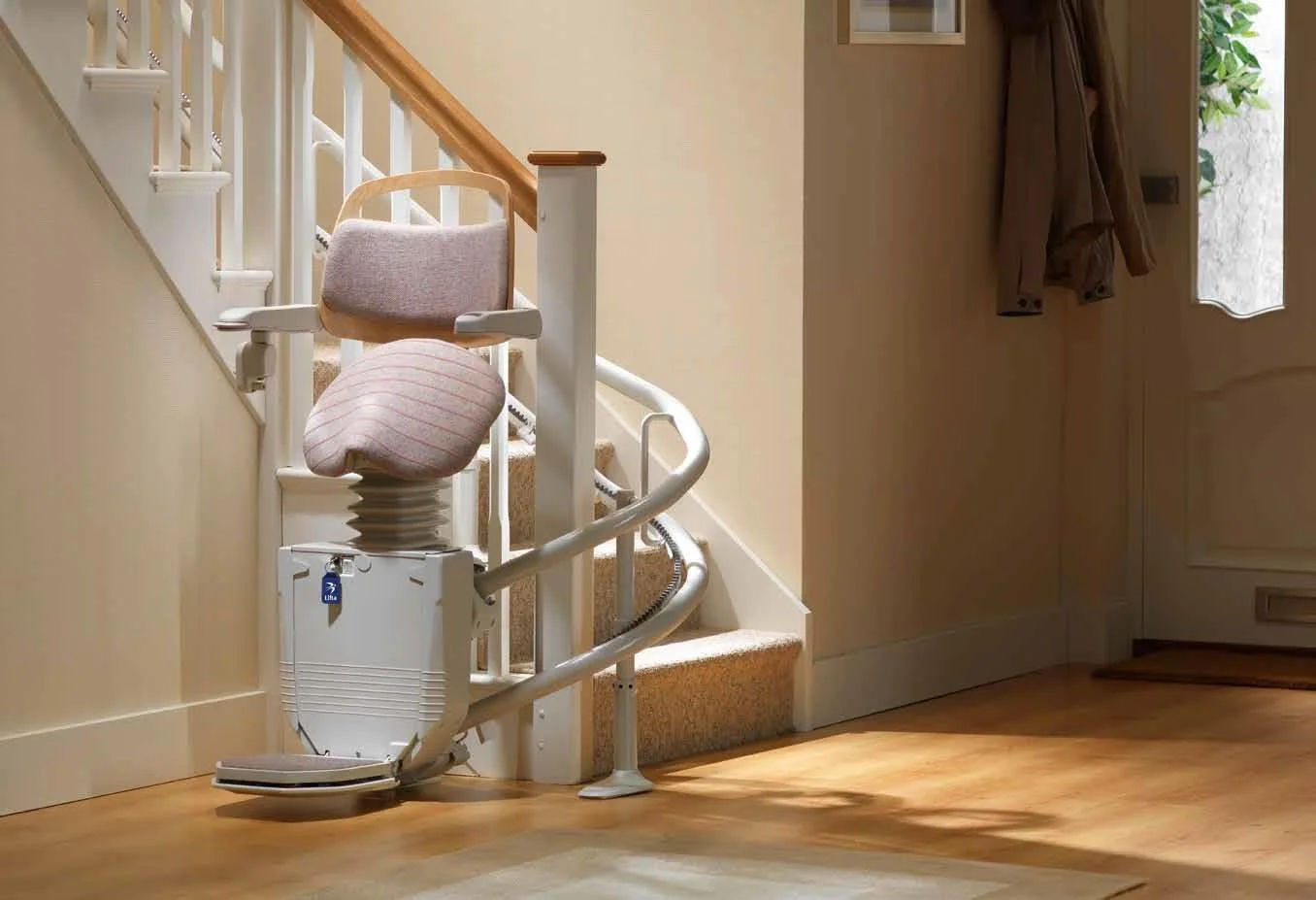
Townhouses tend to have a straight interior staircase, the simplest and quickest install there is. If a staircase turns at a landing or curves, a curved rail is built to fit that exact stair, which takes more measuring and more time.
Walk-up apartments and low-rise buildings are a different case. Shared stairways usually need the building owner's approval, so talk with the landlord or association before planning anything.
The county covers 876 square miles of land and 236 square miles of water, and the southern part is largely marshland, much of it inside Sea Rim State Park, reaching the Gulf of Mexico. That coastal, wet setting is why so many homes are elevated in the first place.
It also brings storm exposure. For someone who cannot easily climb stairs, getting out of a raised house fast during an evacuation is a real concern. An outdoor lift is one piece of that plan, but it helps to think through how the person will leave the house if the power is out.
Jefferson County has a population of 229,161. About 15.7% of residents are 65 or older, and 60.8% of households own their home, so many older people here are living in houses they can modify as they choose.
If a veteran lives in the home, it is worth checking VA benefits early, though the rules on stair lifts are specific and covered below. The Jefferson County Veterans Service Office at 1149 Pearl Street in Beaumont can be reached at (409) 835-8604.
Much of the local economy rests on refining, petrochemicals and port work, and many retired homeowners pay for mobility equipment out of pocket. None of the local programs listed below names stair lifts as a covered item, so the honest approach is to call and ask a case manager what they can refer you to.
One answer is clear: the VA HISA grant explicitly excludes stair glides. STAR+PLUS covers minor home modifications as a category, and USDA Section 504 funds accessibility modifications in eligible rural areas. Statewide, you can also ask about the Amy Young Barrier Removal Program (AYBR) and the Community Living Assistance and Support Services (CLASS) Waiver.
The regional aging agency offering benefits counseling, care coordination, caregiver support, nutrition and transportation for older adults; its listed services do not mention stair lifts or home modifications. Call (409) 924-3381 and ask a case manager about current in-home accessibility referrals.
A local nonprofit running Meals on Wheels, congregate dining and senior transportation in the Beaumont and Jefferson County area; it does not list home repair or modification. Reach it at (409) 892-4455.
A Texas Medicaid program that covers minor home modifications, adaptive aids and medical equipment for people who meet nursing facility level of care and Medicaid limits, including a $2,000 asset limit; stair lifts are not named specifically. Call (877) 782-6440.
A lifetime VA grant of up to $6,800 or $2,000 for medically necessary structural changes to a veteran's home. It explicitly does not cover stair glides or porch lifts.
VA grants for veterans with severe service-connected disabilities, with SAH up to $126,526 and SHA up to $25,350 lifetime for FY2026. Ramps and wider doorways are given as examples, but stair lifts are not named.
Loans up to $40,000 at 1% interest and grants up to $10,000 for very-low-income homeowners 62 or older in USDA-eligible rural areas; accessibility modifications are covered work, but stair lifts are not named. Beaumont and Port Arthur are generally not rural-eligible, while unincorporated parts of the county may qualify.
Exterior repairs such as painting, weatherization and minor fixes for Beaumont homeowners at or below 80% of area median income, with priority for seniors and people with disabilities; accessibility work and stair lifts are not mentioned. Call (409) 832-5853.
Free advocacy, peer support, skills training and referrals for people with disabilities in Jefferson, Orange and Hardin counties; home modifications and stair lifts are not mentioned. Call (409) 832-2599 to ask about current accessibility referrals.
A volunteer nonprofit that builds free wheelchair ramps for people with financial hardship and documented mobility needs, referred by a healthcare or social services professional. It builds ramps only and does not install stair lifts; the number is (214) 558-0339.
Older adults
2210 Eastex Fwy., Beaumont, 77703
Veterans
1149 Pearl Street, Beaumont, 77701
Yes. Many Jefferson County homes sit on pier-and-beam foundations with exterior entry stairs, and an outdoor stair lift is made for that spot. If the steps are very short or a wheelchair is involved, a platform lift or ramp may fit better.
Not through HISA, which explicitly excludes stair glides. The SAH and SHA grants do not name stair lifts either way, so a veteran with a qualifying disability should ask the Jefferson County Veterans Service Office at (409) 835-8604.
Possibly. USDA Section 504 grants of up to $10,000 are open to very-low-income homeowners 62 or older in USDA-eligible rural areas, and unincorporated parts of the county may qualify. Check the address against the USDA eligibility map.
STAR+PLUS covers minor home modifications and adaptive aids for people who qualify, though stair lifts are not named specifically. You apply through Texas HHSC or a STAR+PLUS managed care organization; the program line is (877) 782-6440.
The Area Agency on Aging of Southeast Texas at (409) 924-3381 is a good intake point. A case manager can tell you what referrals are currently available for in-home accessibility.
Usually, yes. Split levels often have several short flights, and each one can take its own straight lift, which tends to be simpler than one rail that turns corners.
Tell us about the stairs in your home and we will explain which lift fits, what it costs and how installation works.
