Hemphill County stretches across 912 square miles of southern plains along the south bank of the Canadian River, and Canadian is its only incorporated city. Some families live near the historic downtown by the Hemphill County Courthouse. Others are on places well out of town, where a trip to the store is a drive.
That spread matters when stairs start to become a problem. Canadian grew as an early-1900s Panhandle railroad town, so some houses carry older layouts, while many others are ranch-style or split-level homes. This page walks through how those homes affect the kind of stair lift that fits, and which programs are worth a phone call before you pay out of pocket.
Canadian became a Santa Fe Railroad division point in 1907, and the town still keeps a historic downtown with buildings like the courthouse and the former Woman's Christian Temperance Union building, which is being converted into the county library. Homes from that era often have one straight flight of stairs between floors.
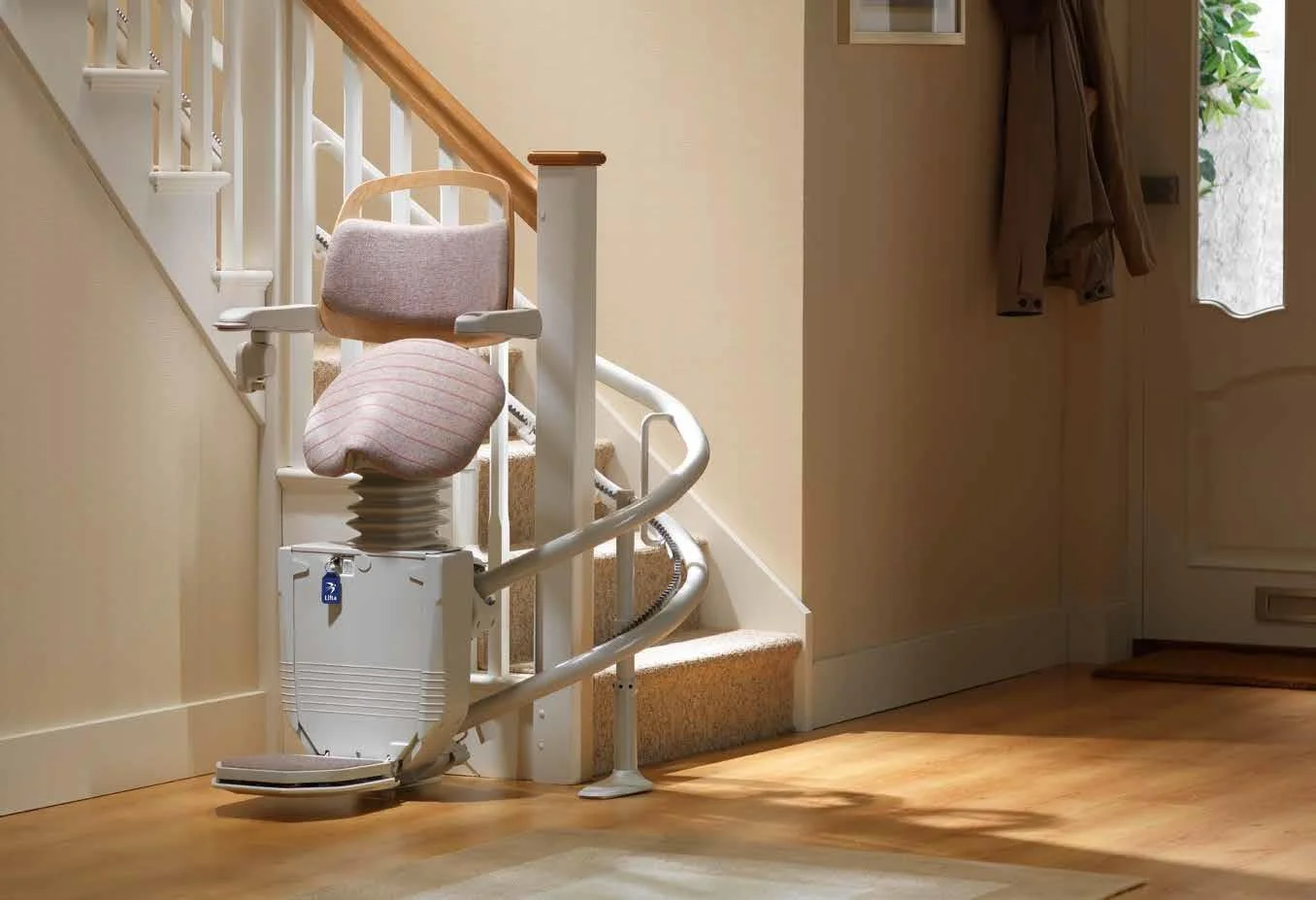
A straight staircase is usually the simplest and least costly lift to install, because the rail comes in one length. If the stairs turn at a landing or wind near the top, a curved rail is built to that exact shape, which takes more measuring and more time.
Many homes in the county are single-family, detached ranch-style houses. Inside, a ranch home may have no stairs at all, but the steps up to the porch or a back door can still be the hardest part of the day. An outdoor-rated stair lift or a platform lift can cover those entry steps.
Split-level homes are different. They tend to have short flights going up and down from the main level, so a person may need help on more than one set of stairs. We look at which flight gets used most and plan from there.
About 16.2 percent of county residents are 65 or older, and 74.5 percent are homeowners. Owners who have been in the same house for years often want to change the house rather than move out of it, and a stair lift is one of the smaller changes that makes that possible.
If someone in your family served, it is worth checking veteran benefits early, though as explained below, the most common VA home grant does not pay for stair lifts.
With one town and a small, dispersed population, many residents live well outside Canadian. That can affect scheduling for installation and for later service visits, so ask about it up front.
When you call, have the address and a rough description of the stairs ready: straight or turning, indoors or out, and how many steps. That helps us plan the visit so the measurement trip counts.
No program on this page names stair lifts as a covered item, so expect to ask questions. Medicaid's STAR+PLUS waiver lists minor home modifications and adaptive aids, and approval for a lift would depend on the person's service coordinator and plan of care. USDA Section 504 repair loans and grants can fund accessibility work for rural homeowners, and Hemphill County counts as rural.
For veterans, the VA HISA grant explicitly excludes stair glides. The larger SAH and SHA grants cover home adaptations for qualifying severe service-connected disabilities but do not itemize stair lifts. The Texas Veterans Commission Amarillo Office at (806) 468-1885 can help sort out VA options.
Statewide, you can also ask about the Amy Young Barrier Removal Program (AYBR) and the Community Living Assistance and Support Services (CLASS) Waiver. For people 60 and over, the Panhandle AAA in Amarillo at (806) 372-3381 is a good first call.
A Texas Medicaid waiver for adults 21 and older who meet nursing facility criteria, with covered services that include minor home modifications and adaptive aids; stair lifts are not named, so approval depends on the plan of care. Call (877) 782-6440.
A Medicaid program that covers home accessibility modifications for people moving from a nursing facility or other institution back into the community. Stair lifts are not listed by name, so coverage would be case-specific.
A lifetime VA grant of up to $6,800 or $2,000 for medically necessary structural changes to a veteran's home. It does not cover stair lifts; stair glides are specifically excluded.
VA grants for veterans with qualifying severe service-connected disabilities, up to $126,526 for SAH and $25,350 for SHA in FY2026, for adaptations like ramps and wider doorways. Stair lifts are not listed in the source reviewed.
Loans up to $40,000 and grants up to $10,000 for very-low-income rural homeowners, with the grant limited to those 62 and older; accessibility modifications are included. Stair lifts are not named specifically.
Short-term in-home support for people 60 and over in the Panhandle, including residential ramps; stair lifts are not listed. Call (806) 331-2227 to confirm intake for a Hemphill County resident.
A nonprofit center for people with disabilities in the Panhandle that offers information and referral but no direct financial help. Home modifications and stair lifts are not mentioned on its pages.
Older adults
415 SW 8th Ave., Amarillo, 79101
Veterans
6010 Amarillo Boulevard, West, Amarillo, 79106-1991
No. The HISA grant lists stair glides among the removable equipment it excludes. Veterans with severe service-connected disabilities can ask about SAH or SHA grants, and the Texas Veterans Commission Amarillo Office at (806) 468-1885 can help.
Yes. Hemphill County, including Canadian, is a USDA-eligible rural area. The grant portion requires age 62 or older and income at or below 50 percent of area median income.
The Panhandle AAA programs start at 60, but the STAR+PLUS waiver accepts adults 21 and older who meet its medical and financial rules, including countable assets at or below $2,000.
Often the problem is the steps to the porch or a back door. An outdoor-rated stair lift or a platform lift can handle entry steps on a ranch-style home.
For someone 60 or older, start with the Panhandle AAA at (806) 372-3381. If they may qualify for Medicaid, the STAR+PLUS line is (877) 782-6440.
Tell us about the stairs in your home and we will explain which lift fits, what it costs and how installation works.
