Hamilton County covers roughly 844 square miles of rolling Central Texas prairie, about 114 miles north of Austin. Most people live in or near Hamilton, the county seat, or in Hico. Out past town, homes sit far apart among ranches, dairies and stream valleys bordered by limestone cliffs.
A lot of the housing here goes back to development patterns from the 1800s through the early 1900s, when this was a ranching and farming county. Older homes and long drives between neighbors make staying at home safely a real question for many families. This page covers which kind of stair lift fits the homes we see here and where to look for help paying for one.
Single-family homes and ranch-style homes make up much of what we see. A ranch house may have most of its living space on one floor, but there are often steps at the front door, the back porch or down to a lower room. A short straight lift or an outdoor unit usually handles those.
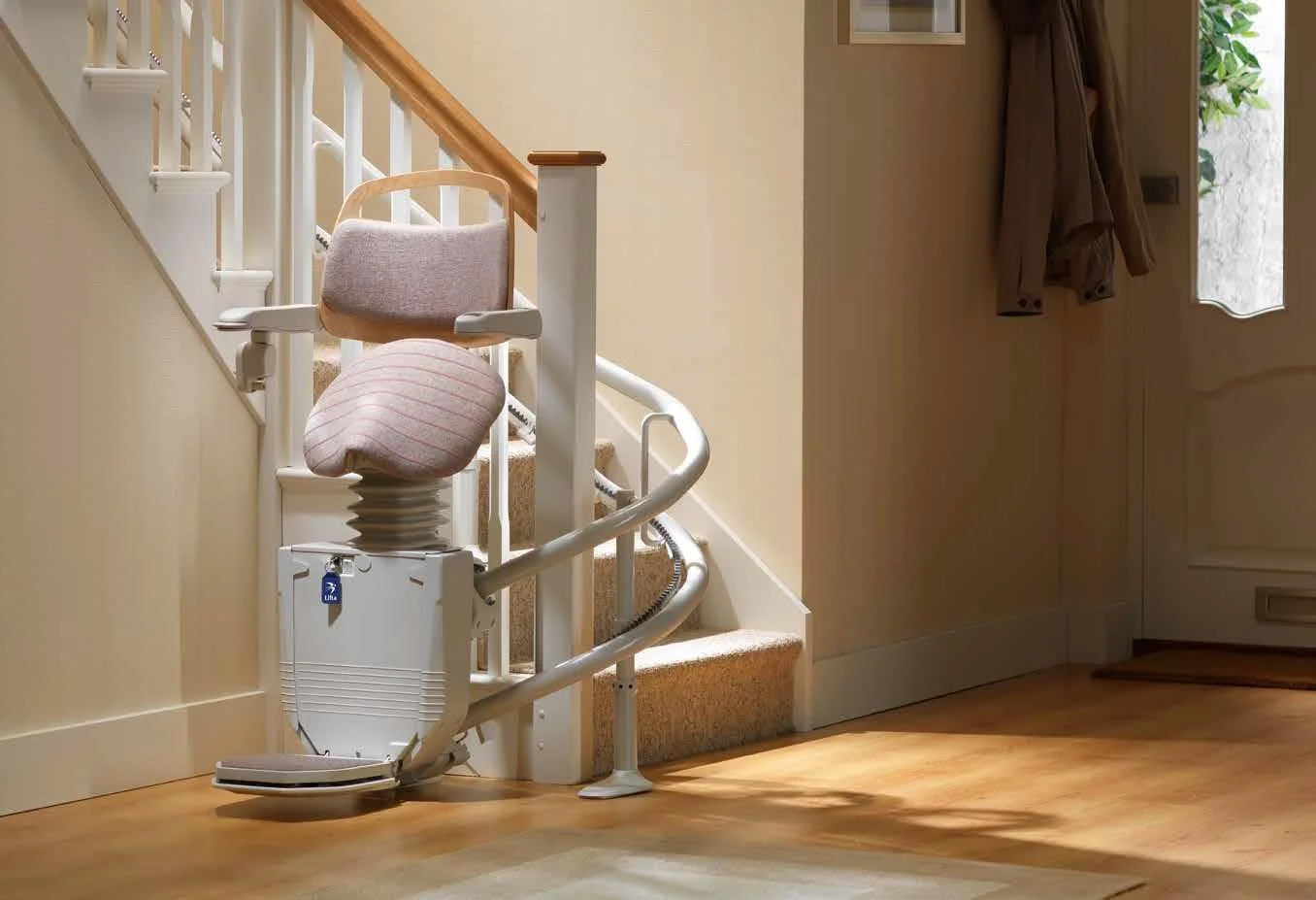
Split-level homes are different. Each short flight between levels may need its own straight lift, or a curved lift if you want one rail to follow the turns. In older homes, we measure the staircase width and check the wall and tread condition before recommending a model.
Low-rise buildings in town can work too, as long as the owner or building manager allows the installation on a shared stair.
Elevation in the county runs from about 900 to 1,600 feet, with flat-topped buttes and sloped stream valleys. Homes built on uneven ground often have raised porches or long runs of exterior steps. An outdoor stair lift is built to handle weather, and a platform lift can be the better choice when someone uses a wheelchair.
On rural property, we also look at the path from the driveway to the door. A lift only helps if the person can safely reach the bottom of it.
About 22.4% of Hamilton County residents are 65 or older, and 69.8% own their homes. That adds up to many owners who would rather adapt the house they have than move.
If that includes someone in your family, read the VA program notes below closely, because the most common VA home grant does not pay for stair lifts.
The county's economy rests mostly on agriculture, with livestock bringing in roughly 90% of farm income. For many senior homeowners, paying the full cost out of pocket is hard, so it makes sense to check assistance first.
A good starting call is the Area Agency on Aging of Central Texas (AAACT) at (254) 770-2330 or 800-447-7169. The Central Texas AAA office in Belton, at 2180 N. Main St., can also be reached at (254) 933-7075. They can point you toward programs that fit your situation.
Texas Medicaid members in STAR+PLUS may have home modifications covered through the waiver. Very-low-income rural homeowners can ask USDA about Section 504 repair loans and grants. Other statewide programs worth asking about include the Amy Young Barrier Removal Program (AYBR) and the Community Living Assistance and Support Services (CLASS) Waiver. Veterans can contact the Texas Veterans Commission Dallas Office at (214) 857-0444.
Provides information and referral, benefits counseling, caregiver support and care coordination for adults 60 and older and their families in Hamilton and nearby counties; stair lift funding is not listed. Call (254) 770-2330 to ask what in-home accessibility help is available now.
A Texas Medicaid waiver for adults, generally 21 and older, who are aged or have a disability and meet nursing-facility level of care; home modifications are a listed benefit, and a stair lift may be covered after a service coordinator's assessment. STAR+PLUS Member Services is (877) 277-9772.
Low-interest repair loans for very-low-income rural homeowners and grants for homeowners 62 and older who cannot repay a loan, used to remove health and safety hazards; stair lifts are not listed by name, so approval would be case by case through the local USDA Rural Development office.
A lifetime grant of up to $6,800 for service-connected conditions or $2,000 for other qualifying conditions, for medically necessary home alterations. It does not cover stair lifts, because the VA excludes stair glides and porch lifts.
Larger VA grants for veterans with severe service-connected disabilities: SAH up to $126,526, SHA up to $25,350, and TRA up to $50,961 or $9,100 (FY2026). Stair lifts are not named in the source, so ask the VA whether one can be part of an approved adaptation.
Older adults
2180 N. Main St., Belton, 76513
Veterans
4500 S Lancaster Road, Dallas, 75216-7167
Not through the HISA grant, which specifically excludes stair glides and porch lifts. The SAH, SHA and TRA grants serve veterans with severe service-connected disabilities, and the source does not say whether a stair lift is covered, so ask the VA directly. The Texas Veterans Commission Dallas Office is at (214) 857-0444.
The Area Agency on Aging of Central Texas serves people 60 and older and their families. STAR+PLUS is open to Medicaid-eligible adults, generally 21 and older, who are aged or have a disability and meet nursing-facility level of care.
Start with the Area Agency on Aging of Central Texas at (254) 770-2330 or 800-447-7169. They handle intake and referral for Hamilton County and can tell you what accessibility help is currently available, including possible referral to STAR+PLUS.
STAR+PLUS lists home modifications as a waiver benefit. Stair lifts are not named, so coverage depends on your service coordinator's assessment and plan of care. Member Services is (877) 277-9772.
Possibly. Section 504 offers repair loans to very-low-income rural homeowners and grants to those 62 and older who cannot repay a loan. A stair lift would need to address a health or safety hazard, and the local USDA Rural Development office decides case by case.
Yes, outdoor stair lifts are made for exterior steps and weather. On sloped lots common around the county's buttes and stream valleys, we check the ground at the top and bottom, and a platform lift may fit better if a wheelchair is involved.
Tell us about the stairs in your home and we will explain which lift fits, what it costs and how installation works.
