Castro County sits on the flat high plains of the Llano Estacado, with homes clustered in Dimmitt, Hart and Nazareth and grain elevators and dairy operations spread across the land between them. Most people here live in standalone single-family houses, not apartments or senior housing, so staying at home usually means adapting the house you already have.
That matters for stair lifts. A ranch-style house may have only a few entry steps, while a split-level home has short flights between floors that someone uses many times a day. This page walks through what fits these homes, what to expect living so far from larger hubs, and which programs may help with the cost.
The housing here is mostly single-family homes, detached houses, ranch-style homes and split-level homes. Each one raises a slightly different question, so it helps to walk the house and count every set of steps before picking equipment.
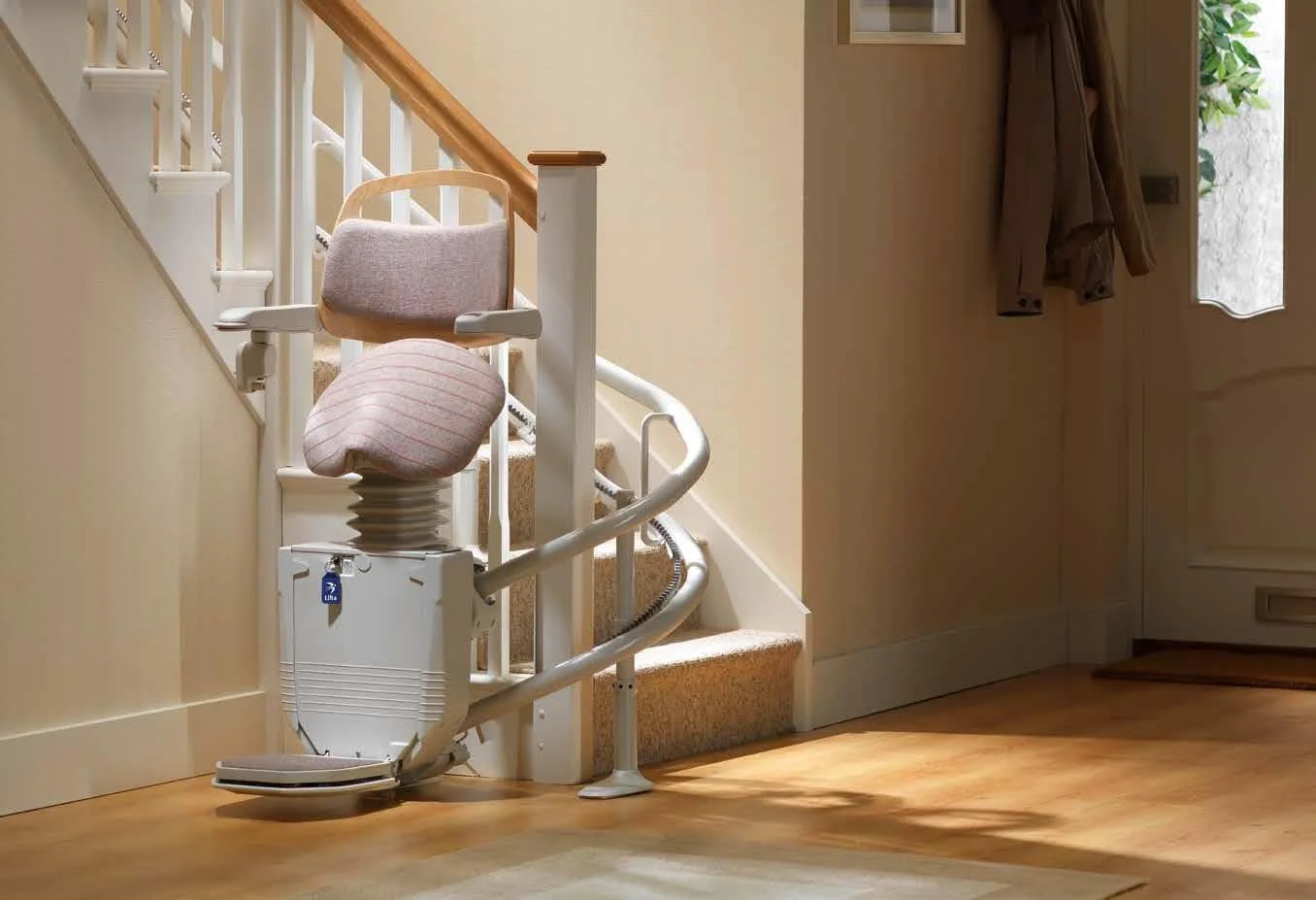
In a split-level home, the short runs between levels are often straight, and a straight stair lift on each run is the simplest fit. If a flight turns or has a landing partway, a curved lift built to that staircase is the usual answer, and it takes longer to measure and make.
For a ranch-style or other one-story house, the trouble spot is often the steps up to the front or back door. That is where an outdoor stair lift, a platform lift or a ramp comes into the conversation.
Castro County covers about 899 square miles with roughly 8.24 people per square mile. Stair lift installers, home-modification contractors and specialists for a medical evaluation are usually based in larger hubs such as Amarillo or Lubbock.
Plan for that distance. Ask any installer up front how they handle the trip for a measuring visit, the install and later service calls, and try to group a home assessment with other appointments in town when you can.
About 17.3% of residents are 65 or older, and 68.0% of households own their home. Owning the house makes permanent changes like a bolted-in stair lift much easier, since no landlord approval is needed.
If your parent served, start with the county veterans contact, Donna Charanza, at 100 E Bedford St. in Dimmitt, (806) 647-4666, before choosing equipment.
No program in this list names stair lifts as a covered item, and one VA program clearly excludes them. Several do cover home modifications or repairs, so a stair lift may be possible case by case, and ramps are often an easier yes.
The Panhandle AAA in Amarillo, at 415 SW 8th Ave., (806) 372-3381, is a good first call to sort out options. Texas also has statewide programs worth asking about, including the STAR+PLUS Home and Community-Based Services (HCBS) Waiver, the Amy Young Barrier Removal Program (AYBR), VA Benefits for Veterans (HISA + Prosthetics) and the Community Living Assistance and Support Services (CLASS) Waiver. Details on each local program are below.
A Medicaid managed care benefit for members 65+ or adults with disabilities, with a $7,500 lifetime cap and up to $300 per year for repairs after that. Ramps, grab bars and handrails are listed, but stair lifts are not named, so ask the member's MCO service coordinator about coverage.
Short-term in-home support for older adults recuperating from a hospital stay or health emergency, with residential ramps mentioned as an extra resource. Stair lifts are not mentioned; call (806) 372-3381.
Loans up to $40,000 at 1% fixed interest over 20 years, and grants up to $10,000 for very-low-income rural homeowners aged 62+, combined up to $50,000. Walk-in tubs and wheelchair ramps are named, but stair lifts are not.
A lifetime grant of $6,800 or $2,000, depending on disability status, for medically necessary structural changes. The VA explicitly excludes stair glides, porch lifts and portable ramps, so it does not cover a stair lift.
Up to $126,526 lifetime (FY2026) for veterans with severe qualifying service-connected disabilities to buy, build or adapt a home. Ramps and wider doorways are given as examples; stair lifts are not named.
Up to $25,350 lifetime (FY2026) to adapt an existing home for veterans with qualifying service-connected disabilities. Stair lifts are not itemized by name.
A nonprofit that builds free wheelchair ramps with volunteer labor, and Castro County is listed in its Amarillo Region. It does not mention stair lifts; call (214) 558-0339 or use its Request a Ramp page.
Provides hearing aids, visual aids and mobility services such as ramps, with an income-based co-payment. It states it does not provide extensive home modifications, so stair lifts are not covered, and Castro County service should be confirmed first.
Older adults
415 SW 8th Ave., Amarillo, 79101
Veterans
100 E Bedford St., Dimmitt, 79027
Not through the HISA grant, which explicitly excludes stair glides. The SAH and SHA grants do not name stair lifts either way, so a veteran with a qualifying service-connected disability should ask. Donna Charanza in Dimmitt, (806) 647-4666, can help with the VA side.
The minor home modifications list does not name stair lifts, though it covers items like ramps and handrails up to a $7,500 lifetime cap. Coverage is decided case by case, so the member's MCO service coordinator is the person to ask.
The USDA Section 504 program offers grants up to $10,000 for homeowners 62 and older who cannot repay a loan, and Castro County qualifies as rural. Stair lifts are not named, so confirm before you count on it.
Maybe not. For a few entry steps, an outdoor lift, a platform lift or a ramp may fit better. The Texas Ramp Project serves Castro County and builds free ramps for those who qualify, at (214) 558-0339.
Providers are usually based in larger hubs such as Amarillo or Lubbock, so expect some travel time. Ask about scheduling for the measuring visit, the install and future service before you sign.
The Panhandle AAA in Amarillo at (806) 372-3381 is a solid starting point for older adults in the county. For veterans, call the Dimmitt office at (806) 647-4666.
Tell us about the stairs in your home and we will explain which lift fits, what it costs and how installation works.
