Across Marion County's 23 towns, from Salem and Keizer to Mount Angel, Aurora and Scotts Mills, a lot of people live in older two-story houses. In Salem, Silverton, Woodburn and Stayton, many homes are pre-1980s farmhouses or bungalows, the kind of Willamette Valley construction where the bedrooms sit upstairs and the laundry sits in the basement.
That layout is often what brings families to us. When a parent can no longer manage the stairs safely, the choice comes down to moving, rearranging the house, or putting in a stair lift. This page covers how local homes and terrain affect that choice, and which Marion County and Oregon programs may help with the cost.
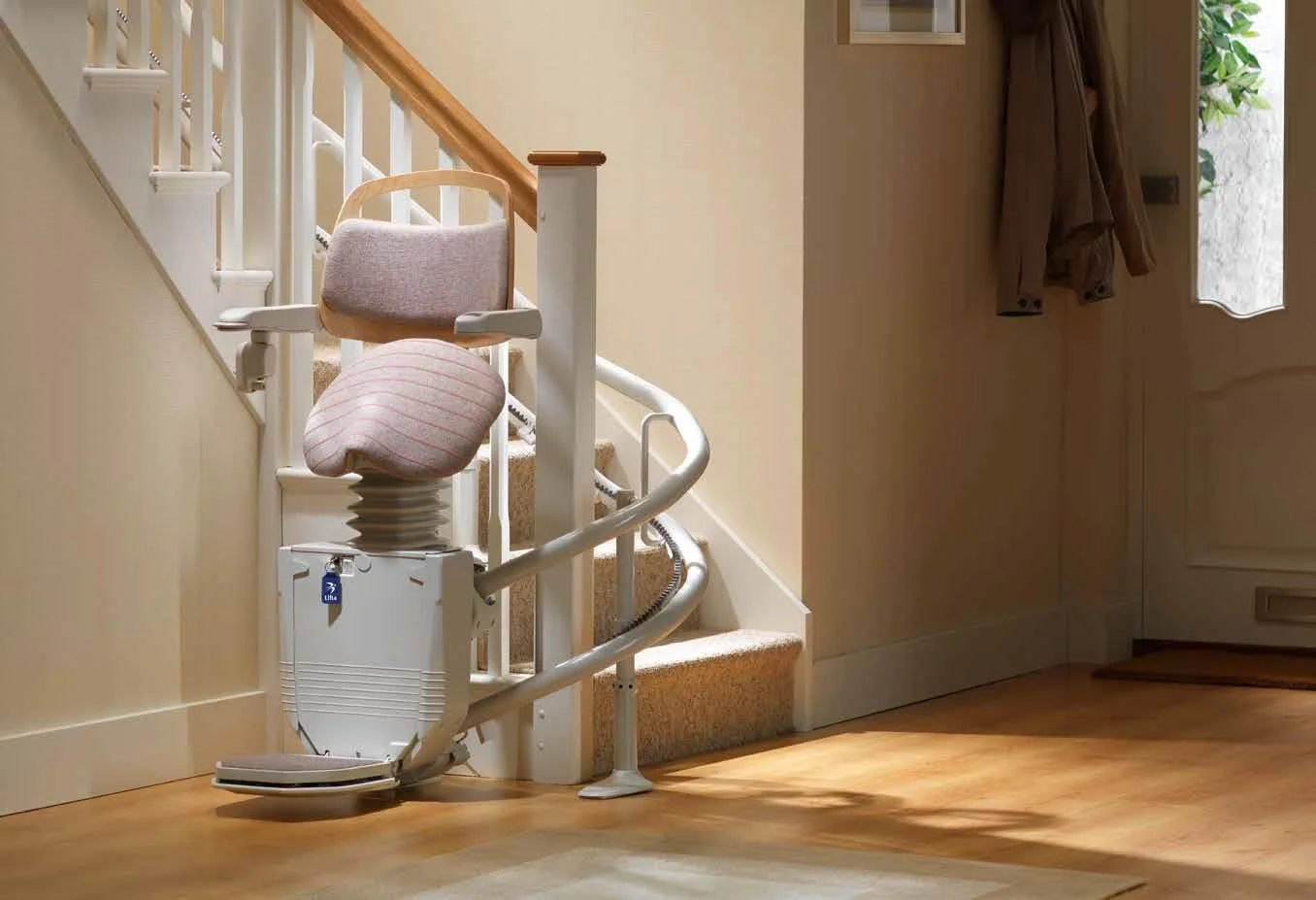
The classic two-story farmhouse or bungalow in Salem, Silverton, Woodburn or Stayton tends to have one straight flight from the main floor to the upstairs bedrooms. A straight stair lift is the simplest fit for that. The rail mounts to the stair treads, not the wall, so plaster walls in an older house are usually left alone.
Basement stairs in these homes are often steeper and narrower than the main staircase. We measure the width, the headroom at the bottom and the landing space before recommending anything, because a narrow basement stair can still take a lift if the seat folds and the rail is placed carefully.
Split-level homes have several short flights instead of one long one. Sometimes a single straight lift on the flight that matters most, usually the one up to the bedrooms, solves the daily problem. If the stairs turn at a landing, a curved rail built to that staircase is the usual answer.
Townhouses and row houses often have tight stairways with a turn near the top or bottom. Those layouts frequently need a curved lift or a rail that extends past the top step so the rider can get off safely. In a walk-up apartment, the renter needs the landlord's written permission first, and the building's shared stairs may not be an option at all.
Salem, Keizer and Woodburn sit on the flat valley floor in the western and central part of the county. Homes there tend to have few exterior steps, so the work is mostly indoors.
To the east, the county climbs into foothills and mountainous terrain toward Mount Hood National Forest and Willamette National Forest. Homes built on slopes there can have long runs of porch or deck steps. An outdoor stair lift with a weather-rated finish, or a vertical platform lift for someone who uses a wheelchair, can be the better fit when the hard part is getting from the driveway to the front door.
The program that names stair lifts outright is the Oregon K Plan, a Medicaid option run by Aging and People with Disabilities. It requires Medicaid eligibility, an assessed need in the person's service plan, and prior approval from the state's central office. Jobs over $500 must be done by a state-licensed contractor, and three bids are required when feasible.
For people who are not on Medicaid, start with NorthWest Senior and Disability Services, the local Area Agency on Aging. They can screen for Oregon Project Independence and point you toward other help. Several local repair loan programs list accessibility work, but none name stair lifts, so ask each one directly before you apply. The full list is below.
The VA HISA grant does not: it specifically excludes stair glides and porch lifts. The larger SAH and SHA grants do not mention stair lifts either way, so confirm with the VA before counting on them.
The Marion County Veteran Service Office at 780 Commercial St. SE, Ste. 302, Salem, can help sort out which VA benefits apply. Call (971) 707-4400. Veterans can also ask about the Oregon Restore Health and Safety Program, which lists accessibility modifications as an eligible repair.
A Medicaid option through Oregon's Aging and People with Disabilities that lists stair lifts by name as an eligible home modification, for people who are OSIP-M and MAGI Medicaid eligible and meet Service Priority Level 1-13. Prior authorization is required; call (503) 304-3400.
The free information, referral and case management agency for older adults and people with disabilities in Marion and nearby counties; its listed services do not mention stair lifts, but it is the front door for Medicaid and in-home help. Call (503) 304-3400.
State-funded limited in-home services, including assistive technology, for older adults who are not on Medicaid; stair lifts and home modifications are not listed. Call the ADRC at (855) 673-2372 for eligibility screening.
1% loans up to $40,000 and grants up to $10,000 for very-low-income homeowners in eligible rural areas, with grants limited to homeowners 62 or older; stair lifts are not mentioned by name. Call (800) 414-1226 and verify your address qualifies.
A lifetime grant of up to $6,800 or $2,000 for medically necessary structural changes such as ramps and bathroom access. It does not cover stair lifts, which the VA excludes as removable equipment.
Grants of up to $126,526 (SAH) or $25,350 (SHA) in FY2026 for veterans with severe qualifying service-connected disabilities to adapt a home. Stair lifts are not listed either way, so confirm with the VA.
State-funded repair help for veteran homeowners, run through local organizations, that lists accessibility and adaptability modifications as eligible; stair lifts are not named. Call (800) 453-5511.
A 0%, partially forgivable deferred loan up to $50,000 for households below 80% of area median income outside Salem city limits, with accessibility improvements listed but stair lifts not named. Funds were fully obligated as of December 2024, so applications go on a waiting list; call (503) 540-1640.
Sliding-scale repair help for homeowners at 30-80% of area median income, focused on accessibility items like ramps and railings plus exterior repairs; stair lifts are not named and the program excludes interior rehab. Call (503) 364-6642.
Free volunteer help for older adults in Salem with small jobs such as installing grab bars; it does not fund stair lifts or other major equipment. Call (503) 588-6303.
Energy-efficiency work like insulation and air sealing for Marion and Polk county households at or below 200% of the Federal Poverty Level; it does not mention accessibility work or stair lifts. Call (503) 585-6232.
Older adults
3410 Cherry Ave NE, Salem, 97303
Veterans
780 Commercial St. SE, Ste. 302, Salem, 97301
It can, through the Oregon K Plan. Stair lifts are listed by name, but the person must be Medicaid eligible, meet Service Priority Level 1-13, have the need written into their service plan, and get prior approval. Call (503) 304-3400 to start.
Not through the HISA grant, which excludes stair glides. The SAH and SHA grants do not mention stair lifts either way. The Marion County Veteran Service Office at (971) 707-4400 can help check what applies.
The USDA Section 504 program offers grants up to $10,000 to very-low-income homeowners 62 or older in eligible rural areas who cannot repay a loan. Stair lifts are not named, so ask first. Call (800) 414-1226.
That program serves Marion County homes outside Salem city limits and lists accessibility improvements, but its funds were fully obligated as of December 2024. You can join the waiting list by calling (503) 540-1640.
Often, yes. Basement stairs in older farmhouses and bungalows tend to be narrow and steep, so we check width, headroom and landing space at the bottom before recommending a lift.
Call NW Senior & Disability Services at (503) 304-3456, or visit their office at 3410 Cherry Ave NE, Salem. They can screen for Medicaid and Oregon Project Independence and refer you to other help.
Tell us about the stairs in your home and we will explain which lift fits, what it costs and how installation works.
