From the hillsides above the Columbia River in Hood River to the orchard country around Odell and Parkdale, and west to Cascade Locks, many homes in Hood River County were built on slopes. That often means more stairs than a flat-lot house would have: inside, on the front walk, or both.
This page walks through how the county's homes and weather shape the choice of stair lift, and which Oregon and federal programs may help pay for one. The four towns here share the same regional offices for aging services and veterans, so the contacts below apply wherever you live in the county.
Hood River County has 38 properties on the National Register of Historic Places, most dating from 1906 to 1920 in Queen Anne, Dutch Colonial Revival and other early-20th-century styles. One example is the Simpson Copple House at 911 Montello Avenue in Hood River, a vernacular Queen Anne residence built in 1906 on a rise overlooking the Columbia River.
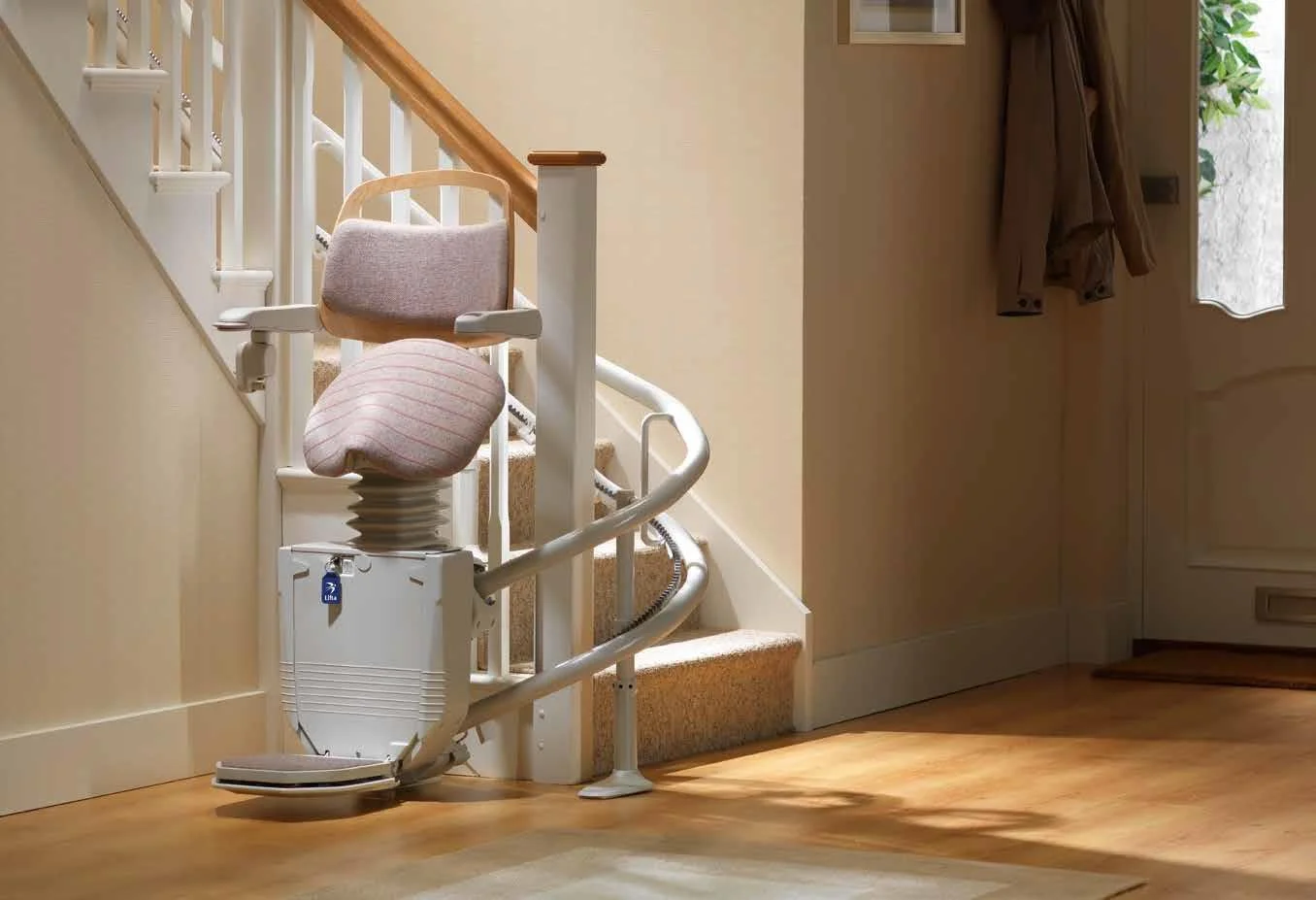
Two-story homes from this era often have staircases that turn at a landing or wind near the top. A straight stair lift only works on a single straight run, so a turning stair usually needs a curved rail built to fit that exact staircase. We measure every step, landing and turn before recommending one or the other.
Older stairs can also be narrow. A stair lift mounts to the treads rather than the wall, and the seat and footrest fold up, so in many cases the stairs stay usable for everyone else in the house.
Not every home here is a century old. The county also has single-family homes, townhouses, split-level homes, walk-up apartments and low-rise buildings, and each one raises its own questions.
A split-level house often has two or three short flights instead of one long one. Sometimes the person only needs one of them, and a short straight lift solves it. If daily life spans several levels, we look at whether more than one lift or a different layout of rooms makes more sense.
In walk-up apartments and low-rise buildings, the stairs are usually shared, so the building owner has to agree before anything is installed. It helps to have that conversation early.
Because so many lots are built into hillsides, the hardest stairs are sometimes outside: the steps from the street or driveway up to the front door. An outdoor stair lift or a platform lift can handle those, but the setting matters.
Rainfall changes a lot across the county. Cascade Locks averages over 76 inches a year, while the city of Hood River gets less than 31 inches. Winters also bring strong easterly gorge winds. An outdoor lift here should be a model built for the weather, with a cover for the seat and controls, and placed where it is as sheltered as the site allows.
Elevation runs from about 60 feet near the river to 11,235 feet at the summit of Mount Hood, so homes higher up toward Parkdale can see different winter conditions than those near the water. We factor that in when choosing materials and placement.
As of the 2020 Census, 16.8% of Hood River County residents were 65 or older, and 65.4% of housing units were owner-occupied. Owning the home matters because most of the payment programs below, and the installation itself, work most simply for owner-occupants.
If that includes you or your parent, the Hood River County VSO at 1790 May Street, Suite A, Hood River, can explain which VA home programs apply. Call (541) 386-1080.
The clearest source of help is Oregon's K Plan and OPI-M ancillary services, whose state guidance names stair lifts under home and environmental modifications. It is for people already receiving Medicaid long-term services or Oregon Project Independence-Medicaid, and the lift must tie to a need in the person's service plan.
Veterans should know that the VA HISA grant specifically excludes stair glides, though it can help with other changes like grab bars or permanent ramps. Other programs, including the USDA Section 504 repair program and the Mid-Columbia Housing Authority Home Repair Program, cover safety and accessibility repairs but do not name stair lifts, so ask before you count on them.
A good first call is the Area Agency on Aging at Mid-Columbia Council of Governments, (541) 298-4101. It is the local intake point for the Oregon programs. Community Action Program East Central Oregon (Mid-Columbia) in The Dalles is another regional office for aging services, at (541) 278-5681.
Oregon Medicaid home modification services whose official guidance lists stair lifts by name, for people receiving Medicaid long-term services (SPL 1-13) or OPI-M (SPL 1-18). Larger modifications need central office prior authorization with 3 contractor bids when feasible; call (503) 945-5600 or start through your local Area Agency on Aging.
A VA grant of up to $6,800 lifetime for service-connected disabilities (or 50%+ combined rating) and $2,000 for other disabilities. Stair glides are specifically excluded, though items like grab bars, roll-in showers and permanent ramps are covered; call the Hood River County VSO at (541) 386-1080.
Larger VA grants (SAH up to $126,526 and SHA up to $25,350 for FY2026) for veterans with certain severe service-connected disabilities who own or will own the home. The source does not mention stair lifts specifically; call (541) 386-1080 to ask.
Grants up to $20,000 for low-to-moderate income homeowner-occupants in Hood River or Wasco County for needed health and safety repairs, with the Oregon side currently taking pre-applications for a waitlist. Stair lifts are not mentioned; call (541) 296-3397.
The regional information and referral office for older adults and people with disabilities in Hood River and nearby counties, and the intake point for Oregon K Plan/OPI-M services. Its own listing does not itemize stair lifts; call (541) 298-4101.
A self-directed Medicaid program that gives an individualized monthly cash benefit to people over 65 or with physical disabilities who qualify for in-home services. The state overview does not mention home modifications or stair lifts; call (503) 945-5600.
Loans up to $40,000 at 1% for 20 years, and grants up to $10,000 for owners 62 and older, for very-low-income homeowners in USDA-eligible rural areas making safety or accessibility repairs. Stair lifts are not named; call (800) 414-1226 and check your address on USDA's eligibility site.
Older adults
515 East 2nd Street, The Dalles, 97058
Veterans
1790 May Street, Suite A, Hood River, 97031
It can, through the K Plan and OPI-M ancillary services, whose guidance lists stair lifts by name. The person must already receive Medicaid long-term services or OPI-M, and the lift must match a need in their service plan. Payment is limited to the lowest cost that meets the need.
No. HISA specifically excludes stair glides and porch lifts. It can still help with grab bars, roll-in showers, permanent ramps or widened entrances, and the Hood River County VSO at (541) 386-1080 can check whether SAH or SHA grants apply.
The USDA Section 504 program offers grants up to $10,000 for owners 62 and older who cannot repay a loan, in eligible rural areas. It covers safety and accessibility repairs but does not name stair lifts, so confirm with USDA at (800) 414-1226.
Call the Area Agency on Aging at Mid-Columbia Council of Governments, (541) 298-4101, at 1113 Kelly Avenue in The Dalles. It serves the whole county and can connect you to the Oregon programs that list stair lifts.
Often, yes, with an outdoor stair lift or platform lift built for the weather. With over 76 inches of yearly rain in Cascade Locks and strong gorge winds in winter, we look closely at covers, materials and placement before recommending one.
Not usually, but it rules out a straight lift for the whole run. A curved rail is made to fit that specific staircase, so we measure it in person first.
Tell us about the stairs in your home and we will explain which lift fits, what it costs and how installation works.
