Grant County spreads across ranch country and high mountain ground, from 1,820 feet up to 9,038 feet at Strawberry Mountain. Most people live in or around four towns: John Day, Canyon City, Prairie City and Mount Vernon. Many of the houses here were built for the mining, ranching and timber work that shaped the county, and few were designed with aging in mind.
This page walks through what local homes usually mean for a stair lift, why scheduling looks a little different in a county this rural, and which offices and programs a Grant County family can call about paying for one. If you are helping a parent stay in the house they have lived in for decades, start here.
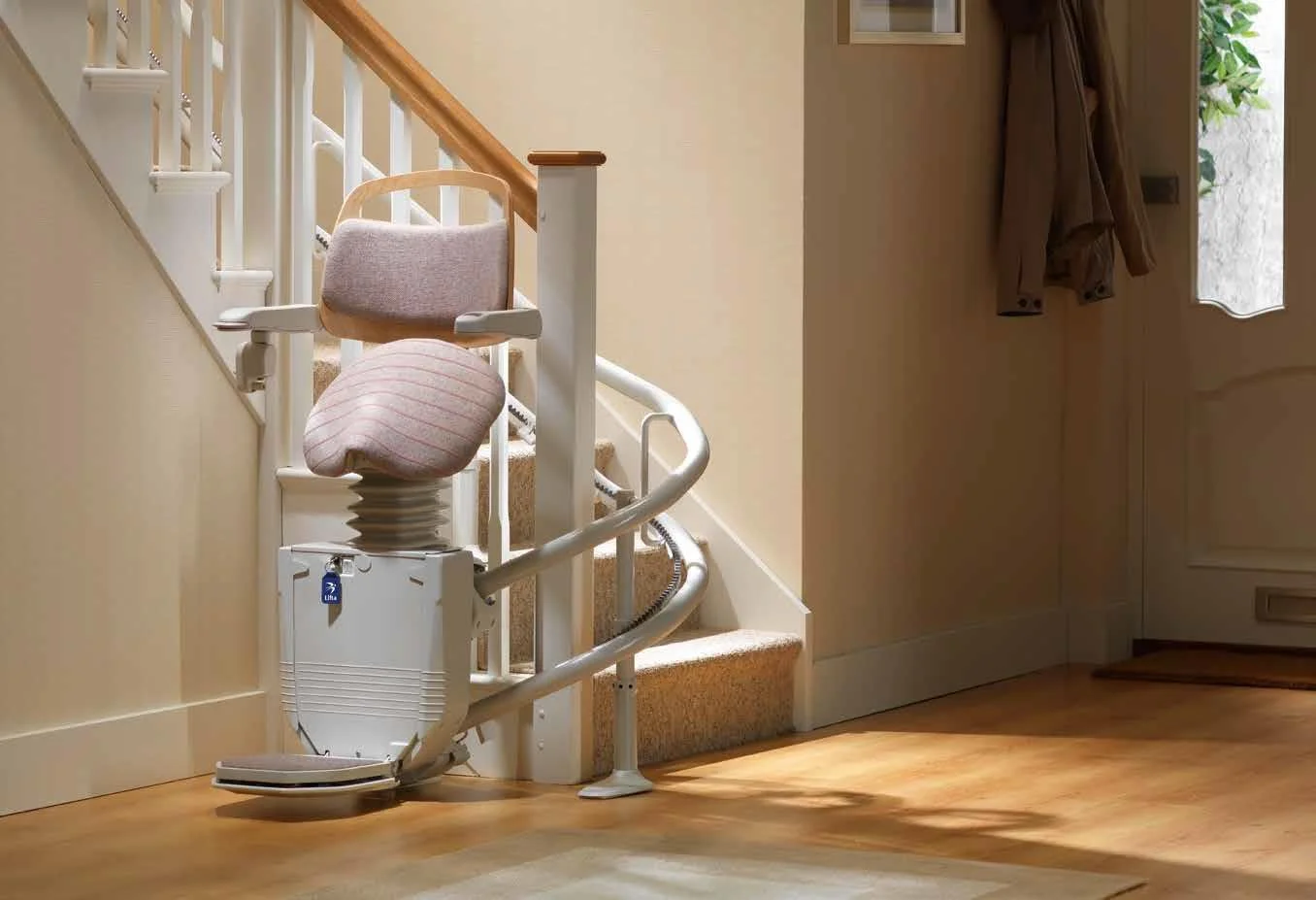
Most homes in Grant County are single-family and detached, with ranch-style and farmhouse-style construction common. A one-story ranch may still have a set of steps down to a basement or up from a garage or mudroom. Those are often straight runs, which are the simplest and quickest stair lifts to fit.
Split-level homes are a different job. They tend to have short flights broken by landings, so a single curved rail or more than one straight unit may be needed. We measure each flight and landing in person before recommending either.
Low-rise buildings with shared stairways can also need a lift, but the building owner usually has to approve the installation. Ask about that early.
Grant County is entirely rural, with about 1.6 people per square mile. Homes sit on steep, rugged ground in places and on open rangeland in others. That often means porch steps, entry stairs or a grade change between the driveway and the door.
An outdoor stair lift is built to handle weather on exterior steps. Where there are only a few steps but a wheelchair is involved, a vertical platform lift may be the better fit. The right choice depends on who will use it and whether they can transfer to a seat.
Because the county is so spread out, few mobility-equipment installers are based locally. Stair lift vendors typically travel in from larger Central and Eastern Oregon service hubs. Plan for the measurement visit and the installation to be scheduled trips rather than same-day calls.
It helps to have all the stairs in question ready to measure on the first visit, including basement, porch and garage steps. That way one trip can cover every option.
About 21.9% of Grant County residents are 65 or older, and the median resident age is 50.8. Roughly 73.9% of households own their homes. That combination means many people are aging in houses they own and plan to keep.
If someone in your family served, the veteran resources below are worth a call before you decide how to pay.
Incomes here are modest. Median household income was $35,974 in 2010 figures, and about 14.4% of residents were below the poverty line. That makes it worth checking every assistance route before paying out of pocket.
For most families, the first local call is the Community Connection of Northeast Oregon Grant County office in John Day. Statewide options to ask about include Oregon Project Independence (OPI / OPI-M), the Oregon K Plan, and Northwest Access Fund loans through the Oregon Statewide AT Program.
Veterans should know one important limit up front: the VA HISA grant does not pay for stair lifts. Other VA grants and the Grant County VSO are covered in the program list below.
A lifetime VA grant of up to $6,800 or $2,000 for medically necessary fixed home alterations such as roll-in showers, widened doorways and permanent ramps. The VA explicitly excludes stair glides and porch lifts, so this grant does not cover a stair lift.
VA grants for veterans with specific severe service-connected disabilities to build, buy or adapt a home they own or will own, with SAH up to $126,526 and SHA up to $25,350 for FY2026. The VA page describes structural modifications like ramps but does not list stair lifts by name, so any lift would need individual project approval.
A Medicaid state plan option that funds home and community-based attendant services and supports for Oregon Medicaid recipients who meet an institutional level-of-care assessment. The source page does not mention stair lifts or home modifications, so call (503) 945-5811 to ask whether a service plan can include them.
The county's Area Agency on Aging touchpoint at 530 E Main St #6 in John Day, offering in-home caregivers through OPI and VA programs, housing rehabilitation and weatherization help. Stair lifts are not listed on its page, so call (541) 575-2949 to ask what housing rehabilitation can cover.
A free federal information and referral service that connects older adults, people with disabilities and caregivers to their regional Area Agency on Aging and Medicaid intake points. It does not fund stair lifts itself; call (800) 677-1116 to be routed.
A state-certified veteran benefits counseling office that helps veterans and dependents apply for VA home-modification benefits such as HISA and SAH/SHA. It is a referral service, not a funding source; call the ODVA line at (800) 692-9666, or the Grant County VSO at (541) 620-8057.
Older adults
2802 Adams Ave., La Grande, 97850
Veterans
530 E. Main St., Ste. 5, John Day, 97845
Start with the Community Connection of Northeast Oregon Grant County office in John Day at (541) 575-2949. It is the county's Area Agency on Aging touchpoint and offers housing rehabilitation and in-home caregiver programs. The regional office in La Grande is at (541) 963-3186.
No. The VA lists stair glides and porch lifts as excluded equipment under HISA. The grant covers fixed alterations like roll-in showers, widened doorways and permanent ramps.
John Day has no VA medical facility. The nearest full-service VA facilities are in Bend or the Boise-area and Walla Walla VA clinics. For benefits help, the Grant County VSO is at 530 E. Main St., Ste. 5, John Day, phone (541) 620-8057.
Yes, outdoor stair lifts are made for exterior steps such as porches and entries. If the user stays in a wheelchair, a platform lift is often the better choice. We decide after measuring the steps in person.
Grant County is entirely rural, and stair lift vendors typically travel in from larger Central and Eastern Oregon service hubs. Having every set of stairs ready to measure on the first visit saves an extra trip.
The Oregon K Plan funds home and community-based attendant services and supports for eligible Medicaid recipients, but its page does not mention stair lifts or home modifications. Call (503) 945-5811 to ask whether a specific service plan can include one.
Tell us about the stairs in your home and we will explain which lift fits, what it costs and how installation works.
