Crook County covers about 2,987 square miles of Oregon high desert, where the Ochoco Mountains rise above Prineville and the Prineville Reservoir. Most people live in or around four communities: Prineville, Juniper Canyon, Prineville Lake Acres and Ochoco West. Out here, the climb to the front door can be as much of a problem as the stairs inside.
This page walks through how the homes and hills in Crook County shape the kind of stair lift that makes sense, and which programs may help cover the cost. If you are sorting this out for a parent, or for yourself, start with the house you have and the steps you use every day.
The 2020 Census counted 11,159 housing units in Crook County, with a 74.5% owner-occupied rate. The same count put the median age at 47.3, with 26.2% of residents 65 or older, which is older than the U.S. as a whole.
That combination matters. People here tend to own their homes and stay in them, so the question is usually not whether to move but how to make the current house work. A stair lift is often the most direct fix when a bedroom, bathroom or laundry room sits up or down a flight of stairs.
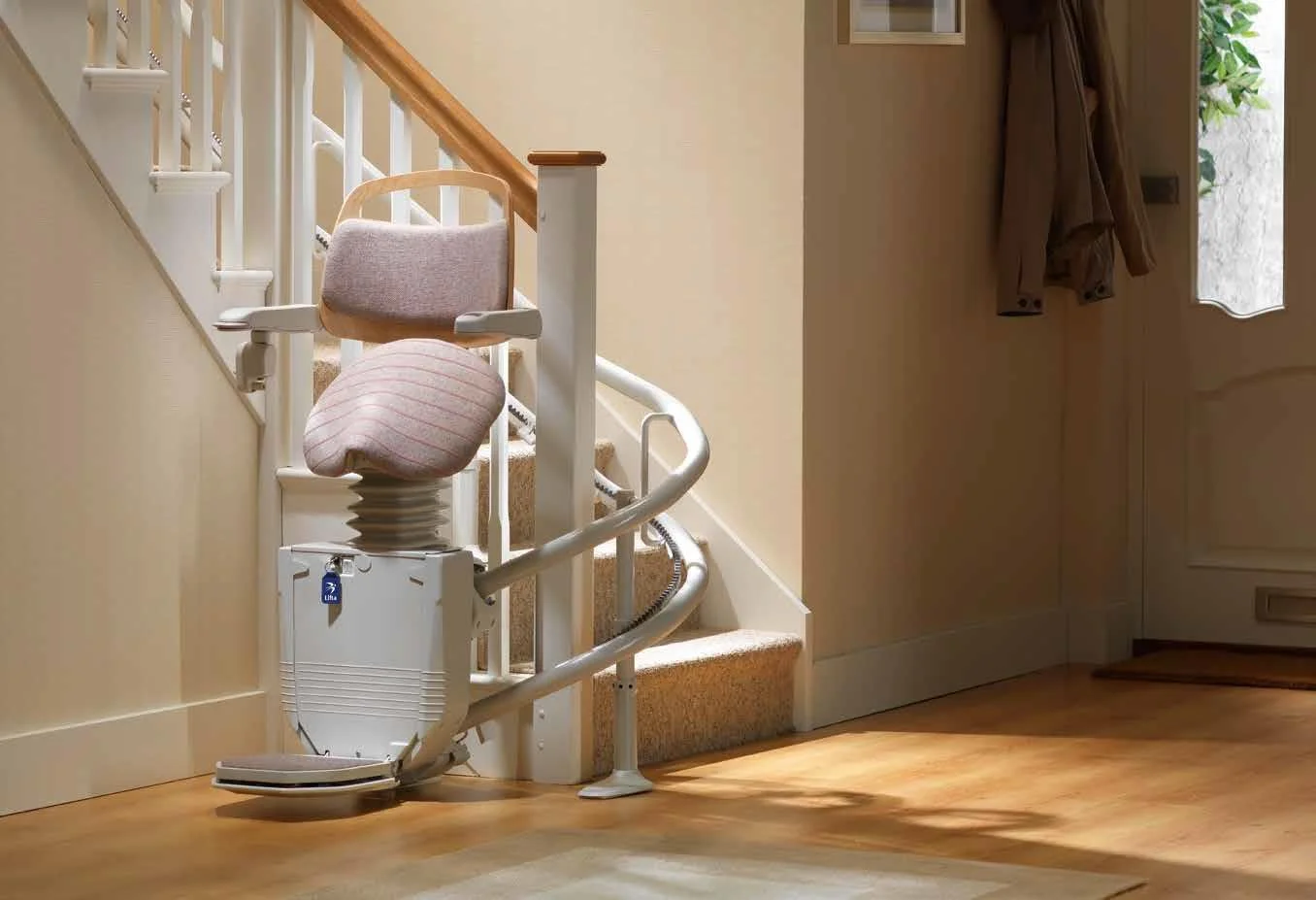
Single-family homes and ranch-style homes are common across the county. A ranch house may keep daily living on one floor, but a basement stairway or a few steps at the entry can still be a daily hurdle. A straight stairway is usually the simplest install, while stairs that turn at a landing call for a curved lift built to fit that staircase.
Manufactured homes bring their own question, which is usually the steps from the yard up to the door rather than anything inside. That points toward an outdoor-rated lift or, where someone uses a wheelchair, a platform lift. Walk-up apartments can be harder, since a renter needs the landlord on board before anything is attached to a shared stairway.
Where the Blue Mountains foothills meet the Cascade Range, elevation changes quickly, and plenty of lots in Juniper Canyon and around the reservoir are anything but flat. A house can sit well above the driveway, with exterior stairs that get used in every season.
For those homes, we look at the full route from the car to the kitchen. Sometimes an outdoor lift on the entry steps does more good than a lift on the interior staircase. Sometimes both are needed, and it helps to know that before pricing anything.
Only one program in our list states outright that it finances stair lifts: the Northwest Access Fund loan, which is open to Oregon residents of all ages with disabilities. It is a loan, not a grant, so it has to be repaid.
Several other programs fund home repairs or accessibility work but do not name stair lifts on their pages, so the honest answer is to call and ask. For older adults generally, the Council on Aging of Central Oregon help desk at (541) 678-5483 can point you to local options. The full list is below.
A nonprofit low-interest loan of up to $60,000, repaid over up to 120 months, that explicitly lists stairlift installation as a financed item for Oregon residents with disabilities, homeowners or renters with landlord permission. Call (206) 328-5116.
Very-low-income homeowners in eligible rural areas, including Crook County, can get a 1% loan up to $40,000, and those 62+ may get a grant up to $10,000 to make the home accessible; stair lifts are not mentioned on the source page. Apply through the USDA Rural Development Oregon state office or a local Service Center.
A grant of up to $126,526 for FY2026 for veterans with qualifying service-connected disabilities who own or plan to own the home. The VA describes covered changes in general terms and does not name stair lifts, so ask Crook County Veterans Services at (541) 447-5304.
A grant of up to $25,350 for FY2026 for veterans with certain service-connected disabilities, and the home may belong to the veteran or a family member. Stair lifts are not named on the source page.
A lifetime grant of up to $6,800 or $2,000, depending on disability status, for medically justified home changes; the VA excludes stair glides and porch lifts, so it will not pay for a stair lift. Apply through the nearest VA Prosthetic and Sensory Aids Service office.
A statewide Medicaid program for Oregonians who need help with daily activities and want to stay at home; the source page does not list stair lifts or home modifications. Call the ADRC at (855) 673-2372 to ask about the home-modification benefit.
A state-funded, needs-based in-home help program serving Crook, Deschutes and Jefferson counties, with a Home Safety Assistance option; stair lifts are not named on the services page. Call the help desk at (541) 678-5483 to ask whether stair-access equipment qualifies.
Free information, referral, advocacy and skills services for people with disabilities in Crook, Deschutes and Jefferson counties, with no Oregon Health Plan requirement; it does not list stair lift help directly but can refer you to funding. Call (541) 388-8103.
Older adults
1036 NE 5th Street, Bend, 97701
Veterans
422 NW Beaver St, Prineville, 97754
Yes. The USDA Section 504 grant is limited to age 62+, but the USDA loan is not. The Northwest Access Fund loan is open to people of all ages with disabilities and explicitly covers stairlift installation.
The HISA grant will not, since the VA excludes stair glides. The SAH and SHA grants cover home adaptations but do not name stair lifts, so call Crook County Veterans Services at (541) 447-5304 to see whether a veteran's situation fits.
The Northwest Access Fund lends to renters as long as the landlord gives permission. Talk with the landlord first, especially in a walk-up apartment with a shared stairway.
Yes. The Council on Aging of Central Oregon serves Crook, Deschutes and Jefferson counties, and its help desk is at (541) 678-5483.
Entry steps outside usually call for an outdoor-rated lift, or a platform lift if a wheelchair is involved. For funding, the Northwest Access Fund loan covers stairlifts, and the USDA Section 504 program may help eligible rural homeowners with accessibility repairs.
Abilitree at (541) 388-8103 is the Center for Independent Living for Crook County and handles referrals. For older adults, the Council on Aging help desk at (541) 678-5483 is another good starting point.
Tell us about the stairs in your home and we will explain which lift fits, what it costs and how installation works.
