From Lakewood and Rocky River on the lakefront to Parma, Cleveland Heights and Shaker Heights, a lot of Cuyahoga County lives in houses built for a growing industrial city. Cleveland was founded in 1796, and much of its housing went up during the boom of the late 19th and early 20th centuries. That left the county with many century-old, multi-story homes where the bedrooms and the full bath sit at the top of a staircase.
The county has 57 towns and a population of 1,235,012, and 19.0% of residents are 65 or older. If a parent's house in Euclid, Garfield Heights or Bedford has stairs that are getting harder to manage, this page walks through what kind of lift tends to fit local homes and which county, state and VA programs are worth a phone call.
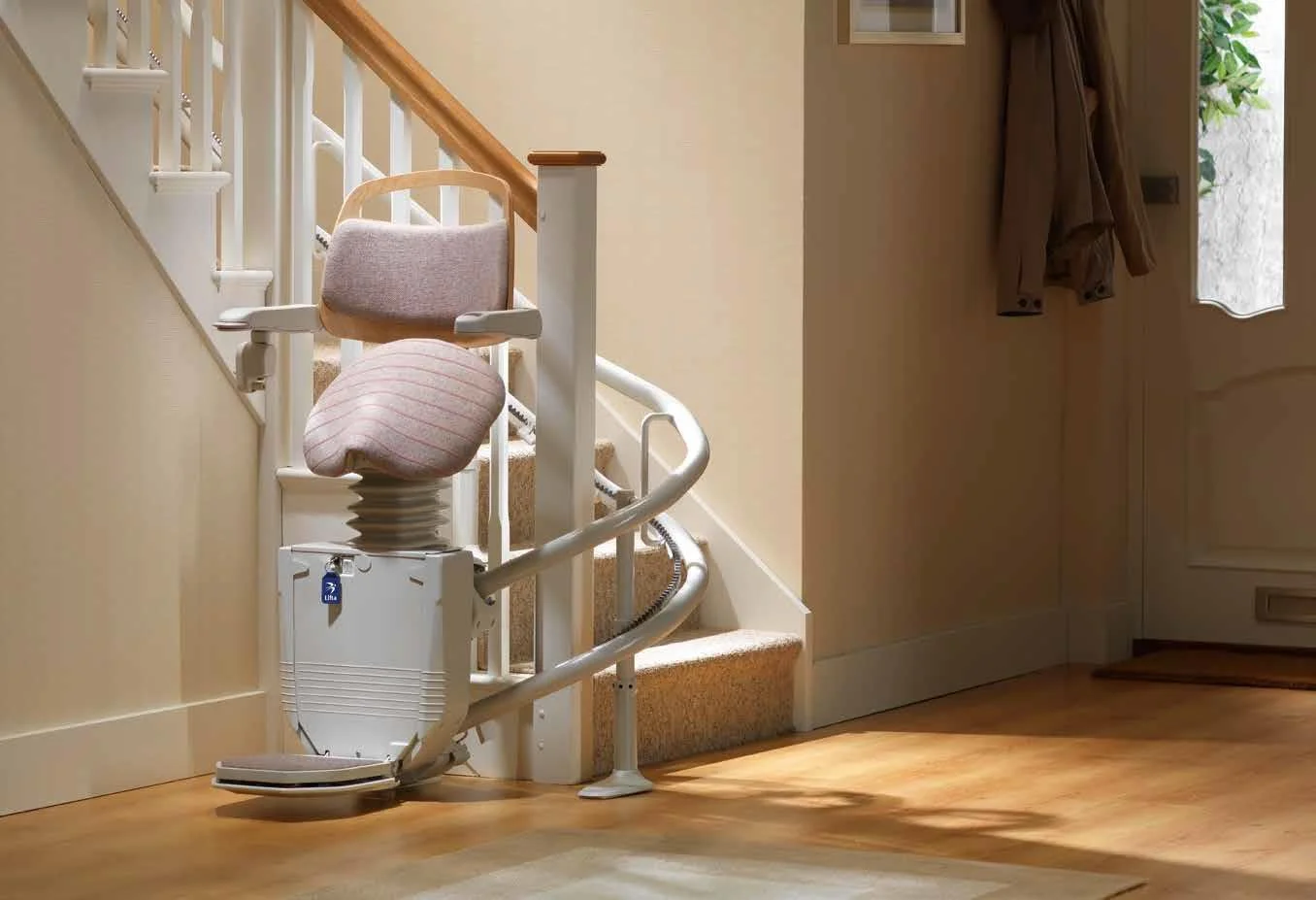
Century-old homes often have the main living space on the first floor and every bedroom upstairs. When climbing gets risky, the choice is usually between moving a bed downstairs, moving out, or putting a lift on the staircase people already use.
A straight staircase with no turns or landings is the simplest case, and a straight rail usually fits it. Older houses often have stairs that turn at a landing or wind near the top, and those need a curved rail built to the exact shape of that staircase. We measure every step before recommending either one.
Townhouses and row houses in the county tend to have narrow stairs between walls. A lift can still work there, but the chair needs to fold up so others can pass, and the rail position matters at the top and bottom.
About 14.3% of all county households have someone 65 or older living alone, and 37.4% of all households have a single occupant. For someone alone in a multi-story house, a fall on the stairs can go unnoticed for hours.
A lift does not replace an emergency response button, but the two work well together. Several programs below offer emergency response services, so it can make sense to ask about both on the same call.
The land rises fast from the Lake Erie shore at 569 feet to Public Square at 650 feet, less than one mile inland. Many lots across the county sit on that kind of grade, which means front steps, side doors and porches with more stairs than you might expect.
The East Side can see seasonal snow totals approaching or exceeding 100 inches. Icy exterior steps add risk on top of the indoor staircase. An outdoor-rated lift is built for weather, and for a wheelchair user a platform lift or a ramp may be the better fit at the entry. The City of Cleveland program listed below names front and back step repairs and ramps.
About 59.8% of county residents own their homes, and as of the 2020 Census 42.5% of housing units were renter-occupied. Most of the repair and modification programs here require the applicant to own and live in the home.
In walk-up apartments and low-rise buildings, the stairs belong to the building, not the tenant. A renter would need the owner's written approval before any lift goes in, so that conversation comes first.
Affordability is a real limit for many families here. In the City of Cleveland, median household income was reported at $30,907. None of the programs listed below name stair lifts on their source pages, so the honest answer is that coverage has to be confirmed by calling each one.
Some come close. WRAAA Works & NailsIt! lists stair rails and grab bars, Community Housing Solutions lists barrier removal for accessibility, and the Cuyahoga County Home Repair Loan Program offers up to $20,000 per household, though its applications are currently closed. The Western Reserve AAA (AAA 10A) at (216) 621-0303 is a good first call to sort out which programs fit.
The Cuyahoga County Veterans Service Office, 1835 Prospect Avenue, Ground Floor, Suite 150, Cleveland, at (216) 698-2600, can help with VA housing grants and VA Benefits for Veterans (HISA + Prosthetics). Statewide, Ohio HOME Choice (Money Follows the Person) is another program to ask about.
A state Medicaid waiver for people 60 and older who need hands-on help with daily activities and want to stay in their own home. Its listed services do not mention stair lifts or home modifications; call (800) 626-7277 to ask.
A county-funded repair and accessibility program for low-to-moderate income owner-occupants who are 60 or older or have a physical disability. It names stair rails and grab bars but not stair lifts; call (216) 453-8359.
Loans of up to $20,000 per household for owner-occupied single-family homes, with income at or below 120% of area median income. Stair lifts are not mentioned, and applications are closed for now; call (216) 574-7100 to ask when they reopen.
A nonprofit repair program for income-eligible county homeowners who have owned for at least one year, covering categories that include barrier removal for accessibility. Stair lifts are not named; call (216) 651-0077.
A county in-home care program for people 60 and older, or 18-59 with a disability, who do not qualify for a Medicaid waiver, with sliding-scale fees. It lists grab bar installation but not stair lifts; call (216) 420-6700.
A state Medicaid waiver for adults with disabilities ages 18-59 offering skilled and home support services. Stair lifts and home modifications are not itemized on the source page; call (216) 420-6700 for the full service list.
Managed care for adults 18 and older enrolled in both Medicare and Medicaid, with benefits that vary by plan. Whether stair lifts are covered is not stated; call (800) 626-7277.
Help for low-income seniors and adults with disabilities who own and live in their Cleveland home, naming step repairs, porch repairs and ramps. Stair lifts are not named; call (216) 664-2000.
A federal grant of up to $126,526 (FY2026) for veterans with qualifying service-connected disabilities, or up to $50,961 to adapt a family member's home. Stair lifts are not specifically named; the Cuyahoga County Veterans Service Office at (216) 698-2600 can help with an application.
A federal grant of up to $25,350 (FY2026), or up to $9,100 for a temporary residence, for veterans with qualifying disabilities. Stair lifts are not specifically named; contact the Cuyahoga County Veterans Service Office at (216) 698-2600.
A Center for Independent Living in Cleveland serving people with disabilities in Cuyahoga and nearby counties, with independent living and benefits assistance. Stair lifts are not listed; call (216) 696-2716.
Older adults
1700 E. 13th Street, Suite 114, Cleveland, 44114
Veterans
1835 Prospect Avenue, Ground Floor, Suite 150, Cleveland, 44115
Most staircases can take a lift, but many century-old homes have turns, landings or narrow stairwells. Straight stairs use a straight rail, while turning stairs need a curved rail made to measure, so an in-home measurement is the first step.
The PASSPORT and Ohio Home Care Waiver source pages do not list stair lifts or home modifications. Call (800) 626-7277 for PASSPORT or (216) 420-6700 for the Home Care Waiver and ask directly.
Yes, several programs serve adults with disabilities. The Ohio Home Care Waiver covers ages 18-59, Options for Independent Living accepts ages 18-59 with a disability, and LEAP serves people with disabilities at (216) 696-2716.
Outdoor-rated lifts are made for exterior steps, and a platform lift or ramp may suit a wheelchair user. In Cleveland, the Age-Friendly Home Investment Program names step repairs and ramps; call (216) 664-2000.
Most programs here require the applicant to own and live in the home. A renter needs the landlord's written approval before a lift is installed.
Call the Cuyahoga County Veterans Service Office at (216) 698-2600. They can help with the VA SAH and SHA grants, which can be used for qualifying home adaptations.
Tell us about the stairs in your home and we will explain which lift fits, what it costs and how installation works.
