Tompkins County covers about 492 square miles of hilly, gorge-cut ground, from the slopes around Ithaca Falls to the country roads near Buttermilk Falls State Park. Many homes in Ithaca, Cayuga Heights, South Hill and Forest Home were built into the hillside, so a front walk, a porch and an inside staircase can all stand between a person and the kitchen.
Out in Dryden, Groton, Newfield, Trumansburg and Brooktondale, the homes spread out but the stairs do not go away. This page walks through what the county's homes mean for choosing a stair lift, and which local and state programs are worth a phone call before you pay.
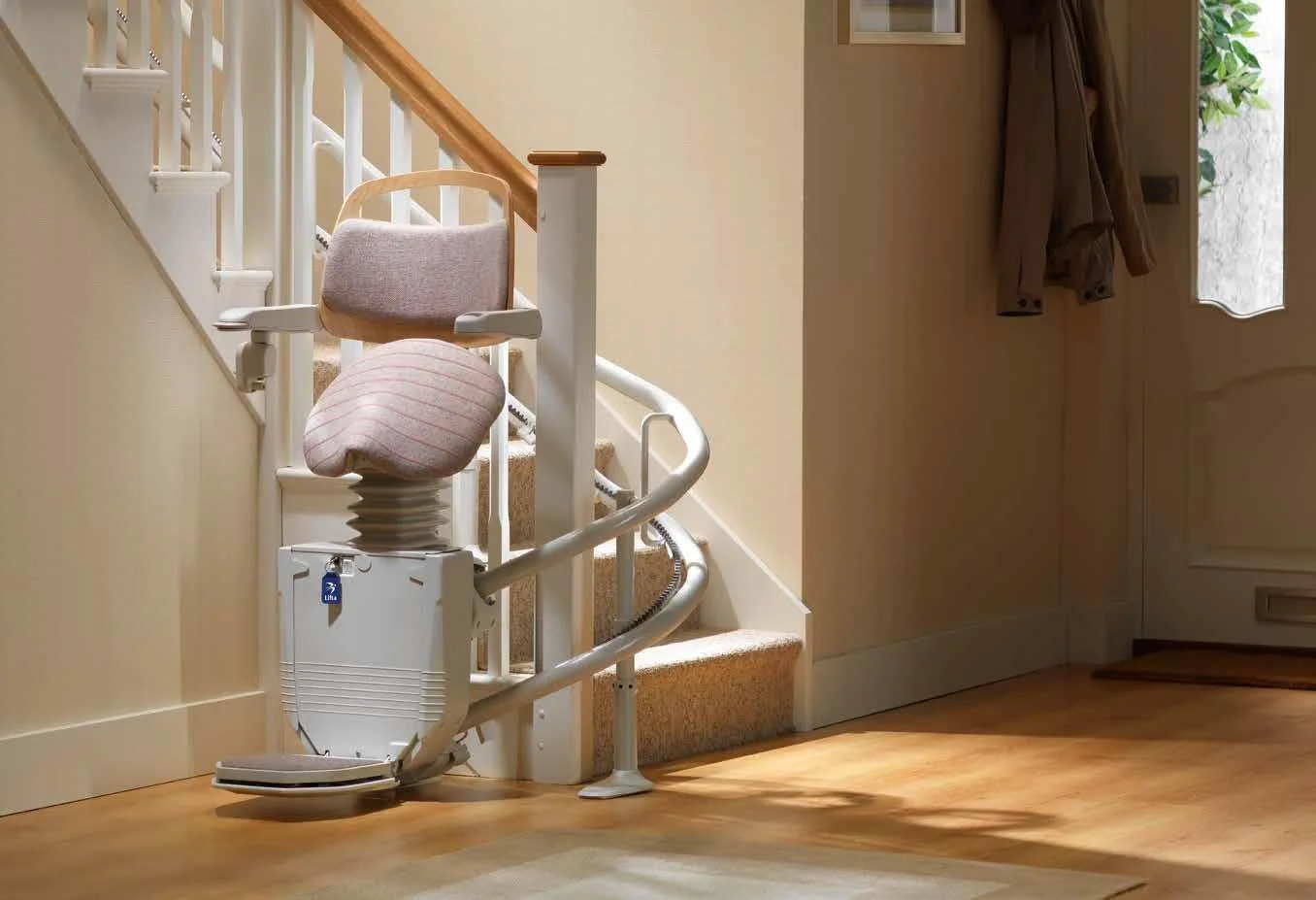
Ithaca and its surrounding hillside neighborhoods sit on steep grades. That terrain tends to come with multi-level layouts, and often with steps outside as well as inside.
An indoor staircase is only part of the picture here. If the trouble starts at the front steps or the porch, an outdoor stair lift built for New York weather may matter as much as the one inside. Where a wheelchair is involved, a platform lift is usually the better fit for the entry.
We look at every set of stairs a person uses on a normal day, not just the main staircase, before recommending anything.
The county's housing stock skews toward older, multi-story homes. A straight staircase in a single-family home or townhouse is the simplest install, with a rail that mounts to the stair treads rather than the wall.
Split-level homes are different. Short runs of stairs with landings in between often call for a curved rail, or for two straight lifts on separate flights, and we measure each run before giving options.
Walk-up apartments and low-rise buildings raise a different question: who owns the stairs. In a shared stairway, the building owner has to approve any installation, so it helps to have that conversation early.
Homeownership sits at 53.8%, which means a large share of households rent and need a landlord on board for any change to the stairs.
For owners, the numbers lean toward staying put. The median owner-occupied property value is $290,900, up 7.15% year-over-year as of 2024, and rising values make an accessibility change at home look more reasonable than moving for many county seniors.
None of the local program pages we reviewed name stair lifts outright. Several fund related work such as ramps, handrails, modified stairs or assistive devices, so it is worth asking each one directly how they would treat a stair lift request.
Start with the Tompkins County Office for the Aging at (607) 274-5482, 214 W. Martin Luther King Jr. St., Ithaca. They deliver EISEP locally for adults 60 and older. Veterans should call the Tompkins County Department of Veterans Services at (607) 274-5920, 111 North Albany Street, Ithaca.
Statewide options to ask about include New York Medicaid Home Modifications (NHTD Waiver & MLTC), VA Benefits for Veterans (HISA + Prosthetics), the New York RESTORE Program and New York EISEP. The programs below are the ones with details we could confirm.
A state accessibility grant for low- and moderate-income New Yorkers with disabilities of any age, owners or renters, applied for through a Local Program Administrator rather than the state directly. The program page lists ramps, lifts, handrails and doorway widening but does not mention stair lifts.
A nonprofit program for low-income senior and disabled homeowners in a service area that includes Tompkins County, funding work such as modified stairs, grab bars and ramps; stair lifts are not listed. Call INHS at (607) 277-4500.
Free professional labor for homeowners 60 and older, homeowners with disabilities, or single heads of household with dependents, with the homeowner usually covering materials; listed work includes fixing steps and adding handrails, but not stair lifts. Call (607) 288-3229 for application help.
A non-Medicaid in-home support program for adults 60 and older whose ancillary services may include home repairs or assistive devices, decided case by case; stair lifts are not named. Call NY Connects at (800) 342-9871 or the Office for the Aging at (607) 274-5482.
A federal grant of up to $126,526 (FY2026 maximum) for veterans with qualifying severe service-connected disabilities who own or will own their home; the VA page mentions ramps and doorway widening, not stair lifts. Ask the Tompkins County Department of Veterans Services at (607) 274-5920 for help applying.
A federal grant of up to $25,350 (FY2026 maximum) to adapt an existing home for veterans with qualifying service-connected disabilities; stair lifts are not explicitly named. The Tompkins County Department of Veterans Services at (607) 274-5920 can help with the application.
Older adults
214 W. Martin Luther King Jr. St., Ithaca, 14850
Veterans
111 North Albany Street, Ithaca, 14850
Yes, possibly. The Access to Home Program serves people with disabilities of any age, and the INHS Minor (Small) Repairs Program accepts homeowners with disabilities of any age. Neither program page names stair lifts, so ask directly.
The Access to Home Program is open to renters as well as homeowners. Your landlord will still need to approve any lift, especially in a walk-up or low-rise building with shared stairs.
Hillside homes in the county often have exterior stairs, and an outdoor stair lift or a platform lift can handle those. We assess the outside entry along with the inside stairs before making a recommendation.
Call the Tompkins County Department of Veterans Services at (607) 274-5920, 111 North Albany Street, Ithaca. They can explain the SAH grant (up to $126,526) and SHA grant (up to $25,350) and whether you qualify.
The Tompkins County Office for the Aging at (607) 274-5482 delivers EISEP locally for adults 60 and older. NY Connects at (800) 342-9871 can also point you to services.
Often it needs either a curved rail or separate straight lifts for each short flight. The right answer depends on the landings and turns, which we measure during a home visit.
Tell us about the stairs in your home and we will explain which lift fits, what it costs and how installation works.
