New York County is Manhattan, an island roughly 13.4 miles long and 2.3 miles wide, and almost everyone here lives up at least one flight of stairs. Much of the older housing is pre-war tenement buildings, five or six stories tall on narrow lots, and many of them never had an elevator installed.
That means a lot of older residents climb several flights of interior stairs every day with no other way up. This page explains how a stair lift can fit Manhattan's walk-up apartments, row houses, townhouses and low-rise buildings, and which local programs may help pay for one.
Manhattan's housing stock includes many "old-law" tenements built from 1879 to 1901 and "new-law" tenements built from 1901 onward. Both types usually sit on narrow lots, and their low-rise scale is why so many never got elevators.
In a walk-up, the stairs are often shared by every unit in the building. Before we measure, it helps to know who controls the stairwell, since a rail mounted there affects your neighbors and needs the owner's approval.
Row houses and townhouses are different. The stairs are usually private to one household, so the decision is yours if you own the home.
A straight lift runs on a single rail up one straight run of stairs. It is the simplest install and works when the flight has no turns between the bottom and top.
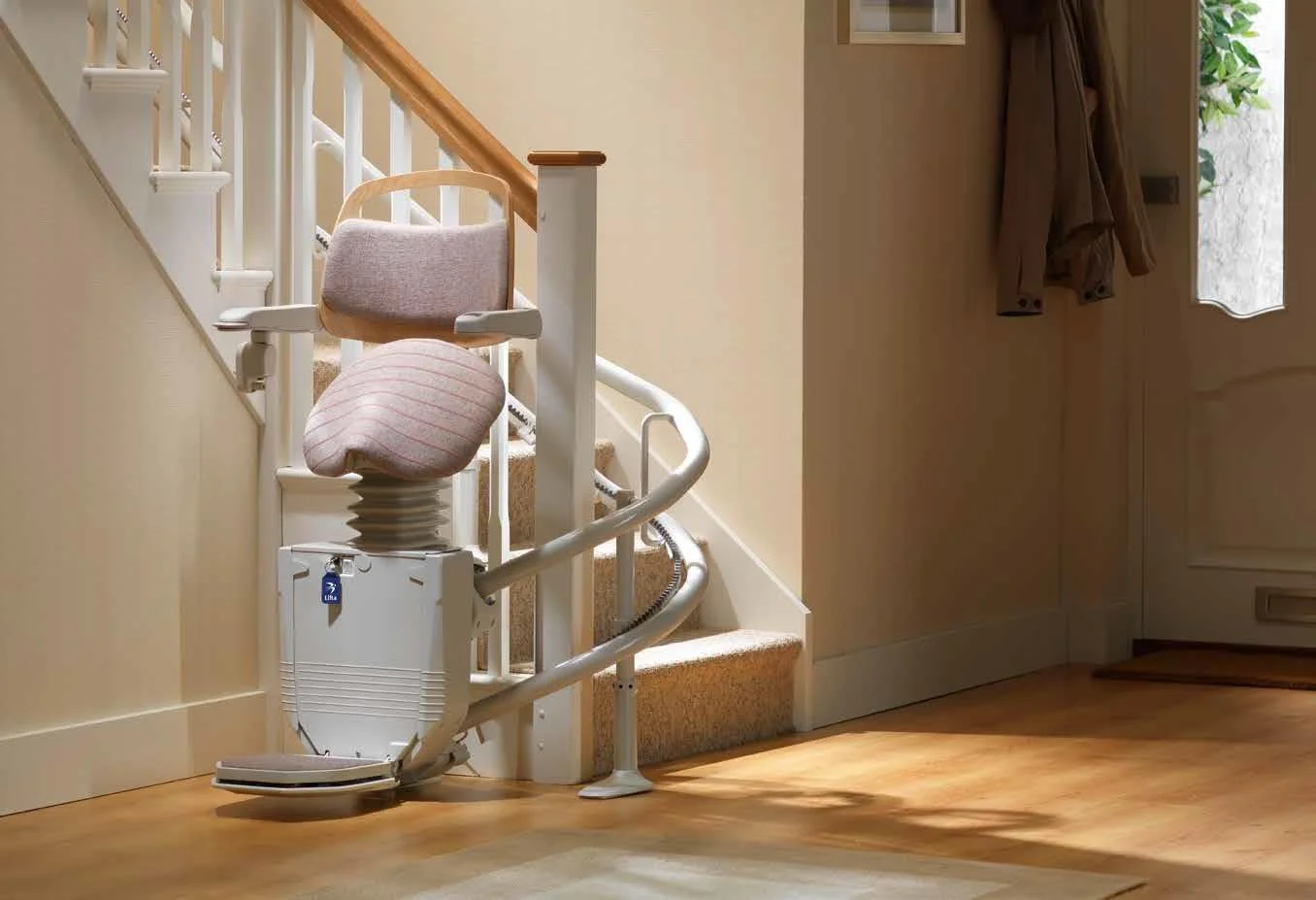
When a staircase turns at a landing or climbs more than one flight, a curved rail is built to follow that exact path. In a townhouse with stairs between several floors, this is often the way to reach the upper levels with one continuous ride.
A platform lift carries a wheelchair rather than a seated rider. It needs more room than a chair lift, which can be hard to find on narrow lots, so we look at width and landing space during the visit.
The median home value in New York County is about $1.09M, and the median household income is about $103,931. Those figures hide a split: the poverty rate is about 16.5%, compared with roughly 12.5% nationally.
Many older residents live on fixed or modest incomes and cannot pay for accessibility upgrades on their own. That is why the funding programs below matter so much for Manhattan households.
The one local program that explicitly names stair lifts is Access to Home through the New York Foundation for Senior Citizens, which lists "stair glides" among eligible modifications. Call them first if your household income may be at or below 80% of area median income.
Other programs cover home modifications or in-home help but do not name stair lifts on their source pages, so ask each one directly. The VA HISA grant specifically excludes stair glides.
If you are not sure where to begin, NY Connects at Hudson Guild can screen you for benefits, including EISEP and Medicaid waiver referrals. The NYC Department for the Aging is at 2 Lafayette St. 7th Floor, (212) 244-6469, and veterans can reach the New York State Department of Veterans’ Services – Manhattan VAMC Office at (212) 686-7500.
A statewide grant program for accessibility modifications for people with a documented disability and household income at or below 80% of area median income (120% for veterans with service-connected disabilities). Its page does not list stair lifts; in Manhattan it is delivered through NYFSC and CIDNY.
A nonprofit-run home modification grant for substantially disabled, low or moderate income New York City residents, with an income limit cited as $95,040 for a one-person household. Stair lifts are covered (listed as "stair glides"); call (212) 962-7655.
Home accessibility upgrades for New Yorkers with disabilities, with a separate track for veterans with disabilities; the page does not list stair lifts. CIDNY's main office is at 1010 Avenue of the Americas, Suite 301; call (212) 674-2300.
A Medicaid waiver for people 65+, or 18-64 with a verified physical disability, who need nursing-facility level of care; it covers environmental modifications but does not list stair lifts. Enrollment can involve a waitlist; call (718) 838-3838.
In-home services for people 60+ who need help with daily activities, including "ancillary services" such as home repairs and assistive devices, though stair lifts are not listed. A cost share based on income may apply; call (800) 342-9871.
A free information and referral office for Manhattan residents of any age and their caregivers; it does not list stair lifts itself but helps find current local funding. Call (212) 966-9852, Mon-Fri 9am-5pm (Wednesday to 7pm), or walk in at Fulton Community Center, 119 9th Avenue.
A no-cost program where a licensed occupational therapist assesses an older adult's home and a licensed contractor installs items like grab bars and railings. Stair lifts are not named among its listed modifications; call (212) 602-4455.
A VA grant of up to $6,800 (service-connected or 50%+ rating) or $2,000 (non-service-connected) for medically necessary home modifications. Stair lifts are not covered: the VA excludes stair glides.
A VA grant of up to $126,526 (FY2026 maximum) for veterans with the most severe qualifying service-connected disabilities who own or will own the home. Stair lifts are not listed; the examples given are ramps and doorway widening.
A VA grant of up to $25,350 (FY2026 maximum) for adapting a home the veteran owns or will own, for qualifying disabilities less severe than SAH criteria. Stair lifts are not listed on the source page.
Older adults
2 Lafayette St. 7th Floor, New York, 10007
Veterans
423 East 23rd Street, Room 1-111C, New York, 10010
Access to Home through the New York Foundation for Senior Citizens explicitly lists stair glides as an eligible modification for income-qualified New York City residents with a substantial disability. Call (212) 962-7655.
The state Access to Home program accepts rental homes that are your primary, permanent residence, as long as the landlord consents. Get the building owner involved early.
No. The VA excludes removable equipment such as portable ramps, porch lifts and stair glides from HISA. Veterans can ask CIDNY about Access to Home for Heroes at (212) 674-2300.
The NHTD Medicaid waiver serves people 18-64 with a verified physical disability, as well as people 65+, if they are Medicaid-eligible and need nursing-facility level of care. Call (718) 838-3838.
Start with NY Connects at Hudson Guild, (212) 966-9852. They screen Manhattan residents for benefits and can point you to EISEP, Medicaid waivers and current local funding.
Tell us about the stairs in your home and we will explain which lift fits, what it costs and how installation works.
