From Lowville and Croghan to Constableville, Port Leyden and Copenhagen, a lot of Lewis County living happens in older, two-story farmhouses. Dairy farming has long shaped the county, and many of those houses were built for large families and working farms. Plenty of owners have lived in them for decades and plan to stay.
That is where a stair lift earns its keep. When the bedrooms and the only full bath are upstairs, the staircase decides whether a home still works. This page walks through how Lewis County houses and winters affect the choice of lift, and which county, state and federal programs are worth a phone call.
Housing here runs mostly to single-family homes and detached houses, with some townhouses, walk-up apartments and split-level homes. With only 20.8 people per square mile as of the 2020 census, most people live in multi-level houses rather than apartments or condos, and 78.7 percent of residents own their homes.
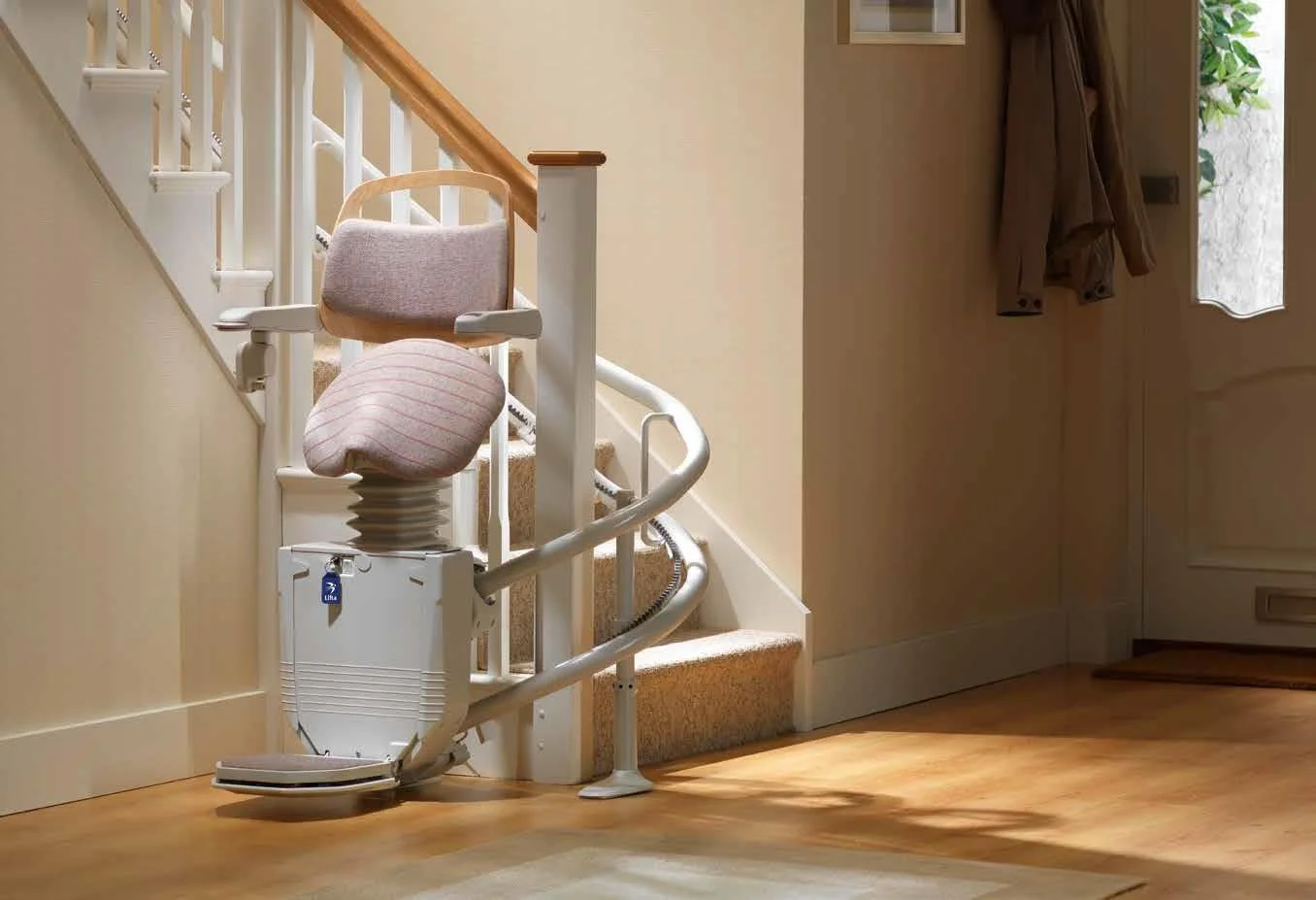
A straight staircase in a farmhouse is usually the simplest install: one rail, mounted to the stair treads, not the wall. Older homes often have a turn, a landing or a narrow winding section, and those call for a curved lift built to fit that particular staircase. Split-level homes have shorter runs between levels, so it is worth measuring each set of steps before deciding which ones need a lift.
Lewis County sits between the Adirondack Mountains and the Tug Hill Plateau, in the Snowbelt, and lake-effect snow off Lake Ontario brings some of the highest snowfall totals in the eastern United States. For much of the year, porch steps and walkways are coated in snow and ice.
That means the inside staircase is only half the picture. An outdoor stair lift rated for weather, or a platform lift for someone using a wheelchair or walker, can take icy entry steps out of the daily routine. If getting in and out of the house is the harder trip, start the conversation there.
About 20.0 percent of residents are 65 or older, and the rural layout means there are few single-story homes nearby for someone who wants to move without leaving town. Adapting the house you already own is often the more practical route.
The county also has fewer home-modification specialists than more urban parts of New York. It helps to book an assessment early, before a fall or a hospital stay forces a rushed decision, so measurements and funding questions can be sorted out at a normal pace.
No program on this page names stair lifts as a covered item, so the honest answer is that funding takes some phone calls. The Lewis County Office for the Aging at 7660 N. State Street in Lowville is the right first stop for anyone 60 or older, including to ask about equipment or modification referrals that are not listed on its public page.
The VA's HISA benefit explicitly excludes stair glides, but the Lewis County Veterans Service Agency can review other VA options. Low-income rural homeowners may also look at USDA Section 504 repair loans and grants, and statewide programs to ask about include New York Medicaid Home Modifications (NHTD Waiver & MLTC), the New York RESTORE Program and New York EISEP. Details on each local program are below.
In-home help with personal care, meal prep, light housekeeping, shopping and case management, with costs shared on a sliding scale from no-cost to full-cost based on income; stair lifts and home modifications are not listed on the program page. Call (315) 376-5432 to ask what help is available, including referrals.
Medical alert devices for people 60 or older with no financial eligibility requirement; stair lifts and home modifications are not listed. The general Office for the Aging line, (315) 376-5313, is also the place to ask about any home-modification referral.
State funding for accessibility modifications such as wheelchair ramps and lifts, handrails, doorway widening and roll-in showers for households at or below 80 percent of area median income (120 percent for disabled veterans); stair lifts are not named. Homeowners cannot apply directly and must go through a Local Program Administrator active in their area, so confirm availability with HCR.
A lifetime benefit of up to $6,800 or $2,000, depending on disability status, for medically necessary home accessibility improvements for enrolled VA health-care patients. It does not cover stair lifts: the VA excludes porch lifts and stair glides as removable equipment.
Grants for veterans with qualifying severe service-connected disabilities, with FY2026 caps of up to $126,526 for SAH and up to $25,350 for SHA, usable up to 6 different times over a lifetime. Stair lifts are not mentioned; the examples given are ramps and widened doorways.
Loans up to $40,000 at a fixed 1% rate over 20 years, and grants up to a $10,000 lifetime maximum for very low income homeowners age 62 or older, combined up to $50,000, including accessibility improvements; stair lifts are not named specifically. Eligibility depends on the address, so check the USDA eligibility map.
A county referral and advocacy office for veterans, active military personnel and their dependents; stair lift or home modification help is not listed. Call (315) 377-2065 for help with VA claims and benefit applications.
Older adults
7660 N. State Street, Lowville, 13367
Veterans
Court House, 7660 North State Street, 1st Floor, Room 120, Lowville, 13367
Its public pages do not list stair lifts or home modifications among its services. It is still the right first call for anyone 60 or older, since staff can explain what help exists and make referrals. Reach the office at (315) 376-5313 or the home care line at (315) 376-5432.
No. The VA excludes porch lifts and stair glides from HISA. A veteran with a qualifying severe service-connected disability can ask about SAH or SHA grants, and the Lewis County Veterans Service Agency at (315) 377-2065 can help review options.
Yes. Lewis County gets some of the highest snowfall totals in the eastern United States, so outdoor stair lifts and platform lifts are worth considering for porch and entry steps, not just the indoor staircase.
USDA Section 504 grants of up to $10,000 over a lifetime are available to very low income homeowners age 62 or older who cannot repay a loan. The program covers accessibility improvements, though stair lifts are not named, and your address must fall in a USDA-eligible rural area.
No. Individual homeowners cannot apply directly to NYS Homes and Community Renewal. Assistance goes through a Local Program Administrator, such as a municipality or not-for-profit, so check with HCR whether one currently serves your part of the county.
Both are in Lowville. The Office for the Aging is at 7660 N. State Street, and the Veterans Service Agency is in the Court House at 7660 North State Street, 1st Floor, Room 120.
Tell us about the stairs in your home and we will explain which lift fits, what it costs and how installation works.
