Buffalo-Cheektowaga has been reported as having some of the oldest housing of any large U.S. metro, with a median home age cited at 66 years and more than a quarter of homes built before 1940. Walk through Buffalo, Kenmore or Tonawanda and you see why: Victorian-era and Italianate two- and three-story houses, foursquares and duplexes, many still with their steep, narrow original staircases.
Those stairs are where a lot of families in Erie County start asking about a stair lift. In houses like these, a lift on the existing staircase is often more practical than moving a bedroom downstairs or building an addition. This page covers how local homes and weather affect the choice, and which county, state, federal and nonprofit programs are worth a phone call.
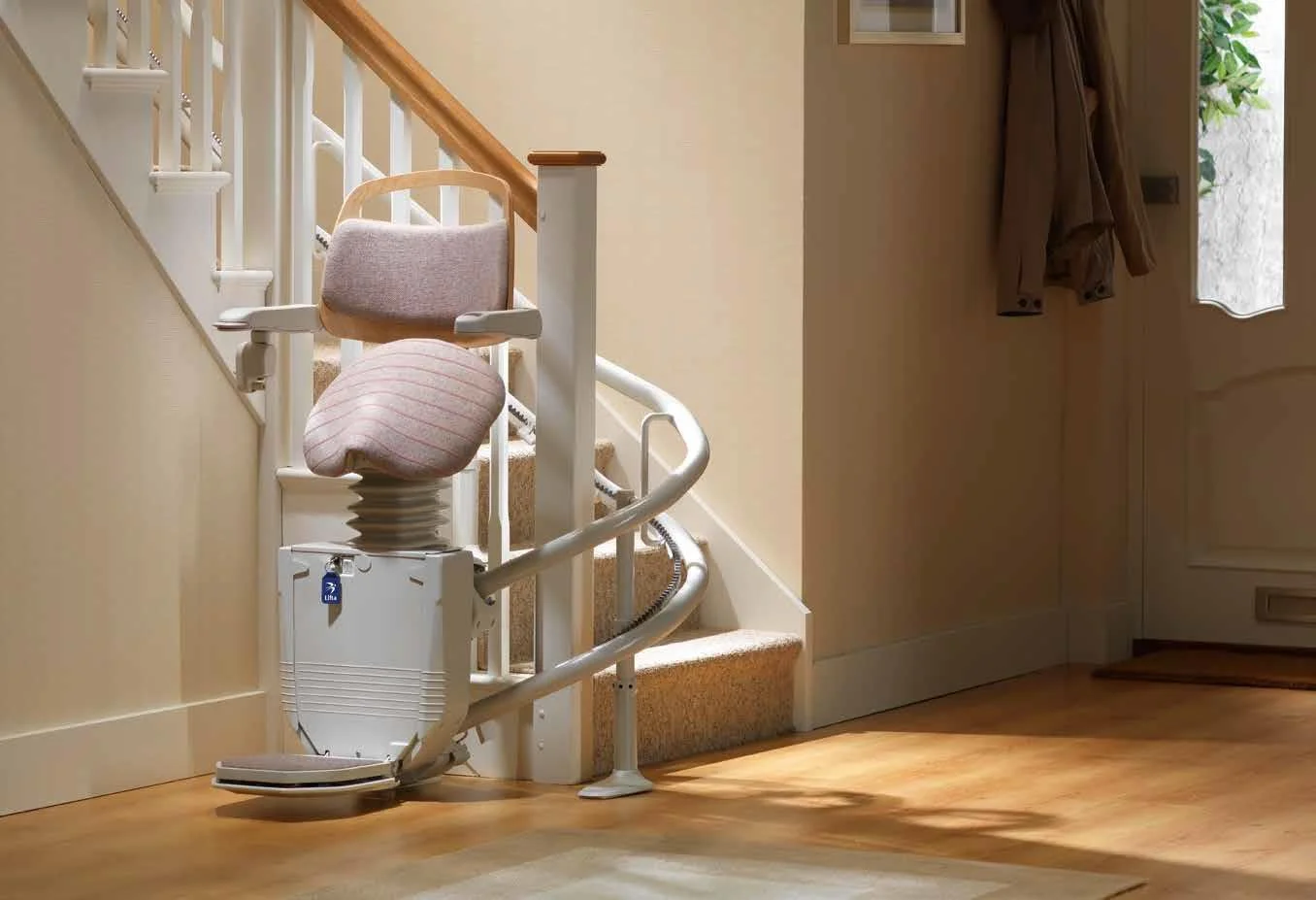
A single straight flight from the front hall to the second floor usually takes a straight stair lift, the simplest and quickest type to install. Narrow treads and steep pitch are common in older Buffalo-area houses, so we measure the width, rise and landing space before recommending a model.
Stairs that turn at a landing, wind around a corner or split into two flights need a curved lift with a rail built to that staircase. Two- and three-story homes may need a lift on more than one flight, which is worth planning together from the start.
The northern half of Erie County, including Buffalo, is fairly flat as it rises from Lake Erie. The Southtowns are a different story: they are part of the northwesternmost foothills of the Appalachians, climbing to around 1,940 feet in Sardinia, compared with about 560 feet on Grand Island.
Homes on sloped lots in towns like Orchard Park, Aurora, Boston, Eden or Springville can have more steps between the driveway and the door. An outdoor stair lift or a platform lift for a wheelchair user can cover those steps. Outdoor equipment here has to be chosen with lake-effect snow in mind, so we talk through cover, clearing and placement before you commit.
Erie County winters can be dangerous. A November 2014 storm dropped over 7 feet of snow on parts of the county including Buffalo, and the December 24-27, 2022 blizzard is estimated to have caused 39 deaths in Erie County alone, with highways closed and responders unable to reach some people having medical emergencies.
When help may not be able to get through, a fall on the stairs at home is a bigger risk than usual. Safe access to every floor you live on, all year, is a practical part of staying home through a Buffalo winter.
Of the county's 991,007 residents, 18.9% are 65 or older, and 66.2% of households own their homes. Many are long-tenured owners living in the same old, multi-story house for decades, often on moderate incomes.
If that includes someone in your family, the VA programs below are worth checking, though they have limits on stair lifts that you should know about before you apply.
No program listed here names stair lifts as a covered item, and the VA HISA benefit specifically excludes stair glides. That does not mean the door is closed. Several programs cover home modifications or assistive devices in general terms, and the people running them decide what fits a given case.
The most useful first call is usually NY Connects at the Erie County Department of Senior Services, (716) 858-8526, at 95 Franklin Street Rm 1329 in Buffalo. Staff can route you to whichever program currently applies. Homeowners with a mobility disability can also ask the county Housing Intake line at (716) 858-2733 about its loan programs.
A statewide Medicaid waiver for people 65 or older, or 18-64 with a physical disability, who need nursing-facility-level care; home modifications have been listed as a service category, but stair lifts are not named. The state has previously reported the program at maximum capacity, so confirm current status at (844) 614-8800.
State funding to make homes accessible for low- and moderate-income people with disabilities, with examples like ramps and lifts, handrails, doorway widening and roll-in showers; stair lifts are not specifically named. Homeowners cannot apply to the state directly and must go through a Local Program Administrator serving Erie County.
A deferred loan of up to $10,000 for low- and moderate-income owner-occupants with a disability that significantly impairs mobility; listed work includes ramps, re-plumbing kitchens and baths, and walkways, and stair lifts are not named. Call the county Housing Intake line at (716) 858-2733.
A deferred loan of up to $15,000 at 0% interest for essential repairs on owner-occupied 1-2 family homes in Erie County; stair lifts and accessibility work are not named under this program. It uses the same intake as the accessibility program, at (716) 858-2733.
Federal repair loans for very-low-income homeowners, with grants for those 62 or older to remove health and safety hazards; stair lifts are not named. Only addresses in USDA-designated rural areas qualify, so the City of Buffalo core and inner suburbs are out, while some outlying towns may qualify.
A VA benefit of up to $6,800 lifetime for service-connected disabilities, or $2,000 for other qualifying disabilities, for permanent changes like ramps, roll-in showers and lowered counters. It does not cover stair lifts: stair glides are specifically excluded.
VA grants of up to $126,526 (SAH) or $25,350 (SHA) for veterans with certain severe disabilities who own or will own the home; stair lifts are not named among the covered modifications. The Erie County Veterans Service Agency at (716) 858-6363 can help with the application.
A New York program for people 60 or older who need help with daily activities, offering in-home care, respite and ancillary services that may include home repairs or assistive devices; stair lifts are not specifically named. In Erie County it runs through the Department of Senior Services at (716) 858-8526.
A free information and referral line for older adults, people with disabilities and caregivers, with a list of ramp, lift and home modification providers; it does not fund equipment itself. Call (716) 858-8526 as your first stop.
No-cost critical home repairs for income-qualified homeowners, with priority for elderly and disabled residents; stair lifts are not named and the accessibility scope is not confirmed. Ask what applies to your home at (716) 764-9548.
A free loan closet of durable medical equipment for personal and mobility needs, such as portable items rather than installed lifts; stair lifts are not named. Call (716) 836-0822 to ask about equipment or referrals to modification funding.
Older adults
95 Franklin Street Rm 1329, Buffalo, 14202
Veterans
Edward A Rath County Office Building, 95 Franklin Street, Suite 800, Buffalo, 14202
Steep, narrow original staircases are common in Erie County's older homes, and a stair lift is often the more practical option there compared with relocating a bedroom or adding a room. We measure the staircase first to confirm which straight or curved model fits.
The VA HISA benefit specifically excludes stair glides. The SAH and SHA grants cover larger home adaptations for qualifying veterans but do not name stair lifts. The Erie County Veterans Service Agency at (716) 858-6363 can review what a veteran may qualify for.
EISEP starts at age 60, but other programs do not use that cutoff. The NHTD waiver includes people 18-64 with a physical disability, and the county Housing Accessibility Program is based on income and a mobility-impairing disability rather than age.
Start with NY Connects at the Erie County Department of Senior Services, (716) 858-8526, 95 Franklin Street Rm 1329, Buffalo 14202. Staff there can point you to the program that currently fits your situation.
Possibly. USDA Section 504 repair loans and grants only apply to USDA-designated rural addresses, and some outlying Erie County towns may qualify while the Buffalo core does not. Eligibility is checked address by address on the USDA map.
The county's Housing Accessibility Program offers up to $10,000 and the Housing Rehabilitation Loan Program up to $15,000, but neither names stair lifts among covered work. Ask the Housing Intake line at (716) 858-2733 whether your project can be considered.
Tell us about the stairs in your home and we will explain which lift fits, what it costs and how installation works.
