Drive through Savage, Prior Lake or Shakopee and you see the same thing block after block: ramblers, split-levels and two-story homes built during the county's growth boom after the 1990s. Scott County went from 89,498 residents in 2000 to 150,928 in 2020, and many of the homes built for those new families put the bedrooms up a flight of stairs or a half level away from the kitchen.
Those floor plans worked fine for young families. For a parent who now holds the railing with both hands, they can decide whether staying home is still realistic. This page walks through what Scott County homes usually need in a stair lift, what the county's layout means for getting service, and which programs in Minnesota may help with the cost.
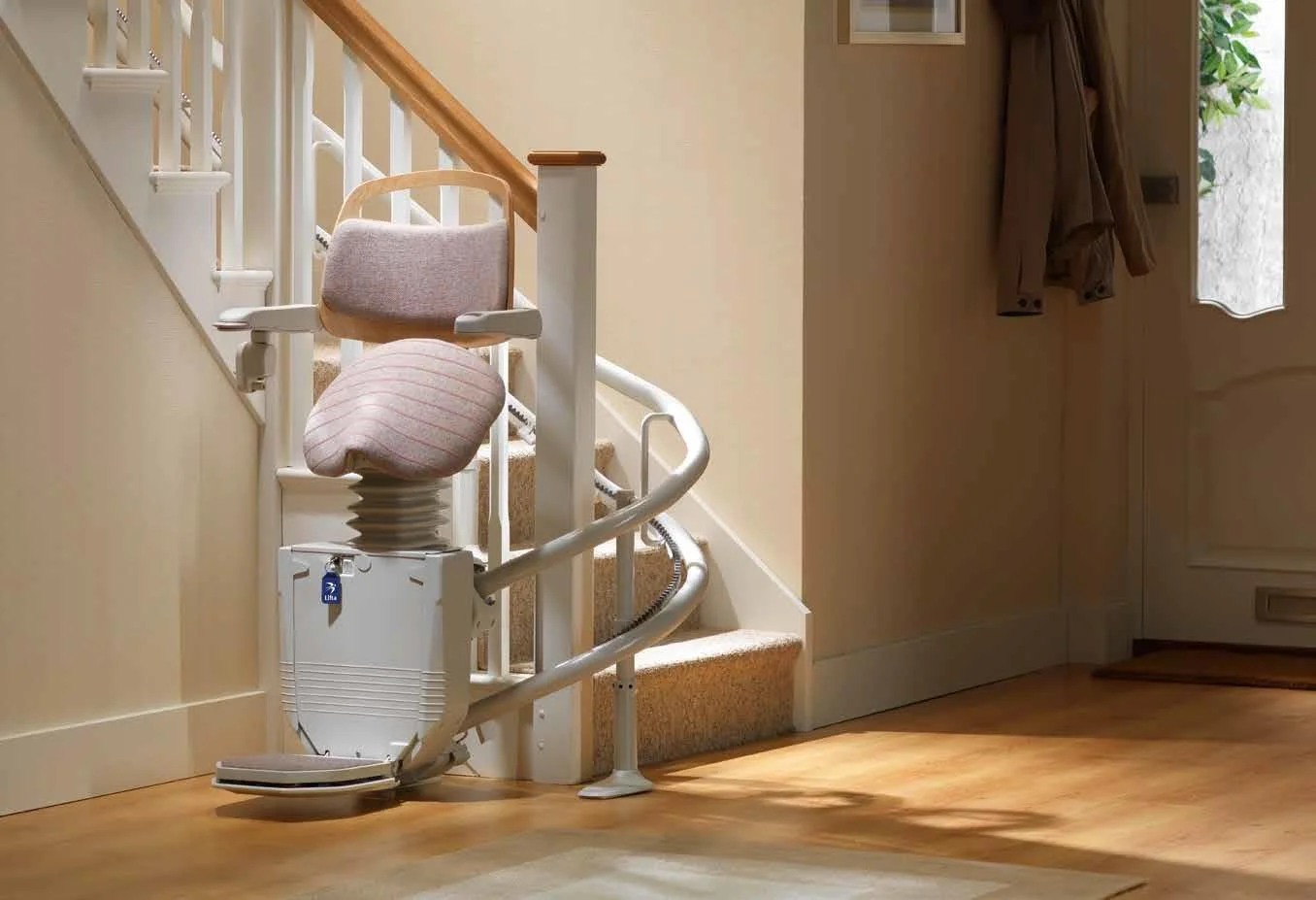
A two-story home with one straight flight is the simplest job. A straight stair lift rides a rail bolted to the stair treads, not the wall, and it is usually the lowest-cost option.
Split-level homes are different. Instead of one long flight, they often have two short runs going up and down from the entry, so one person may need a lift on each run, or a curved rail that follows a turn. We measure every step and landing before recommending either one.
Ramblers keep most living space on one floor, but steps at the entry can still be the problem. In those cases an outdoor stair lift or a vertical platform lift may make more sense than anything inside.
Townhouses in Scott County often stack living space over two or three floors with narrow stairs. A straight rail usually fits, but we check the stair width and where the rail will end at the top so the seat can fold out of the way.
Walk-up apartments bring a different question: who owns the stairs. If the stairway is shared, the building owner has to approve the installation before any work starts.
About 11.9% of Scott County residents are 65 or older, and 82.7% own their homes. That second number matters, because owners can install a stair lift without a landlord's sign-off and several of the repair loan programs below are open only to homeowners.
The county Veterans Service office in Shakopee, at Government Center West, 200 4th Ave W, can be reached at (952) 496-8176 to talk through VA benefits.
Scott County covers 356 square miles of land, one of the smallest counties in Minnesota by area, with the Minnesota River along its northern and western edges. That compact size means Shakopee, Jordan, Belle Plaine, Credit River and Elko New Market are all a reasonable drive for a home visit.
About 81.9% of residents live in urban areas and 18.1% in rural ones. If your parent lives in the rural part of the county, a federal rural repair program described below may be worth a call.
Start with the Elderly Waiver if your parent is 65 or older and needs a nursing home level of care. It is the one program here whose source confirms home modifications as a covered service. You can apply through the county Long-Term Care Consultation office or the Senior LinkAge Line at (800) 333-2433, and processing can take up to 3 months.
For homeowners with lower incomes, state and federal repair loans can fund accessibility work, though their materials do not name stair lifts specifically. Veterans should know that the VA HISA grant lists stair glides as excluded. Other statewide options include the Alternative Care (AC) Program, the Community Access for Disability Inclusion (CADI) Waiver and the Minnesota Housing Fix Up Loan (Accessibility Loan). The list below covers each program and who to call.
A state Medicaid waiver for Minnesotans 65 and older who need a nursing facility level of care and meet the income limit of $2,982 per month and asset limit of $3,000 for a single applicant; home modifications are a covered service. Apply through the county Long-Term Care Consultation office or the Senior LinkAge Line at (800) 333-2433.
A deferred loan of up to $37,500 for low-income homeowners with no monthly payments or interest, forgiven after 15 years in the home, and the ELP branch covers essential accessibility improvements; stair lifts are not named in the source. The listed contact is (952) 496-2125.
Federal loans up to $40,000 at 1% over 20 years, and grants up to $10,000 for homeowners 62 and older, in eligible rural areas for very-low-income owners; accessibility improvements such as wheelchair ramps are covered, but stair lifts are not named.
A lifetime grant of $6,800 for service-connected disabilities or $2,000 for other qualifying disabilities, used for medically needed home changes. Stair glides are specifically excluded, so it will not pay for a stair lift.
Grants of up to $126,526 (SAH) or $25,350 (SHA) for veterans with qualifying severe service-connected disabilities who own or will own the home. The program describes ramps and widened doorways; stair lifts are not named.
A regional nonprofit offering home repair and housing assistance referrals for low- to moderate-income households in Scott, Carver and Dakota counties; the page reviewed does not mention stair lifts or home modifications. Call (952) 496-2125.
A volunteer group providing exterior painting and home improvement help at no cost to homeowners 60 and older, people with disabilities, and veterans or surviving spouses in the Twin Cities Metro area who plan to stay 2 or more years; interior stair lifts are not mentioned. Call (612) 208-2791.
An information and referral agency for older adults and caregivers in the Twin Cities metro, offering services such as meals, caregiver respite, transportation and chore help; it does not list a stair lift or home modification grant. Call (651) 641-8612.
Older adults
2365 N. McKnight Rd., Suite 3, North St. Paul, 55109
Veterans
Government Center West 200 4th Ave W, Shakopee, 55379
It may. Home modifications are a covered Elderly Waiver service for Minnesotans 65 and older who need a nursing facility level of care and meet Medical Assistance limits. Call the Senior LinkAge Line at (800) 333-2433 to start, and plan for processing that can take up to 3 months.
Yes, but split-levels often have two short runs instead of one flight. That can mean a lift on each run or a curved rail, depending on the landings, so we measure in person before quoting.
The VA HISA grant does not; its rules list stair glides as excluded. The SAH and SHA grants cover adaptations like ramps and widened doorways but do not name stair lifts. The Scott County Veterans Service office at (952) 496-8176 can review your situation.
The Elderly Waiver starts at 65, but the USDA Section 504 grant starts at 62 and Hearts & Hammers serves homeowners 60 and older or people with disabilities. Neither names stair lifts, so ask each one directly. Minnesota also has the CADI Waiver for people with disabilities.
The USDA Section 504 program serves very-low-income homeowners in eligible rural areas with loans up to $40,000 and grants up to $10,000 for owners 62 and older. Its materials cover accessibility work like ramps but do not mention stair lifts.
The Metropolitan Area Agency on Aging, at 2365 N. McKnight Rd., Suite 3 in North St. Paul, offers referrals, caregiver support, meals and chore help. Their number is (651) 641-8612.
Tell us about the stairs in your home and we will explain which lift fits, what it costs and how installation works.
