Kanabec County is rural east-central Minnesota, with partly wooded rolling hills, the Snake River running south through the middle, and Mora as the county seat and largest city. Ogilvie and the countryside around it round out a county of farmhouses and small-town homes on 534 square miles.
Many of those houses were built with a basement stair, a second-story stair, or a split-entry layout that puts a short flight right inside the front door. This page walks through which kind of stair lift tends to fit these homes, what the drive times out here mean for scheduling, and which programs may help with the cost.
The 2020 census counted 7,735 housing units in Kanabec County, and the county is classified as 100% rural. That means most homes are standalone houses rather than apartment buildings. Single-family and detached houses, split-level homes, some townhouses and a few walk-up apartments make up the mix.
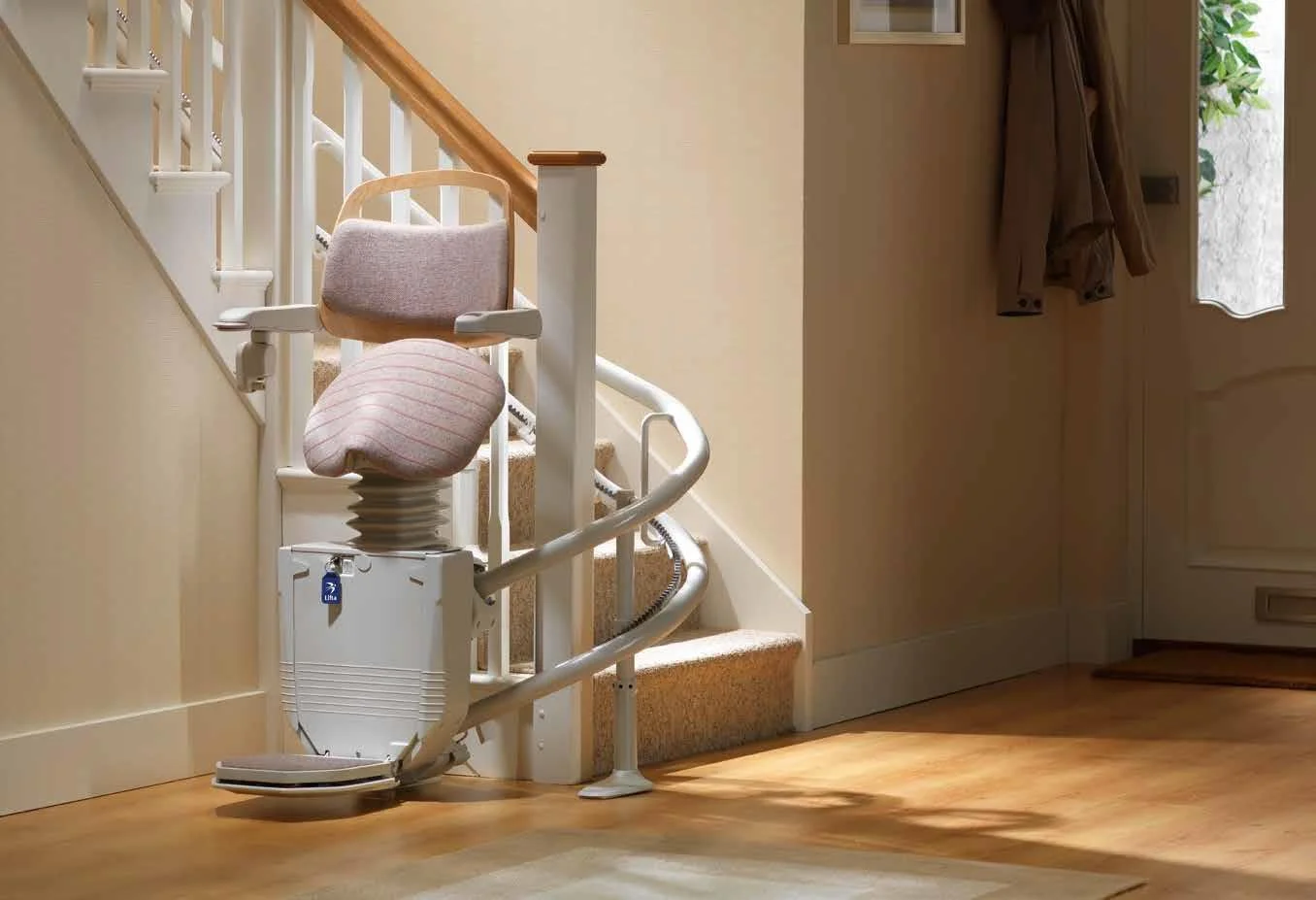
Older farmhouses here often have a steep, narrow stair to the basement or the second floor. If that stair runs in one straight line with no landing, a straight stair lift is usually the simplest and quickest install. If it turns a corner or has a landing partway up, a curved lift built to that stair is the usual answer.
The county's rolling, drainage-cut hills mean many houses sit on sloped lots, and builders often answered that with split-level or split-entry designs. Those homes usually have two short flights instead of one long one. Each flight can sometimes take its own straight lift, or one curved rail can run the whole route, depending on how the stairs line up.
Sloped lots can also put steps between the driveway and the door. For those, an outdoor stair lift made to handle Minnesota weather is worth looking at, since the stair you use every day may be outside rather than inside.
A fully rural county means longer drives between homes, contractors and inspectors. That can stretch the time between the first measurement visit, the install and any follow-up. Planning ahead helps, especially if a hospital discharge or a change in mobility is coming up.
A good first step is a home visit to measure the stair and check where power is available. With the measurements in hand, you can compare a straight or curved lift and line up funding before the install date.
The clearest route to stair lift funding here is the Minnesota HCBS disability waivers (CADI, BI and CAC), whose home accessibility modification service does cover stair lifts for enrolled people. If you are on one of those waivers, your waiver case manager or county case management agency is the place to start.
Other programs help with home repair or accessibility more generally but do not name stair lifts in the sources reviewed, so ask before you count on them. These include the Lakes and Pines Housing Rehabilitation Loan, USDA Section 504 repair loans and grants, and the VA SAH and SHA grants. Statewide options such as the Alternative Care (AC) Program and the Minnesota Housing Fix Up Loan (Accessibility Loan) are also worth asking about. The VA HISA grant specifically excludes stair glides.
For people enrolled in the CADI, BI or CAC Medicaid waivers, this service covers stair lifts as a home accessibility modification under the approved service plan. Work through your waiver case manager, and the phone listed for this service is (320) 253-0765.
Funds home and community-based services for Minnesotans age 65 and older who need a nursing-home level of care but choose to live at home. The source reviewed does not mention stair lifts, so ask your case manager whether a lift can be part of your plan.
The Area Agency on Aging for a 14-county region that includes Kanabec County, offering information, referral and care coordination rather than paying for modifications. The source does not mention stair lifts; the office is at 600 25th Ave. South, Suite 108, St. Cloud.
Financing for eligible low-income homeowners in a seven-county area that includes Kanabec, for basic permanent repairs that can include handicap accessibility improvements. Stair lifts are not specifically named; call (320) 679-1800 to check income limits and funding.
Loans up to $40,000 at a fixed 1% rate for 20 years, plus grants up to $10,000 for very-low-income homeowners age 62 and older who cannot repay a loan, in rural areas such as Kanabec County. Stair lifts are not named among covered repairs, so confirm before applying.
Provides up to $6,800 or $2,000 over a lifetime, depending on disability status, for medically necessary home changes for veterans. It does not cover stair lifts, since it excludes stair glides and porch lifts.
Grants for veterans with certain severe service-connected disabilities, up to $126,526 for SAH and $25,350 for SHA in FY2026. The source gives ramps and wider doorways as examples but does not name stair lifts, so ask the VA directly.
Older adults
600 25th Ave. South, Suite 108, St. Cloud, 56301
Veterans
18 North Vine Street, Mora, 55051
Often, yes. If the stair runs straight with no turns, a straight lift is usually the fit. If it turns or has a landing, a curved lift built to that stair is the usual choice, and a home measurement visit settles it.
It depends on how the two short flights line up. Sometimes each flight gets its own straight lift, and sometimes one curved rail runs the whole way. Measuring the stairs is the only way to know.
The Minnesota Elderly Waiver (EW) serves people 65 and older who need a nursing-home level of care and want to stay home, though its source does not mention stair lifts. The Central Minnesota Council on Aging can point you to local services.
The VA HISA grant specifically excludes stair glides. The SAH and SHA grants do not name stair lifts either way. Kanabec County Veterans Services at 18 North Vine Street in Mora, (320) 679-6380, can help you sort out which VA benefits apply.
Among the programs reviewed, the Minnesota HCBS disability waivers (CADI, BI and CAC) home accessibility modification service is the one confirmed to cover stair lifts. You need to be enrolled in one of those waivers and work through your case manager.
Kanabec County is fully rural, so drive times between homes, contractors and inspections can stretch the schedule. Booking the measurement visit early gives you more room to line up funding and an install date.
Tell us about the stairs in your home and we will explain which lift fits, what it costs and how installation works.
