Itasca County stretches across 2,928 square miles of Minnesota's Iron Range, with more than 1,400 lakes, the Mississippi River and Lake Winnibigoshish inside its borders. Homes here range from in-town houses in Grand Rapids and Coleraine to standalone rural places outside Bigfork and lakeshore cabins near Deer River. Each one puts its stairs in a different spot, and that shapes which stair lift will work.
About 77% of residents live in rural areas, so many homes are older properties rather than newer subdivision builds. Those houses often have owner-built additions, split-level layouts or basement stairs that were never planned with accessibility in mind. This page walks through what that means for a stair lift and where people in Itasca County can look for help paying for one.
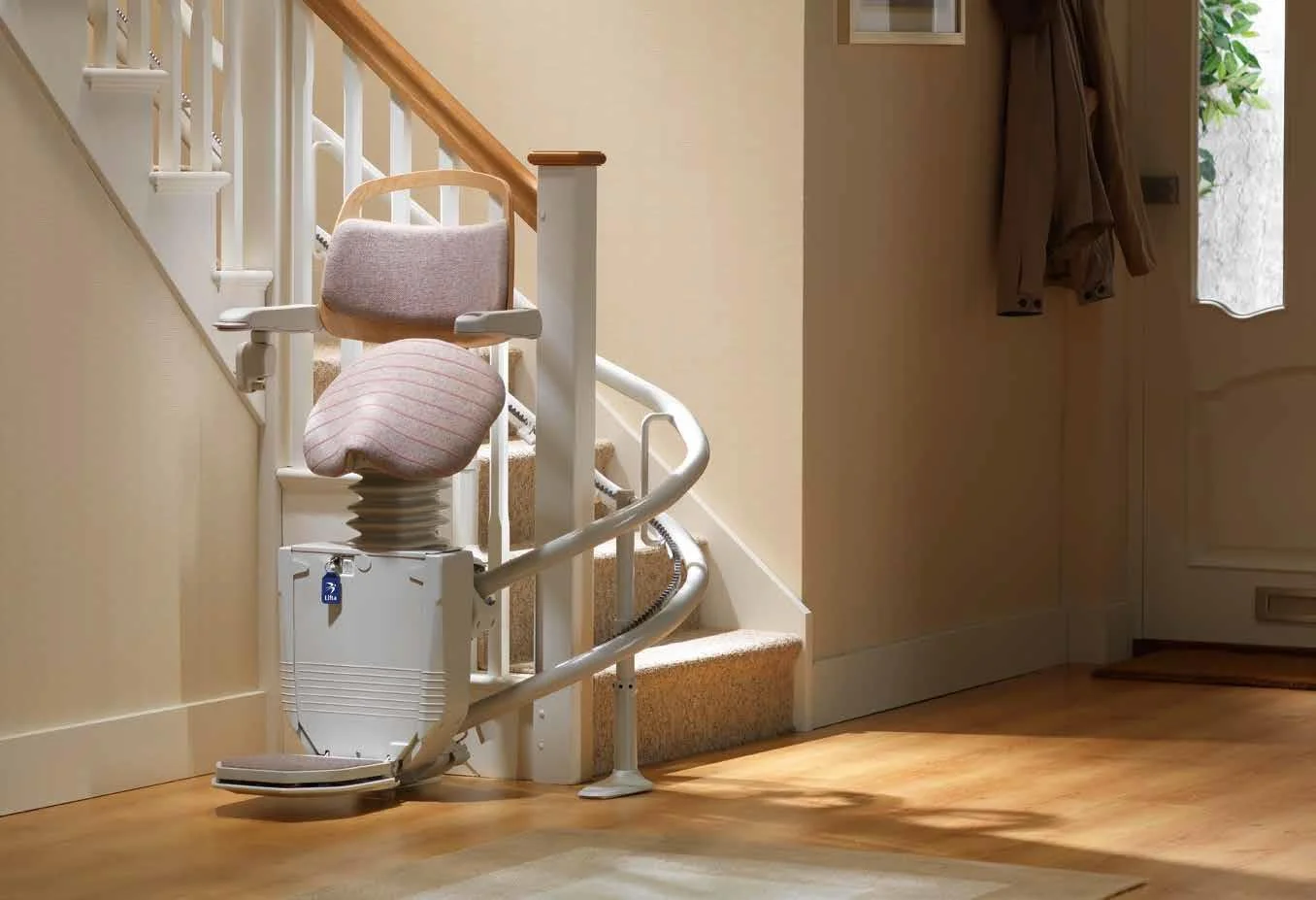
The common housing here includes single-family homes, detached houses, townhouses, walk-up apartments and split-level homes. A single straight flight, such as the main staircase in many Grand Rapids or Keewatin houses, usually fits a straight stair lift, which is the simplest to install.
Split-level homes are different. They often have two or more short flights, and if you need to ride more than one, a curved lift that follows the turns or separate straight units may be needed. We measure each run before recommending either.
Basement stairs in older rural homes deserve a close look. Steep, narrow or owner-built steps can still take a lift, but the rail mounting and clearance at the top and bottom have to be checked in person.
A notably high 25.2% of housing units in the county are recorded as vacant, which matches the large stock of seasonal lake cabins and cottages. Many of these sit on wooded, hilly lots where the path to the door or the dock involves exterior steps.
For those spots, an outdoor stair lift built for weather exposure is the usual answer. Where a wheelchair user needs to get up a short rise, a platform lift can be a better fit than a seat. Tell us how the property is used across the seasons, because that affects which option makes sense.
About 23.4% of Itasca County residents are 65 or older, and roughly 70.5% are homeowners. That combination means many people are aging in houses they own and would rather adapt than leave.
If someone in your family served, check the VA grants below before paying out of pocket, since the county veterans office in Grand Rapids can help with the application.
None of the sources for the programs below name stair lifts specifically, so the honest answer is that coverage has to be confirmed by phone. Several of them do list accessibility modifications as allowed work, which is a good sign worth asking about.
For lower-income homeowners, the Minnesota Housing Rehabilitation Loan Program and Emergency & Accessibility Loan Program offer up to $37,500 combined as a deferred loan. The Fix Up Loan Program's Accessibility Loan option has no income limit and ranges from $2,000 to $75,000.
People 60 and older can start with the Arrowhead Area Agency on Aging at (218) 722-5545. Those on Medical Assistance who meet level-of-care criteria should ask Itasca County Health & Human Services at (218) 327-2941 about Environmental Accessibility Adaptations under the Elderly Waiver or CADI, which IMCare administers locally.
Offers zero-interest loans with payment plans set per family for Itasca County homeowners, and lists accessibility modifications such as ramps among covered work; stair lifts are not specifically named. Call (218) 999-9001.
A regional funder and referral hub for adults 60 and older in the seven-county Arrowhead region, including Itasca; its pages do not list a direct stair lift or home-modification grant. Call (218) 722-5545 to ask about current partner-agency options.
Provides up to $126,526 (FY 2026) for veterans with qualifying service-connected disabilities who own or will own the home; ramps and widened doorways are given as examples, and stair lifts are not named. No phone is published, so apply via va.gov or a VA regional loan center.
Provides up to $25,350 (FY 2026) for veterans with certain qualifying disabilities when the veteran or a family member owns the home. The source does not list specific modification types, including stair lifts.
Helps adapt a family member's home where a veteran is temporarily living, up to $50,961 if SAH-eligible or $9,100 if SHA-eligible (FY 2026). Specific modification types, including stair lifts, are not named.
An advocacy and referral office, not a funding source, that helps Itasca County veterans and families obtain earned state and federal benefits, and the local starting point for VA housing grants. Call (218) 327-2858.
A deferred loan of up to $37,500 combined for low-income homeowners with assets under $25,000, forgiven if the home is not sold or transferred during the term; it covers accessibility needs for a household member with a disability, though stair lifts are not named. Call Minnesota Housing at (651) 296-7608 to find the agency serving Itasca County.
A fixed-rate loan from $2,000 to $75,000 over 1 to 20 years that lists accessibility improvements as an eligible use, with no income limit on the Accessibility Loan option; stair lifts are not specifically named. Loans go through a lender directory, and Minnesota Housing can be reached at (651) 296-7608.
For people on Medical Assistance who meet level-of-care criteria, these waivers offer environmental accessibility adaptations such as grab bars, bathroom changes, ramps and home repairs; stair lifts are not specifically named. In Itasca County the benefit is administered through IMCare.
The Grand Rapids office at 822 NE 5th Ave offers weatherization, energy assistance, emergency heating repair and housing services, and does not mention stair lifts or accessibility work. Call (218) 999-0800 to ask about any home-modification referral.
The county department that includes Adult Protection, the Developmental Disabilities Unit, the Housing Support Program and IMCare, which handles Elderly Waiver and CADI-type services locally; no stair lift benefit is itemized. Call (218) 327-2941.
Older adults
424 W. Superior Street, Suite 507, Duluth, 55802
Veterans
410 NE 2nd Avenue, Grand Rapids, 55744
The Arrowhead Area Agency on Aging serves adults 60 and older, but other programs have no age floor. The Minnesota Housing Fix Up Accessibility Loan is open to homeowners statewide with no income limit, and the CADI waiver serves adults with disabilities who qualify for Medical Assistance.
Outdoor stair lifts are made for exterior steps like those on hilly lakeshore lots. We look at the slope, the surface the rail would mount to and how the cabin is used through the year before recommending one.
Not always. If you only need to ride one flight, a straight lift may do. If the stairs turn or you need to ride both, a curved lift or two separate units are the usual choices, and we decide after measuring.
Medical Assistance and waiver benefits in Itasca County run through IMCare, the county-based health plan within Itasca County Health & Human Services. Call (218) 327-2941 and ask about Environmental Accessibility Adaptations.
The VA Temporary Residence Adaptation Grant is meant for veterans temporarily living in a family member's home, and the veteran does not have to own it. Start with the Itasca County Veterans Service Office at 410 NE 2nd Avenue in Grand Rapids, (218) 327-2858.
None of the program sources name stair lifts specifically. Several cover accessibility modifications in general, so call the program, describe the stair lift and ask directly before you sign anything.
Tell us about the stairs in your home and we will explain which lift fits, what it costs and how installation works.
