From Grand Marais up the Gunflint Trail and along the North Shore through Lutsen, Tofte, Schroeder, Hovland and Grand Portage, Cook County homes sit on land that rises off Lake Superior toward Eagle Mountain, at 2,301 feet the highest natural point in Minnesota. Many of the houses here are lake cabins, cottages and multi-level homes that were never built with aging in place in mind.
The county's median age is 53.1, and 27.2% of residents are 65 or older. If you or a parent are starting to dread the basement steps or the climb to a cabin loft, this page covers which kind of stair lift tends to fit local homes, what the winters mean for installation, and which programs may help with the cost.
Housing in Cook County runs from single-family homes and ranch-style houses to split-level homes, cabins and cottages. The Census counts the whole county as rural, and of the 5,936 housing units recorded in 2020, 54.3% were vacant, which mostly reflects seasonal cabins and vacation homes.
A straight staircase with no landing is the simplest and usually the least costly job. Split-level homes often have short runs between half floors, which can still take a straight lift if each run is handled on its own.
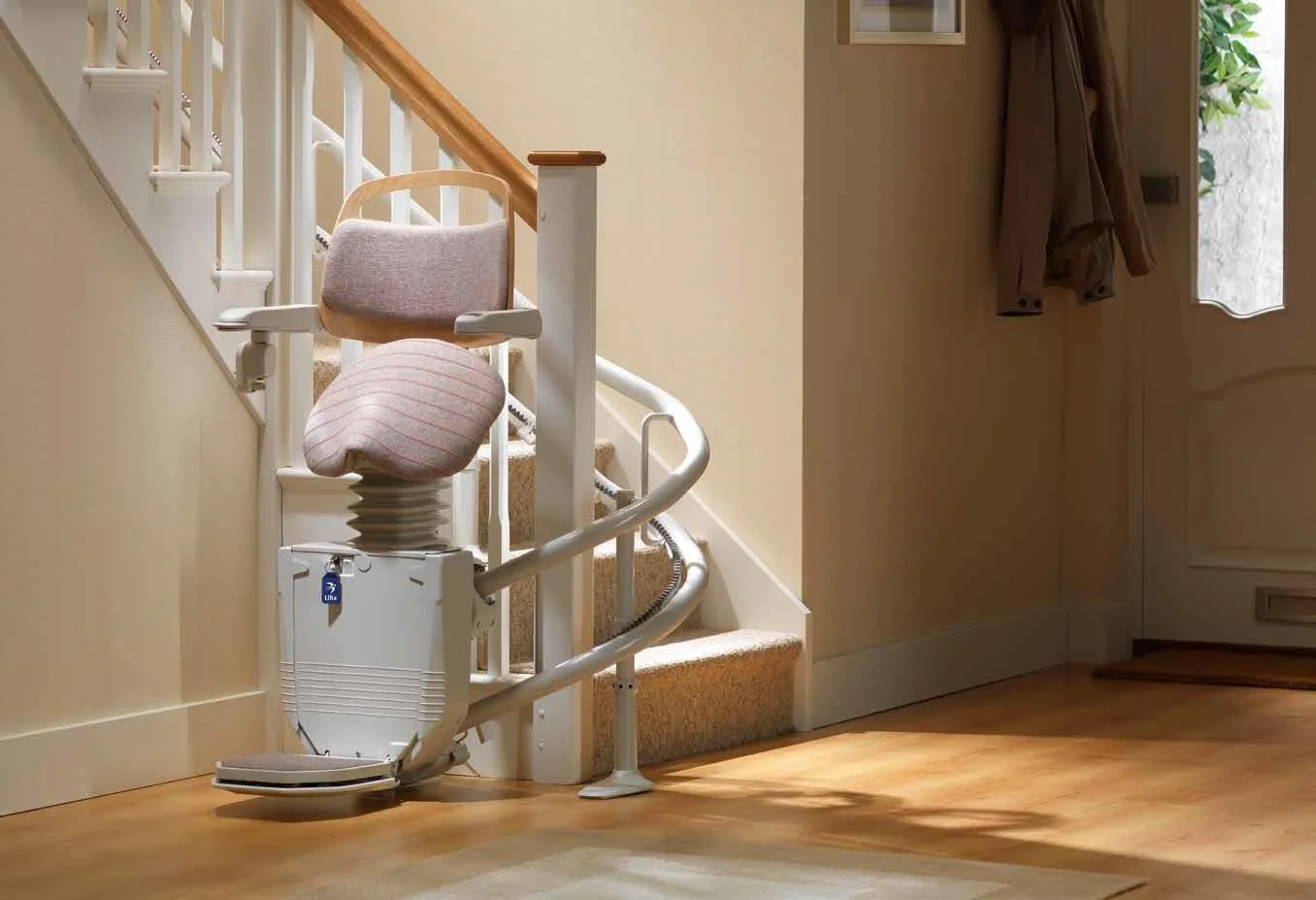
Older lake cabins are a different story. Stairs that turn, wind or stop at a landing usually need a curved lift built to the shape of that staircase, and narrow or steep cabin stairs need careful measuring before anyone can say what will fit.
Winters here are long. The average January high is 22 degrees F, the county sees roughly 116 days a year below freezing, and average snowfall is 50.8 inches.
That matters in two ways. Icy entry steps and decks are where a lot of risk sits, so some homeowners look at an outdoor lift or a platform lift for the way in, not just the stairs inside. Remote sites, long drives and winter roads can also make installation logistics harder and add to cost, so it helps to plan before the snow arrives.
A straight or curved chair lift suits someone who can still sit and stand with some help but struggles to climb. A platform lift is meant for a wheelchair or walker user who needs to stay in the chair from one level to the next.
With 71.3% of residents owning their homes, most people here can make a permanent change to their own stairs. Renters, or anyone sharing a family cabin, should get the owner's agreement before a lift is mounted.
No program in our list names stair lifts directly, so the honest approach is to ask each one whether a lift qualifies under its home modification or accessibility rules. The Minnesota Elderly Waiver lists home modifications as a covered service, and the Minnesota Housing Fix Up Loan has an accessibility option with no income limits.
For lower-income homeowners, AEOA and the Minnesota Housing Rehabilitation Loan Program offer repair loans, some of them forgivable. 2nd Street, Room #1600, Grand Marais, (218) 387-3639. The VA HISA grant does not pay for stair glides, but the SAH and SHA grants are worth asking about for severe service-connected disabilities.
If you are not sure where to begin, the Arrowhead AAA at 424 W. Superior Street, Suite 507, Duluth, (218) 722-5545, is the referral point for senior services in the region.
A Medicaid waiver for Minnesotans 65 and older who need a nursing facility level of care, with a 2026 income limit of $2,982/month and a $3,000 asset limit for a single applicant. Home modifications are a listed service but stair lifts are not itemized; Cook County residents apply through the county Long-Term Care Consultation office, and the Senior LinkAge Line is (800) 333-2433.
The regional aging agency for seven northeast Minnesota counties, including Cook, which contracts for meals, caregiver support, transportation and in-home services rather than giving cash grants. Stair lifts and home modification grants are not listed, but it is a good first call for local referrals at (218) 722-5545.
Income-qualified home repair loans for owners who have occupied their home 6+ months, including an MHFA Rehabilitation Loan up to $37,500, an MHFA Emergency Loan up to $27,000 and CDBG Single Family Rehab up to $30,000. The Emergency Loan lists ramp or bathroom modifications for accessibility, though stair lifts are not named; call (218) 735-6819.
A statewide loan of $2,000-$75,000 with terms of 1 to 20 years for owner-occupants, including an Accessibility loan option with no income limits. Stair lifts are not named in the source, so ask whether yours qualifies by calling Minnesota Housing at (651) 296-7608.
A forgivable loan up to $37,500 for low-income homeowners, forgiven if you do not sell, transfer title or stop living in the home during the term of up to 15 years. Stair lifts are not specifically mentioned; contact Minnesota Housing at (651) 296-7608.
A VA grant of up to $6,800 or $2,000 lifetime, depending on disability status, for medically necessary permanent changes such as ramps and roll-in showers. It does not cover stair glides or porch lifts; call (800) 827-1000.
Grants for veterans with qualifying severe service-connected disabilities, up to $126,526 for SAH and $25,350 for SHA in FY2026, used to build, buy or remodel a home for accessibility. Stair lifts are not specifically named; call (800) 827-1000 or Cook County Veterans Services at (218) 387-3639.
Older adults
424 W. Superior Street, Suite 507, Duluth, 55802
Veterans
411 W. 2nd Street, Room #1600, Grand Marais, 55604
Often yes, but stairs that turn or have a landing usually need a curved lift made to fit that exact staircase. Many older cabins in the county were not built with accessibility in mind, so an in-home measurement comes first.
They can. With an average January high of 22 degrees F and 50.8 inches of snow a year, outdoor steps take a beating, and remote sites and winter conditions can make installation harder and costlier. Planning before winter helps.
The HISA grant explicitly excludes stair glides and porch lifts. The SAH and SHA grants do not name stair lifts either way, so veterans with severe service-connected disabilities should ask Cook County Veterans Services at (218) 387-3639 or the VA at (800) 827-1000.
The Minnesota Housing Fix Up Loan has an Accessibility loan option that has no income limits. It is a loan, not a grant, with terms of 1 to 20 years; call (651) 296-7608.
The repair programs are built for people who live in the home. AEOA requires that you own and occupy it for 6+ months, and the Fix Up Loan is for owner-occupants, so a cabin used only part of the year may not qualify.
The Arrowhead AAA at (218) 722-5545 handles senior service referrals for Cook County. For the Elderly Waiver, the Senior LinkAge Line is (800) 333-2433.
Tell us about the stairs in your home and we will explain which lift fits, what it costs and how installation works.
