Ottawa County runs from the Lake Michigan shoreline at Grand Haven and Holland inland to Hudsonville, Jenison, Allendale and Coopersville. The Grand River cuts across the county, and Lake Macatawa and Spring Lake sit close to many of the lakeshore towns. That spread shows up in the houses: older two-story homes in the Dutch-settled core of Holland and Zeeland, newer subdivisions in the ring around Grand Rapids, and farmhouses out in the agricultural townships.
Each of those home styles puts stairs in a different place, and that decides what kind of lift makes sense. Below we walk through how Ottawa County homes and winters affect the choice, and which local and state programs may help with the cost.
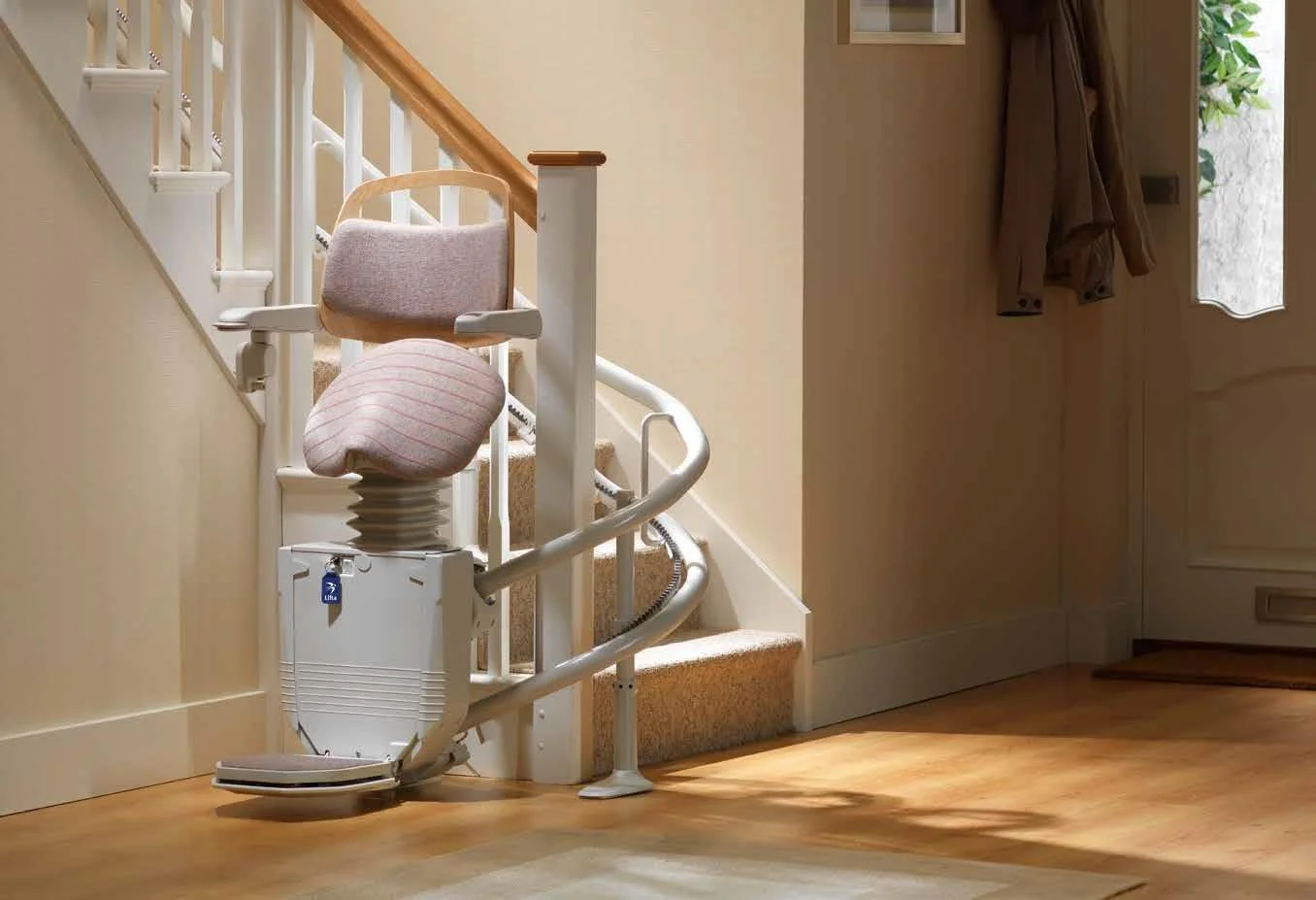
Many of the older homes in Holland and Zeeland were built with the bedrooms upstairs and a single interior staircase. When climbing that staircase gets hard, the usual options are moving to the first floor or adding a way up.
If the staircase runs in one straight line from bottom to top, a straight stair lift is often the simplest fit. Older stairs can have a turn, a landing or a narrow width, and in that case a curved lift built to the exact shape of the stairs is the usual answer. We measure before recommending either one.
Much of Hudsonville, Jenison and Coopersville was built out largely since the 1990s. Some of those homes are single-story, which may need no lift at all, while split-level homes have short flights between each level.
A split-level can mean two short runs instead of one long one, so the plan depends on which levels the person actually needs to reach every day. Townhouses often stack living space on several floors and may need a lift on more than one flight. For someone who uses a wheelchair and cannot transfer to a seat, a platform lift is the option to ask about.
Ottawa County has 24 miles of Lake Michigan shoreline, and the lakeshore brings lake-effect snow and icy winter conditions. Exterior steps and sloped approaches get slick, which raises fall risk for older residents coming and going.
If the front or back steps are the real problem, an outdoor stair lift built for weather exposure is worth discussing, along with railings or a ramp. Farmhouses in the rural townships often have porch steps that matter as much as the stairs inside.
Most seniors aging in place here own their homes rather than rent, which matters because many repair grants and loans are limited to owner-occupied homes.
Renters in walk-up apartments face a different situation. A permanent lift usually needs the building owner's approval, and several of the programs below would not apply.
Ottawa County is one of the wealthier counties in Michigan, with a median household income of about $90,502. That means some seniors will be over the income limits for low-income programs and will pay out of pocket, while others may qualify for Medicaid through the MI Choice Waiver or for VA benefits.
MI Choice is the one program in our list whose source names stair lifts as a covered modification. The local access point is the AAA of Western Michigan (Region 8) at 1279 Cedar St. NE in Grand Rapids, (616) 456-5664. Confirm the number and your covered modifications directly with the agency before planning around it.
Veterans can start with Ottawa County Veterans Services at 12251 James Street, Suite 300, Holland, (616) 393-8387. Statewide options also include MI Coordinated Health (formerly MI Health Link), the MSHDA Property Improvement Program (PIP) and VA Benefits for Veterans (HISA + Prosthetics).
A Medicaid waiver for adults who need a nursing-home level of care but want to stay home and who meet Michigan Medicaid income and asset limits. Its source lists stair lifts as a covered home modification, with budgets set individually; the Area Agency on Aging of West Michigan is the local access point.
The regional intake and referral agency for adults 60 and older and adults with disabilities, including access to the MI Choice Waiver. The source does not mention stair lifts as something it funds directly.
A federal grant of up to $126,526 (FY2026) for veterans who own or will own the home and have certain severe service-connected disabilities, with a TRA option up to $50,961. The source describes adaptations in general terms and does not mention stair lifts by name.
A federal grant of up to $25,350 (FY2026), with a TRA option up to $9,100, for veterans with qualifying service-connected disabilities such as loss of use of both hands. The source does not mention stair lifts by name.
Loans up to $40,000 at 1% for 20 years, and grants up to $10,000 for homeowners 62 and older, in USDA-designated rural areas for very-low-income households. The source does not mention stair lifts; call (517) 324-5210 to check whether your address qualifies.
A county home-repair program for Ottawa County residents who own and live in a single-family home, at no cost to qualifying homeowners. It is described as covering critical repairs such as roofing, furnaces, plumbing and septic, and the source does not mention stair lifts.
A nonprofit repair program centered on the Holland and Zeeland area for owner-occupied homes at or below 80% of area median income, such as $63,680 for one person or $90,960 for four. It lists ramps, railings and grab bars but does not mention stair lifts; call (616) 393-8001.
A free Center for Independent Living for Ottawa and Allegan County residents with disabilities, offering advocacy, information and referral, and nursing-home transition help. The source does not mention stair lifts; call (616) 396-5326.
Older adults
1279 Cedar St. NE, Grand Rapids, 49503
Veterans
12251 James Street, Suite 300, Holland, 49424
Possibly, through the MI Choice Waiver, whose source lists stair lifts as a covered modification. You need a nursing-home level of care and must meet Michigan Medicaid financial limits. Start with the AAA of Western Michigan (Region 8) at (616) 456-5664.
The USDA Section 504 grant requires age 62 or older, but the loan portion does not list that age rule. MI Choice is based on care needs and Medicaid eligibility, and the AAAWM serves adults 60 and older plus adults with disabilities.
Only USDA-designated rural areas qualify, and denser areas like central Holland and Grand Haven may fall outside that map. Eligibility is checked address by address, so call (517) 324-5210 to confirm.
Most of the repair programs listed here, including USDA Section 504, the county Home Rehabilitation Program and Lakeshore Habitat for Humanity, require an owner-occupied home. MI Choice and Disability Network Lakeshore are not limited to homeowners in the information we have.
Call Ottawa County Veterans Services in Holland at (616) 393-8387. They can help with VA options such as the SAH and SHA grants, which require qualifying service-connected disabilities and home ownership.
Yes, outdoor stair lifts are made for exposed steps. With lake-effect snow and ice along the lakeshore, outdoor steps are often where falls happen, so we look at exterior stairs during the home visit too.
Tell us about the stairs in your home and we will explain which lift fits, what it costs and how installation works.
