From Lewiston and Hillman to Atlanta and Canada Creek Ranch, Montmorency County is spread across 563 square miles of state forest, jack pine barrens and lakes in Michigan's northern Lower Peninsula. The whole county is classified by the Census as rural, and most homes here are older single-family houses, ranch-style homes and split-levels owned by the people living in them.
Those homes were rarely built with aging in place in mind. If a parent is starting to struggle with the basement steps, the stairs to a bedroom or the steps up to the front door, a stair lift can often be added to the house as it stands. This page walks through what fits local homes and which county, regional and state programs may help with the cost.
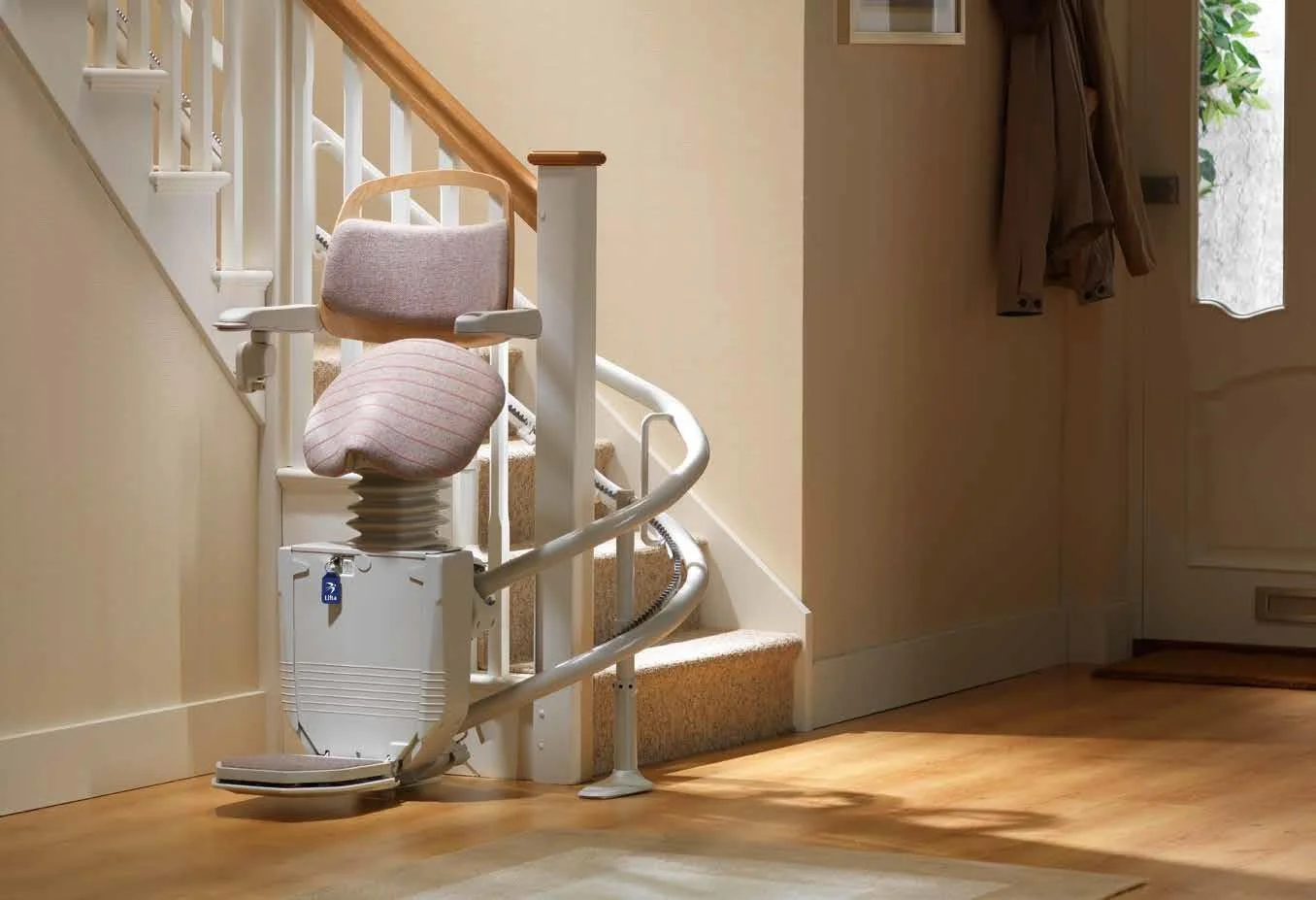
A single-family home with one straight flight between floors is the simplest case. A straight rail runs along the stairs, mounts to the treads rather than the wall, and is usually the lowest-cost option.
Ranch-style homes often keep everything on one floor, but the stairs to a basement laundry or workshop can still become a daily problem. Split-level homes are a different challenge, with short flights between levels and sometimes a turn or landing. Turns and landings usually call for a curved rail built to the exact shape of the staircase.
When the trouble is getting into the house, an outdoor lift on the entry steps is one option. For someone who uses a wheelchair and cannot transfer to a seat, a platform lift may be the better fit.
The median age in Montmorency County is 56.6, and 33.1% of residents are 65 or older. That is a large share of households where stairs can turn from routine into risk.
Atlanta is the county seat, and the rural layout means longer trips to medical providers and equipment installers than in more urban parts of Michigan. It is worth planning ahead: measure the stairs, settle on funding and schedule the install before a fall forces a rushed decision.
Over half of the county's housing units (51.6%) are recorded as vacant, which in practice includes many seasonal places. If the home with the stairs is a part-year house, mention that when we talk, since it affects how and where a lift is used.
Two programs on the list below name home or accessibility modifications directly. The Michigan Assistive Technology Loan Program (MATP) lends up to $30,000 for home modifications, with repayment terms up to 7 years. Habitat for Humanity Northeast Michigan lists accessibility and aging-in-place modifications for owner-occupied homes in Montmorency County.
The MI Choice Medicaid Waiver and NEMCSA's in-home services focus on care at home and do not name stair lifts, so ask directly before counting on them. The Montmorency County Commission on Aging is a good first call for referrals, and it runs a medical equipment loan closet.
Veterans should know that the VA HISA grant specifically excludes stair glides. Statewide, the MSHDA Property Improvement Program (PIP) and MI Coordinated Health are also worth asking about. The Montmorency County Veterans Service Office in Atlanta can be reached at (989) 785-8043, and the Northeast Michigan Community Service Agency AAA office in Alpena at (989) 356-3474.
A Medicaid waiver for adults 18 and older who meet nursing-facility level of care and want to stay at home, run in this county through NEMCSA. Stair lifts are not listed in the source, so call (800) 219-2273 to ask.
In-home help with bathing, dressing, meals and housekeeping, plus a donation-based Nutrition Program for adults 60 and older. Stair lifts and home modification funding are not listed; the number is (800) 219-2273.
A low-interest loan of up to $30,000 for Michigan residents with a disability or seniors who need assistive technology, with home modifications listed as eligible and terms up to 7 years. Call (989) 356-4600.
Need-based repairs for owner-occupied homes in Montmorency and nearby counties, including accessibility and aging-in-place modifications; owners must be current on mortgage and property taxes. Call (989) 354-5555.
A coordination point for county seniors that offers help with home remodeling and repair and a medical equipment loan closet. Stair lifts are not listed; call (989) 785-2580.
A lifetime VA grant of up to $6,800 or $2,000 for medically necessary structural changes to a veteran's home. It does not cover stair lifts, as stair glides are specifically excluded.
VA grants for veterans with certain severe service-connected disabilities, up to $126,526 for SAH and $25,350 for SHA (FY2026). Stair lifts are not mentioned in the source; the county veterans office at (989) 785-8043 can help with questions.
Older adults
2375 Gordon Rd., Alpena, 49707
Veterans
12265 M‑32, Atlanta, 49709
Usually, yes. Short straight flights take a straight rail, while stairs with a turn or landing need a curved rail made for that staircase. We measure each flight to see which applies.
Not through the HISA grant, which excludes stair glides. The SAH and SHA grants do not mention stair lifts in the source, so a veteran should ask the Montmorency County Veterans Service Office at (989) 785-8043.
The Michigan Assistive Technology Loan Program (MATP) lists home modifications as eligible, with loans up to $30,000 and repayment up to 7 years. The rate is fixed and based on credit score. Call (989) 356-4600.
Its Critical Home Repair Program serves owner-occupied homes in Montmorency County and lists accessibility and aging-in-place modifications. You must be current on mortgage and property taxes and show financial need. Call (989) 354-5555.
The Montmorency County Commission on Aging at (989) 785-2580 handles referrals and runs a medical equipment loan closet. The regional NEMCSA aging office in Alpena is at (989) 356-3474.
Tell us about the stairs in your home and we will explain which lift fits, what it costs and how installation works.
