Drive through Midland and you see the work of Alden B. Dow and the architects he inspired, including Jackson Hallett, Glenn Beach, Robert Schwartz and Francis Warner. Their Mid-Century Modern buildings dominate the city, from the Midland Center for the Arts to the Grace A. Dow Memorial Library, and that style carried into the postwar houses on larger, tree-shaded lots.
Those homes, along with the houses in Coleman and Sanford, often come with raised entries, split-level layouts or full second stories. This page explains how those layouts affect a stair lift choice, what Michigan winters mean for outside steps, and which local and statewide programs are worth a phone call.
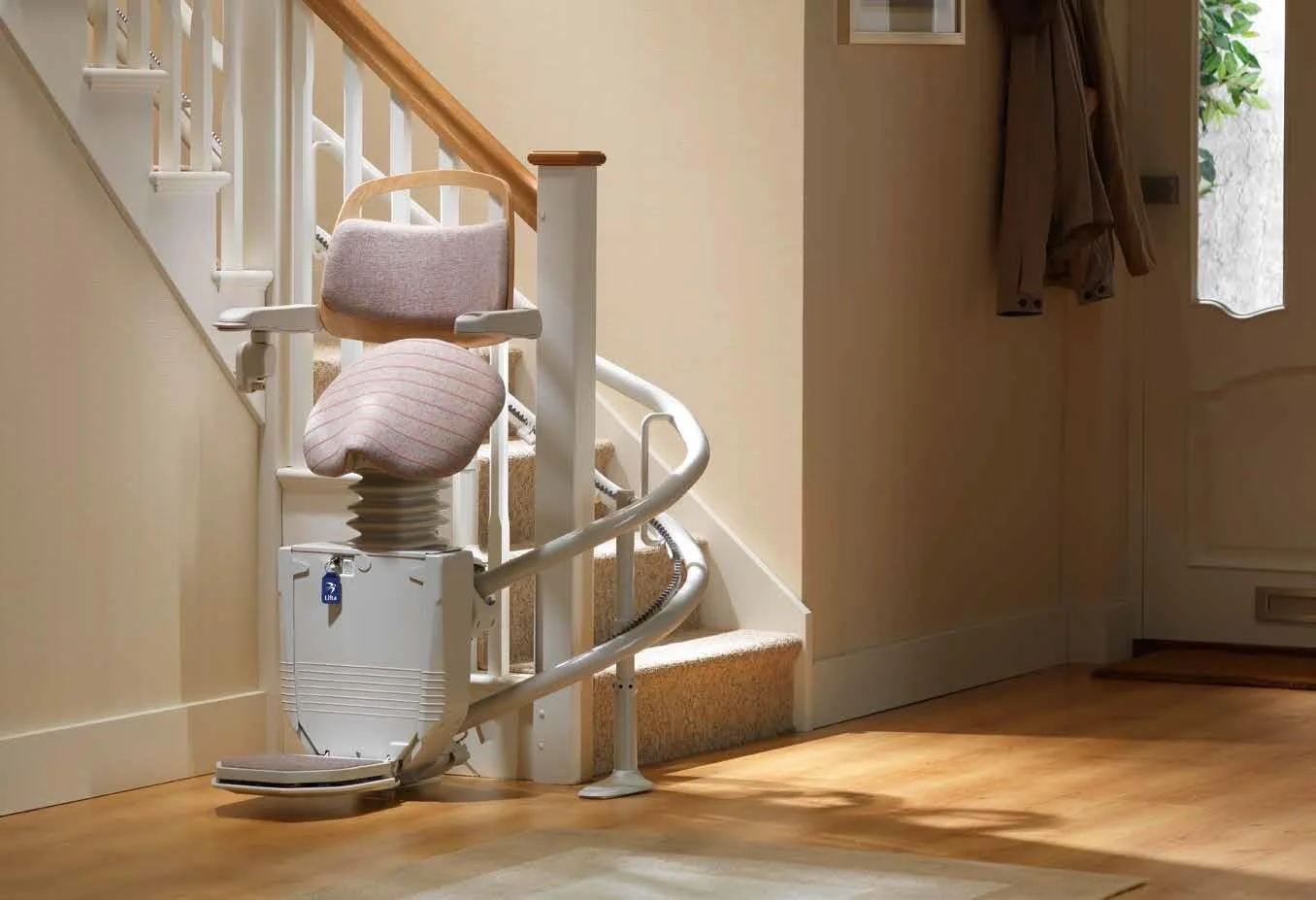
A split-level home usually has several short runs of stairs instead of one long flight. Each short run can take its own straight stair lift, or a single curved lift can follow a run that turns at a landing. Which one fits depends on whether you need to reach every level or only the bedroom floor.
Mid-century houses with a full second story often have one straight flight, which is the simplest and quickest kind of lift to install. Open or floating stair designs, common in modern-style homes, need a closer look at where the rail can be mounted before anything is ordered.
Midland County averages 31.4 inches of snow a year, and winter highs hover around freezing. The record low is -19 degrees F. Raised front entries and porch steps become a fall risk every winter for older homeowners.
An outdoor stair lift is built with weather-resistant parts for exactly this kind of entry. Where the steps are few but a wheelchair is involved, a platform lift may make more sense than a seat. It helps to look at the outside approach and the inside stairs together during the same visit.
Not every home here is a detached house. Townhouses and walk-up apartments also appear in the county, and their stairs are often narrow or shared. A slim straight lift with a folding seat and rail can leave room for others to pass.
If you rent, the landlord has to agree before a lift goes in. Some local safety programs also require either homeownership or landlord permission, so it is worth asking early.
About 20.1% of county residents are 65 or older, and 66.9% are homeowners. Many people have lived in the same house for a long time and would rather adapt it than move.
For them, VA benefits and the Midland County Veteran Affairs office at 220 W Ellsworth St, Room 105, Midland, (989) 832-6843, are a good first stop.
None of the programs below names stair lifts outright, and one VA benefit excludes them. Still, several pay for home safety and accessibility work, and a caseworker can tell you what applies to your situation.
For older adults who need help with daily activities, the MI Choice Medicaid Waiver Program lists Environmental Accessibility Adaptations and Assistive Technology among its services. Locally, the Senior Safety Team and Home Ramp Up handle stair, handrail and entry safety at no cost to the homeowner. Veterans should ask about VA Specially Adapted Housing and Special Home Adaptation grants. Statewide, you can also ask about MI Coordinated Health (formerly MI Health Link) and the MSHDA Property Improvement Program (PIP).
A Medicaid waiver for people 65 and older, or 18 and older with a disability, who would qualify for nursing-home care, with income no greater than $2,982 a month gross and assets no greater than $9,950 for a single person. Its services include Environmental Accessibility Adaptations and Assistive Technology, though stair lifts are not listed by name; call Region VII Area Agency on Aging at (800) 858-1637.
An information and referral hub for older adults and caregivers that connects people to programs helping them stay in their homes. It is not an equipment fund and stair lifts are not listed; call (800) 858-1637.
A lifetime VA benefit of $6,800 for service-connected disabilities and $2,000 for other qualifying disabilities, arranged through the local VA Prosthetic and Sensory Aids Service. It does not cover stair lifts, since stair glides and porch lifts are explicitly excluded.
Grants for veterans with qualifying severe service-connected disabilities to modify a permanent home, with FY2026 caps of $126,526 for SAH and $25,350 for SHA. The VA gives ramps and wider doorways as examples; stair lifts are not listed by name.
Free labor and parts for Midland County seniors who own their home or have landlord permission, including securing stairs and handrails, grab bars and anti-slip surfaces. Stair lifts are not listed, and snow removal is excluded; call (989) 633-3742.
Program-funded safety work for adults 62 and older, including safer ramps or steps, grab bars and handrails, with no cost to the person served. Stair lifts are not listed by name; the Midland office is at (989) 832-7377.
Older adults
708 Root Street, Flint, 48503
Veterans
220 W Ellsworth St, Room 105, Midland, 48640
Usually, yes. Short runs can each take a straight lift, and a run that turns at a landing can take a curved lift. The right setup depends on which levels you need to reach.
Outdoor stair lifts are made for exposed entries, which matters in a county that averages 31.4 inches of snow a year. For a wheelchair user, a platform lift may be the better fit.
Home Ramp Up serves adults 62 and older. The MI Choice Medicaid Waiver Program also serves adults 18 and older who have been determined disabled and meet its other requirements.
The HISA benefit explicitly excludes stair glides. The SAH and SHA grants cover home modifications but do not name stair lifts, so ask Midland County Veteran Affairs at (989) 832-6843 about your case.
They secure stairs and handrails for Midland County seniors at no charge for labor and parts. They do not list stair lifts, and they do not do snow removal, plumbing or electrical work. Call (989) 633-3742.
You will need your landlord's permission. The Senior Safety Team also accepts renters who have landlord permission.
Tell us about the stairs in your home and we will explain which lift fits, what it costs and how installation works.
