Bay City's older neighborhoods were built on lumber money. The Center Avenue Historic District alone holds more than 250 buildings on the National Register, many of them houses from the late-19th-century lumber boom, and a lot of those homes have bedrooms and the main bath upstairs.
Across the rest of Bay County, in Essexville, Auburn and Pinconning, you'll find single-family homes, detached houses, duplexes, townhouses and low-rise buildings. This page walks through how those homes tend to work with a stair lift, and which local and statewide programs are worth a phone call before you pay out of pocket.
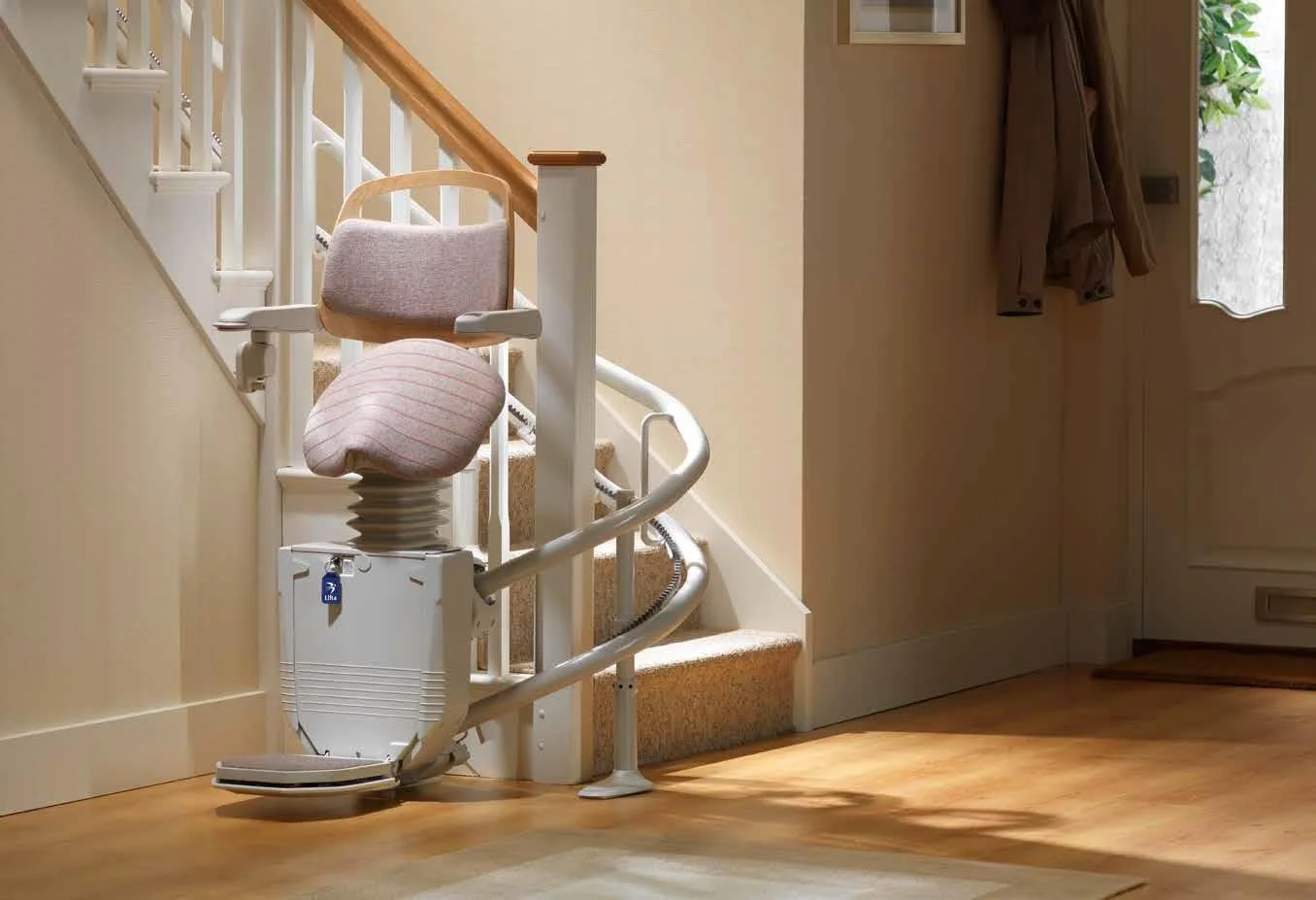
The mansions built with lumber, milling and shipbuilding money are typically two or three stories with a full staircase to the upper floor. When the bedrooms are up there, a rail on the stairs usually makes more sense than trying to convert a downstairs room.
Grand staircases in these homes often turn at a landing or curve partway up. Those need a curved rail made to fit that exact staircase, so we measure on site before quoting. A plain straight run between floors can take a standard straight rail, which is simpler and quicker to install.
Duplexes and townhouses often have a single straight flight between floors, which is the easiest layout for a stair lift. In low-rise buildings, check with the owner or association before any work is done on shared stairways.
Steps outside matter too. If the trouble starts at the porch or entry steps, an outdoor-rated lift or a vertical platform lift may be the better fit than an indoor rail. We look at both the inside and outside stairs during a visit.
Per the 2020 Census figures for Bay County, 21.2% of residents are 65 or older, and 14.4% of residents are 65 or older and living alone. For someone alone in a two-story house, a stair lift can be the difference between using the whole home and living on one floor.
The same figures show 76.4% of occupied homes are owner-occupied and only 7.3% of housing units sit vacant. Most people here own the house they want to stay in, which makes a permanent install like a stair lift a practical choice.
The strongest lead for Medicaid-eligible adults is the MI Choice Waiver, which covers home modifications and approves each one individually. Region 7 Area Agency on Aging handles it locally from 1615 S Euclid Ave in Bay City.
Veterans should know the VA's HISA grant specifically excludes stair glides, so it won't pay for a stair lift itself. The larger VA SAH and SHA grants don't name stair lifts either, so ask directly. The local Department of Veteran Affairs office at 515 Center Avenue, Ste. 103, Bay City, can be reached at (989) 895-4108.
Statewide, the MSHDA Property Improvement Program (PIP) and MI Coordinated Health (formerly MI Health Link) are also worth asking about. Details for each local program are listed below.
A Medicaid home and community-based program for Michigan residents 18 and older who need nursing-facility level of care, with monthly gross income up to $2,982 and countable assets up to $9,950. It covers stair lifts as a home modification, approved case by case with no published flat cap; call Region 7 Area Agency on Aging at (989) 893-4506.
Information and referral for adults 60 and older and adults with disabilities in Bay County, and the local link to MI Choice Waiver services. Its own page does not list stair lifts; call (989) 893-4506 or 1-800-858-1637.
A lifetime grant of $6,800 or $2,000, depending on disability status, for veterans with a VA physician's prescription showing medical necessity. It does not cover stair lifts, since stair glides are explicitly excluded; call (800) 827-1000.
Grants of up to $126,526 (SAH) or $25,350 (SHA) for veterans with a permanent and total qualifying service-connected disability who own or will own the home. The source does not mention stair lifts specifically; call (800) 827-1000 to ask.
A Center for Independent Living serving Bay County residents with disabilities of any age, offering accessibility reviews. Stair lifts are not listed among its services; call (989) 835-4041.
A statewide device-loan and low-interest loan program for Michigan residents with a disability or older adults who need assistive technology. Stair lifts and home modifications are not listed and no loan cap is published, so treat it as a lead and call (800) 578-0280 or Michigan Relay 711.
Older adults
708 Root Street, Flint, 48503
Veterans
515 Center Avenue, Ste. 103, Bay City, 48708-5941
Usually, yes. Many of these lumber-era homes have a full staircase to the upper floor, and if it turns or curves, a custom curved rail is made to fit it. We measure the staircase in person before giving a quote.
The MI Choice Waiver covers home modifications, including stair lifts, approved individually. You need nursing-facility level of care, income up to $2,982 a month and assets up to $9,950. Call Region 7 Area Agency on Aging at (989) 893-4506.
No. The VA excludes stair glides from HISA coverage. Ask about the SAH and SHA grants at (800) 827-1000, or visit the Department of Veteran Affairs office at 515 Center Avenue, Ste. 103, Bay City.
Yes, possibly. MI Choice is open to adults 18 and older who meet its requirements, and Disability Network Mid-Michigan serves people with disabilities of any age at (989) 835-4041.
Region 7 Area Agency on Aging is a good first call at (989) 893-4506. It handles MI Choice locally and can point you to other services.
Tell us about the stairs in your home and we will explain which lift fits, what it costs and how installation works.
