In Terre Haute's older core neighborhoods, many houses are multi-story, and the original interior staircase is still the only way to the bedrooms. Those are the homes where we most often fit a stair lift in Vigo County. Out in places like Seelyville, Riley, Prairieton and New Goshen, the mix shifts toward newer single-story ranch and suburban construction, but split-level homes and townhouses still put a few steps between rooms.
We install across all 12 towns in the county, from North Terre Haute and West Terre Haute to St. Mary of the Woods, Tecumseh, Lewis, Lakewood and Prairie Creek. This page walks through what your type of house usually needs, and which local offices and programs to call about paying for it.
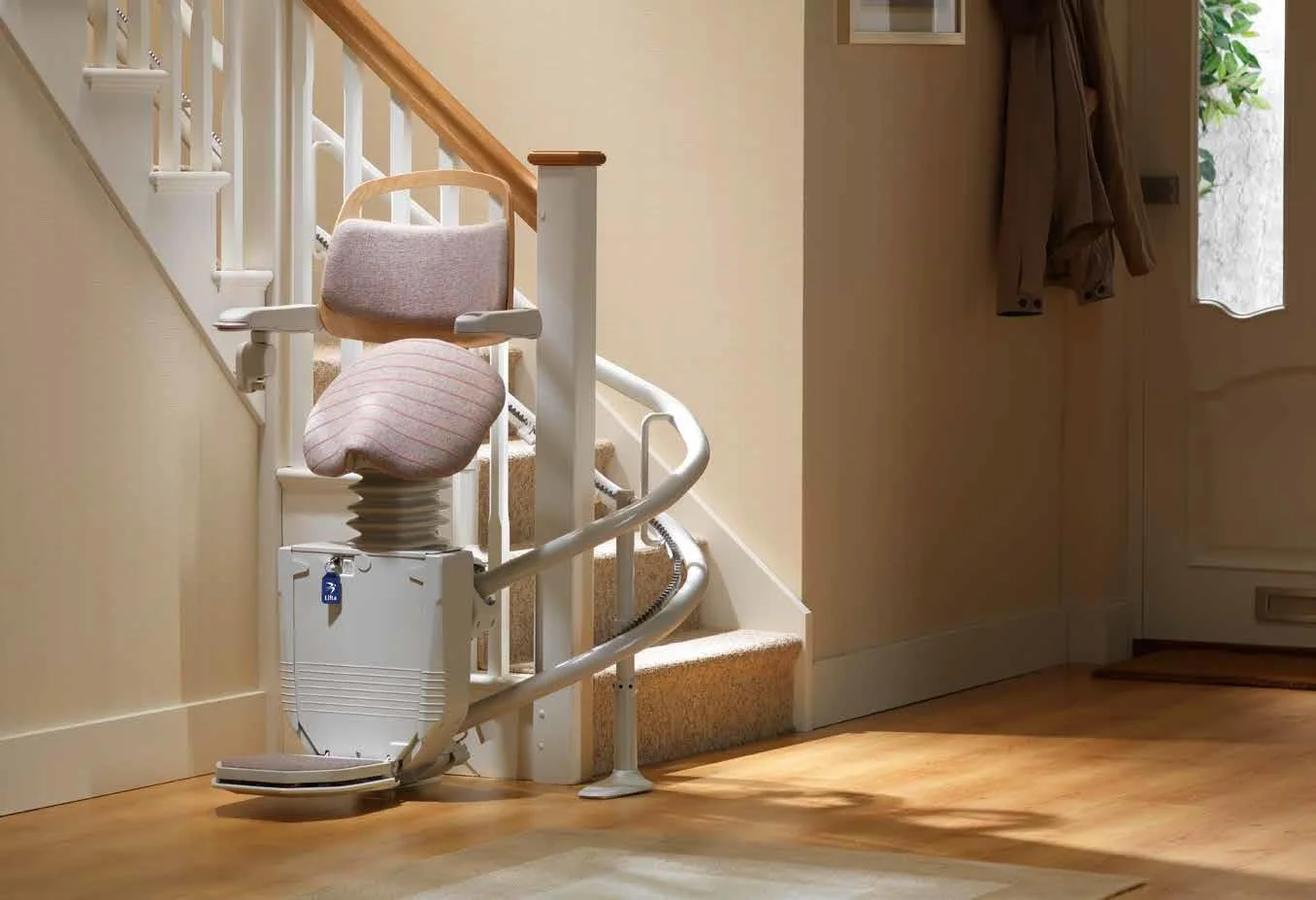
A multi-story house with its original staircase is the classic stair lift job. If the staircase runs in one straight flight, a straight rail mounts to the stair treads, not the wall, so plaster and trim stay as they are.
Older staircases often turn at a landing or wind partway up. Those need a curved rail built to the exact shape of your stairs, which takes a site measurement and more lead time than a straight unit. We look at the stairs in person before quoting either type.
Split-level homes have short runs of steps between each level. Sometimes one short straight lift on the run used most each day solves the problem, and sometimes a second run matters too. We sort that out by watching how you actually move through the house.
Townhouses usually have a single interior flight, which often suits a straight lift. In a walk-up apartment, the stairs may be shared or outside the unit, so the building owner has to be part of the conversation before anything is installed. Where steps are outdoors, an outdoor-rated lift or a platform lift may be the better fit.
Vigo County sits on Indiana's western border along the Wabash River, and its highest point, Sanford Hill, reaches only 680 feet. Per the 2020 census, 75.2% of residents live in urban areas, mostly in and around Terre Haute, while 24.8% live in rural areas spread across the outlying communities.
That rural share matters when you are arranging help. A home visit, an assessment from the Area Agency on Aging, and the install itself all have to reach houses well outside the city, and we schedule around that.
About 16.7% of Vigo County residents are 65 or older, and 56.0% of households own their home. Ownership matters because most funding sources, and most landlords, treat a stair lift differently in a rented home.
If that includes your parent, start with the Vigo County Veteran's Assistance Office at (812) 462-3261, 163 Oak Street, Vigo County Annex, Terre Haute. Be aware that the VA HISA grant does not pay for stair lifts, though it can cover other permanent changes.
Many families pay privately, but it is worth checking assistance first. The most direct starting point is Thrive West Central, the Area Agency on Aging for Vigo County, at (812) 238-1561, 2800 Poplar St., Suite 9A, Terre Haute. They handle the screening for Indiana's Medicaid waivers, which list home modifications as a covered category, though the state's pages do not name stair lifts specifically.
Other options to ask about include the USDA Section 504 repair loans and grants for rural homeowners, The WILL Center, and Wabash Valley Habitat for Humanity. Statewide, also ask about the CHOICE Program (Community and Home Options to Institutional Care for the Elderly and Disabled) and the INDATA Alternative Financing Program (AFP). None of the sources we reviewed confirms stair lift coverage, so confirm before you count on any of them.
Indiana's Medicaid home and community waiver for people 60 and older who meet nursing-facility level of care; home modifications and home modification assessments are covered categories, but stair lifts are not named. Apply through Thrive West Central at (812) 238-1561.
Covers aged, blind or disabled people under 60 who meet nursing-facility level of care and income up to 300% of the SSI federal benefit rate; home modifications are listed, but stair lifts are not itemized. Start with (812) 238-1561, plus a separate Medicaid application.
The local intake, screening and referral point for aging and disability services in Vigo and nearby counties, including the level-of-care screening for the Medicaid waivers; it is not a cash grant and stair lifts are not listed. Call (812) 238-1561.
Offers loans up to $40,000 at 1% for up to 20 years, and grants up to $10,000 lifetime for very-low-income homeowners 62 and older in USDA-eligible rural areas. Stair lifts are not named as an eligible repair, so coverage is unconfirmed.
Pays up to $6,800 or $2,000 lifetime, depending on disability status, for permanent changes like ramps and roll-in showers, but it explicitly excludes stair glides. Call (812) 478-1825.
A free Center for Independent Living in Terre Haute offering advocacy, referral, skills training and a wheelchair-ramp construction program; it does not list stair lift funding. Call (812) 298-9455 to ask about current referral options.
Builds or repairs homes with qualified low-income families in Terre Haute and the Wabash Valley; its page does not list a stair lift or accessibility program. Call (812) 232-9200 to ask whether repair help applies.
Older adults
2800 Poplar St., Suite 9A, Terre Haute, 47803
Veterans
163 Oak Street, Vigo County Annex, Terre Haute, 47807
Thrive West Central at (812) 238-1561. As the Area Agency on Aging for Vigo County, it does the screening for the PathWays for Aging and Health and Wellness waivers and can point you to other local services.
The Indiana Health and Wellness Waiver serves aged, blind or disabled people under 60 who meet nursing-facility level of care and the 300% SSI income standard. It lists home modifications but does not name stair lifts, so ask the case manager.
Not through HISA, which excludes stair glides as removable equipment. The Vigo County Veteran's Assistance Office at (812) 462-3261 can talk through other VA benefits, and HISA questions go to (812) 478-1825.
The USDA Section 504 program serves very-low-income homeowners in USDA-eligible rural areas, with grants up to $10,000 for those 62 and older. It does not specifically name stair lifts, so confirm before applying.
Usually, yes. Staircases with a landing or a turn take a curved rail built to the shape of your stairs, so we measure on site first.
Tell us about the stairs in your home and we will explain which lift fits, what it costs and how installation works.
