Scott County has two towns, Scottsburg and Austin, and a lot of open ground in between. According to the 2020 Census, 68.9% of residents live in rural areas, so many of the homes we visit are farmhouses and older rural houses on township roads rather than houses on in-town blocks in Scottsburg.
That spread matters when you plan a stair lift. The layout of the house, the condition of older stairs and the drive out to a property all shape what gets installed and what it takes to get it done. This page walks through how local homes fit different lift types and which programs can help pay for one.
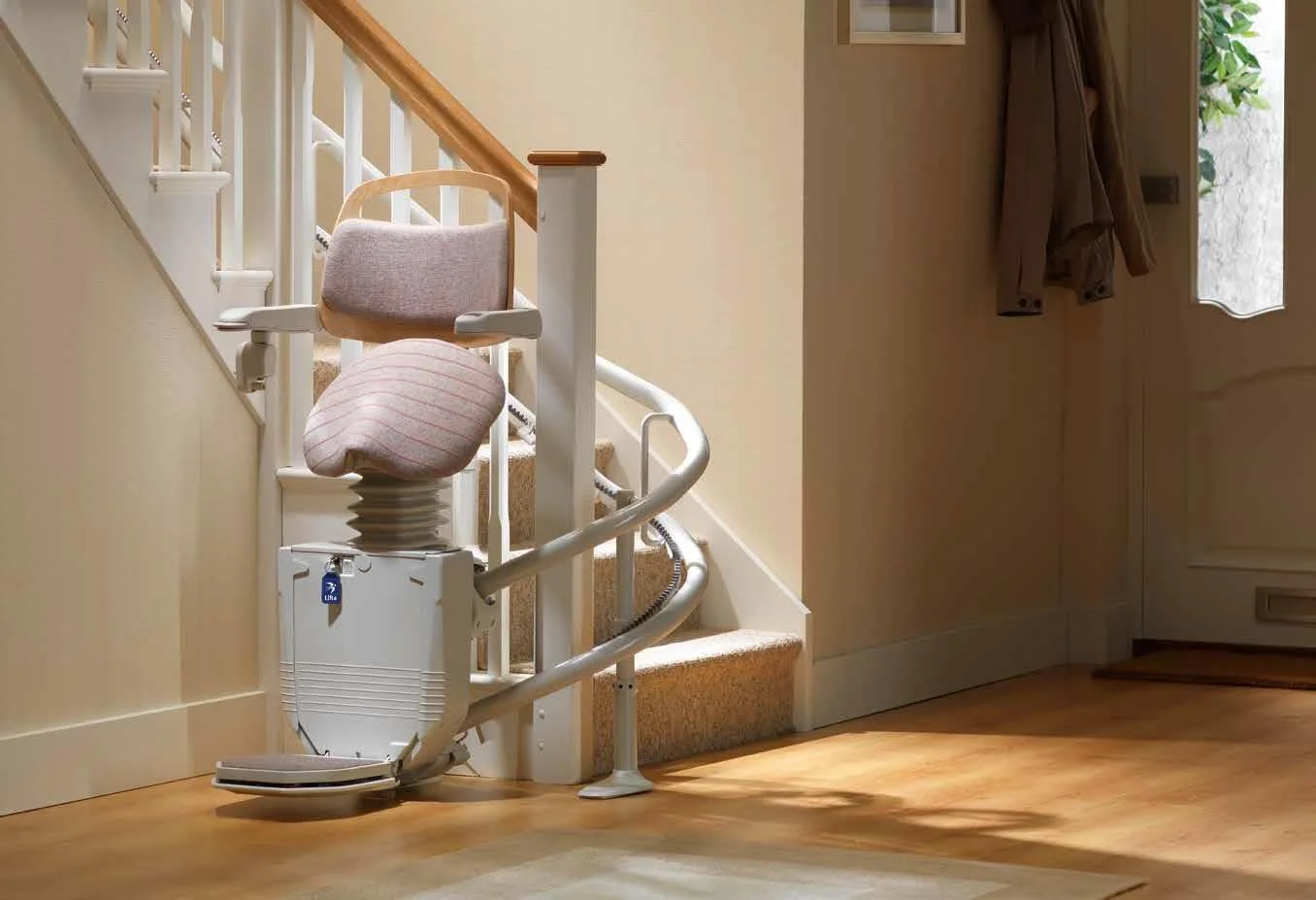
Most housing here is single-family homes and detached houses, with a fair number of split-level homes and ranch-style homes in the mix. Each of these puts stairs in different places, and that decides the type of lift.
A split-level house usually has short runs of stairs between levels instead of one long flight. Sometimes a straight lift on the run used most often is enough. If the stairs turn or there is more than one run to cover, a curved rail built to the staircase is the usual answer.
Ranch-style homes often keep daily living on one floor, but the steps that cause trouble may be the ones down to a basement laundry or up to the front door. Basement stairs are often a straight run. Entry steps outside can take an outdoor-rated lift, and where a wheelchair is involved, a platform lift may make more sense than a seat.
Farmhouses and older rural homes often have narrow or steep staircases, and some were changed by past owners over the years. We measure the stairs, check the width and look at where the rail can be anchored before recommending a straight or curved model.
Scott County covers 192.75 square miles, and outside Scottsburg's core the homes are spread out. That added distance can raise the cost and stretch the scheduling of home modifications for outlying residents, so it helps to ask about travel and timing when you request a quote.
The 2020 Census put Scott County's median age at 41.1 years, with 17.7% of residents age 65 or older. Many families are starting to think about how a parent will manage the stairs in the house they already own.
About 57.5% of residents are homeowners. Owning the home makes a permanent rail installation simpler, and ownership is also a requirement for some of the veteran grants listed below.
The county does not have its own home-modification fund for seniors. Residents rely on regional and state programs instead, including LifeSpan Resources and the Southeastern Indiana Independent Living Center (SIILC), both based outside the county.
The clearest route to stair lift funding is the Indiana PathWays for Aging Waiver for people 60 and older, or the Health and Wellness Waiver for people 59 and under. The program lists stair lifts by name under Home Modifications. You apply through LifeSpan Resources at (812) 948-8330, whose office is at 33 State St., Third Floor, New Albany.
Veterans should know that the VA HISA grant excludes stair glides, though it can cover ramps and other permanent changes. The Scott County Veteran's Services Office at 1471 N Gardner Street in Scottsburg, (812) 752-8477, can help with VA applications. Statewide, it is also worth asking about the INDATA Alternative Financing Program (AFP).
These Medicaid waivers list stair lifts among covered home modifications for people who meet nursing-facility level of care, with 2024 limits of $2,829/month income and $2,000 in assets for a single applicant. Apply through LifeSpan Resources for Scott County, or call (800) 403-0864.
LifeSpan Resources serves Clark, Floyd, Harrison and Scott counties and runs the CHOICE program, a funding source of last resort that pays for minor physical adaptations to the home; the source does not name stair lifts. Call (812) 948-8330.
HISA pays up to $6,800 or $2,000 over a lifetime for medically necessary changes such as ramps and roll-in showers, but it does not cover stair lifts. Call the VA at (800) 827-1000.
These grants, up to $126,526 for SAH and $25,350 for SHA in FY2026, help homeowners with certain severe service-connected disabilities adapt a home; the source names ramps and wider doorways but does not mention stair lifts. Call (800) 827-1000.
This county office helps veterans and dependents apply for VA benefits, including the HISA, SAH and SHA housing grants, but it does not fund home modifications itself. Call (812) 752-8477.
SIILC offers in-home help with daily activities, peer counseling and information and referral for people with disabilities; its listed services do not mention stair lifts or home modifications. Call (812) 427-3333 to confirm whether it serves your address.
Older adults
33 State St., Third Floor, New Albany, 47151
Veterans
1471 N Gardner Street, Scottsburg, 47170
Yes, possibly. The Health and Wellness Waiver covers people 59 and under who are aged, blind or disabled and meet nursing-facility level of care, and its Home Modifications benefit names stair lifts. Contact LifeSpan Resources at (812) 948-8330 to start.
Not through HISA, which specifically excludes stair glides. The SAH and SHA grants do not name stair lifts in their source material. The Scott County Veteran's Services Office at (812) 752-8477 can review which VA benefits fit your situation.
For a single applicant in 2024, income can be up to $2,829/month and assets up to $2,000. Home equity is exempt up to $713,000.
It can. Much of the county's housing is spread out on township roads, and that distance can add cost and travel time for any home-modification contractor. Ask about travel when you get a quote.
LifeSpan Resources serves Scott County from 33 State St., Third Floor, New Albany. The phone number is (812) 948-8330.
It depends on how the stair runs connect. A single straight run can take a straight lift, while stairs that turn or link several levels usually need a curved rail. We measure the stairs before recommending one.
Tell us about the stairs in your home and we will explain which lift fits, what it costs and how installation works.
