Harrison County's ground rises from about 455 feet on the Ohio River floodplain to 972 feet at Lagle Ridge. Along the eastern edge, the Knobstone Escarpment climbs as high as 610 feet over the valley. Houses in Corydon, Palmyra, Lanesville, New Salisbury, Ramsey and Crandall were often built to fit that slope, and the stairs show it.
This page walks through what local homes usually need for a stair lift, from inside staircases to steps at the front door. It also lists the agencies and programs that can help pay, with the phone numbers to call, so you can start planning with a clear picture.
Much of the county's older housing is multi-level farmhouses and hillside homes set into sloping ground. Many sit on raised foundations, have exterior entry stairs, or use split-level layouts. Each of these can be fitted with a lift, but each calls for a different kind.
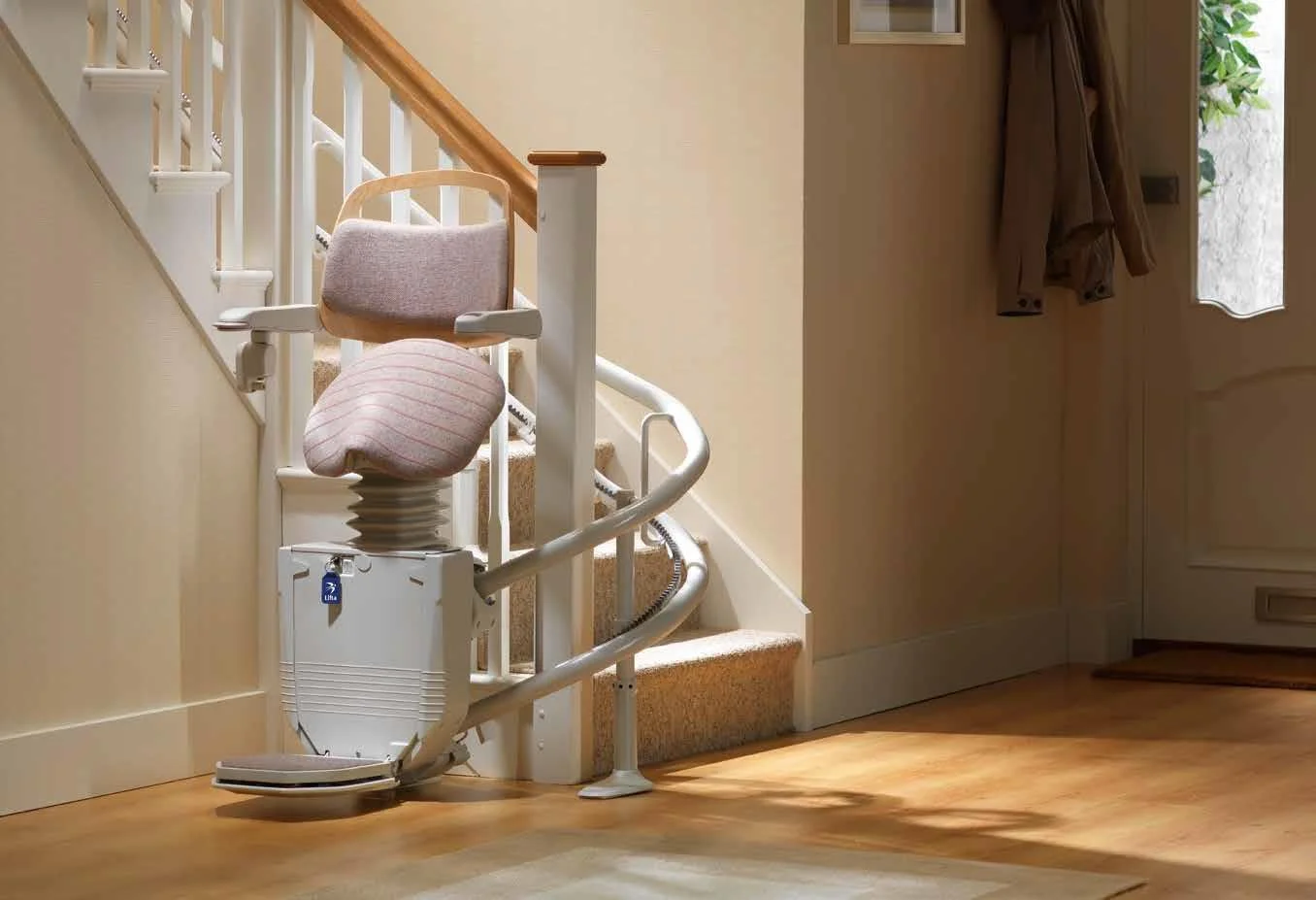
A long, straight indoor staircase usually takes a straight rail, the simplest and quickest install. Stairs that turn at a landing or wrap around a corner need a curved rail built to the exact shape of your steps, which takes careful measuring before anything is ordered.
Split-level homes have short flights between floors, and a household may need help on more than one of them. We look at which levels hold the bedroom, bathroom and kitchen before suggesting where a lift makes the most difference.
Ranch-style homes often have their stairs at the basement or at the entry, not between living floors. In walk-up apartments, the building owner's approval usually matters before any rail goes on a shared stairway, so it helps to ask early.
Raised foundations and exterior entry stairs are common across rural parts of the county. If getting into the house is the hard part, an outdoor-rated stair lift can run along porch or deck steps and stand up to the weather.
Where someone uses a wheelchair, a platform lift may be a better fit than a seat. We check the space at the top and bottom of the steps, because a platform needs more room than a chair.
The 2020 Census counted 39,654 residents with a median age of 42.2, and 18.5% were 65 or older. It also found 81.2% of housing units owner-occupied and 85.6% of residents living in rural areas.
For families, that means most older residents own the house they would modify, which keeps the decision in their hands. It also means homes can be spread out, so planning a visit and an install date ahead of time is worth doing.
Indiana's Medicaid HCBS waiver is the one program on this list whose source names stair lifts as a covered home modification. Applicants must meet nursing-facility level of care plus income and asset limits, and enrollment runs through the state Medicaid line or a LifeSpan Resources case manager.
Other programs fund home repairs or accessibility work without naming stair lifts, so call and ask directly. Veterans should know that the VA HISA grant does not cover stair glides. The state also lists the INDATA Alternative Financing Program (AFP) among statewide resources worth asking about.
This Medicaid waiver lists stair lifts by name among covered home modifications for people who are aged, blind or disabled and meet nursing-facility level of care. Call the Medicaid line at (800) 403-0864 or work through a LifeSpan Resources case manager.
The area agency on aging for Clark, Floyd, Harrison and Scott counties offers CHOICE funding for minor home adaptations as a last resort after other resources are used; the source does not mention stair lifts. Call (812) 948-8330 to ask about an in-home assessment.
Rural homeowners at or below 50% of area median income can get repair loans up to $40,000, and those 62 and older who cannot repay a loan can get grants up to $10,000. The source describes accessibility repairs but does not mention stair lifts.
HISA pays for medically needed structural changes such as ramps and widened doorways, up to $6,800 or $2,000 lifetime depending on the disability. It does not cover stair lifts; call (800) 827-1000 with questions.
These grants, up to $126,526 for SAH and $25,350 for SHA in FY2026, help veterans with certain severe service-connected disabilities adapt a home. The source does not mention stair lifts; call (800) 827-1000.
OCRA awards funds to local governments, not homeowners, which then run local repair programs that can include accessibility work; stair lifts are not named. Contact [email protected] to learn whether a local program is active.
CASI serves income-eligible households in Clark, Floyd and Harrison counties with weatherization and energy help; stair lifts are not mentioned. Call (812) 288-6451 to ask about any accessibility repairs.
This Corydon office does not fund home changes or mention stair lifts, but it helps veterans file disability claims that can lead to VA housing grants. Call (812) 738-4249.
Older adults
33 State St., Third Floor, New Albany, 47151
Veterans
245 Atwood Street, Suite 102, Corydon, 47112
It can. The Indiana Medicaid HCBS waiver lists stair lifts as a covered home modification for people who meet nursing-facility level of care, with an income limit of $2,829 a month and an asset limit of $2,000 for a single person. Call (800) 403-0864 or ask LifeSpan Resources.
The HISA grant specifically excludes stair glides. The SAH and SHA grants do not mention stair lifts either way. The Harrison County Veteran's Service Office at 245 Atwood Street, Suite 102, in Corydon can help with the disability claims those grants require.
The USDA Section 504 program offers grants up to $10,000 to rural homeowners 62 and older who cannot repay a loan and have income at or below 50% of area median income. Its source does not name stair lifts, so confirm the project qualifies before counting on it.
Lifespan Resources is at 33 State St., Third Floor, New Albany, 47151, and serves Harrison County. Call (812) 948-8330 to ask about the CHOICE program and an in-home assessment.
Yes. Many homes here sit on raised foundations with exterior entry stairs, and an outdoor-rated lift is built for that. If a wheelchair is involved, a platform lift may suit better.
Split-levels have short flights between floors, so the first step is deciding which flight matters most for daily life. Sometimes one lift is enough, and sometimes a household needs more than one.
Tell us about the stairs in your home and we will explain which lift fits, what it costs and how installation works.
