Dubois County earned its 'Wood Capital of the World' name from German cabinetmakers and carpenters who settled here in the early 1800s. Their trade built towns like Jasper, Huntingburg and Ferdinand, and it left a housing mix that runs from older homes in the historic town cores to newer single-story houses out in the countryside.
That mix matters when someone in the family starts having trouble with stairs. A two-story house near the square in Jasper, a split-level in Huntingburg and a farmhouse near Birdseye or Celestine each call for a different kind of lift. This page walks through what fits, what it means for your stairs, and which programs can help cover the cost.
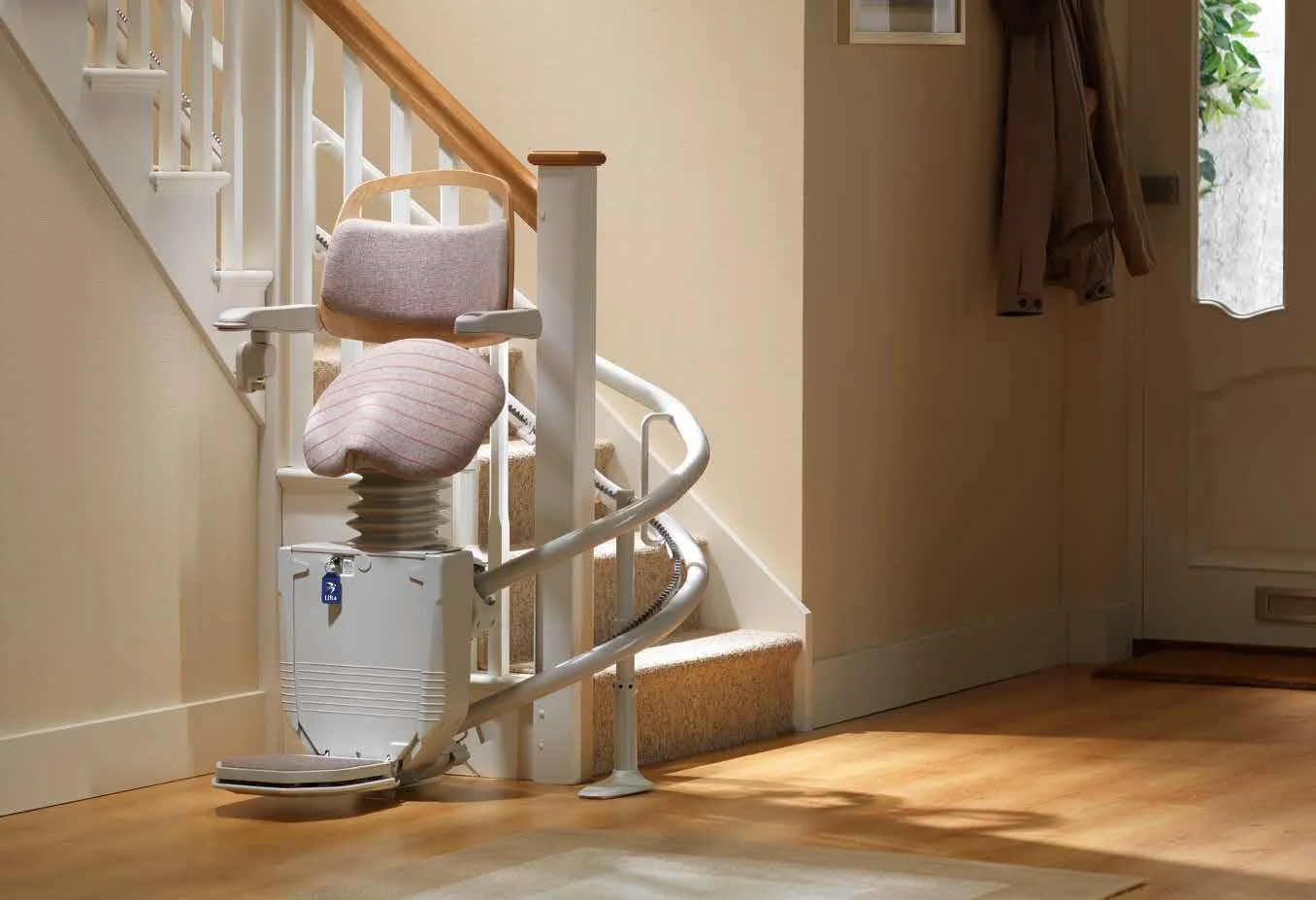
Many of the older detached houses and single-family homes in the town cores of Jasper, Huntingburg, Ferdinand and Holland have one straight flight from the main floor to the bedrooms. A straight stair lift is usually the simplest fit for that layout. The rail mounts to the stair treads, not the wall, so older plaster stays untouched.
We check the width of the stairway, the condition of the treads and where the nearest outlet sits. Narrow stairs in older homes often still work, because the seat and footrest fold up when nobody is riding.
Split-level homes have short flights between several levels. Sometimes one curved rail can follow the turns, and sometimes two straight lifts on separate flights do the job better. We measure each flight before suggesting either one.
Townhouses tend to have a single long flight, which suits a straight lift. In walk-up apartments the stairs are often shared, so the building owner has to approve any installation before work begins.
As of the 2020 census, 47.6% of county residents lived in rural areas. Out toward Patoka Lake, the Hoosier National Forest and the smaller communities like Dubois and Saint Anthony, the trouble spot is often the porch or entry steps rather than an indoor staircase.
For those steps, an outdoor stair lift built to handle weather can be an option, and a vertical platform lift can work where someone uses a wheelchair. Newer single-story homes in the countryside may only need help at the front or back door.
About 18.4% of Dubois County residents are 65 or older, and 66.1% of households own their home. Owning the house makes a stair lift easier to arrange, since no landlord sign-off is needed, and several of the programs below require that you own and live in the home.
The Dubois County Veterans Service Office at 602 Main St in Jasper can be reached at (812) 481-7090 for help sorting out VA benefits.
Help comes from a few directions: Indiana Medicaid waivers, federal rural repair loans, a county repair grant, VA grants and a local center for independent living. Each has its own rules, and not all of them name stair lifts. The program list below spells out what each one says.
For a starting point, call Generations Vincennes University (PSA 13), the area agency on aging, at (812) 888-5880. Its office is at 1019 N. 4th St., Vincennes 47591. You can also ask them about statewide options such as the CHOICE Program (Community and Home Options to Institutional Care for the Elderly and Disabled) and the INDATA Alternative Financing Program (AFP).
A Medicaid home and community-based waiver for Indiana residents who need a nursing-facility level of care, split into PathWays for age 60 and up and Health and Wellness for age 59 and under. Home Modifications are an authorized service and can cover a stair lift; call (877) 284-9294 to enroll.
Offers repair loans up to $20,000 at 1% interest for up to 20 years, and grants up to $7,500 for homeowners 62 or older with very low income, in eligible rural areas that include Dubois County. The source does not mention stair lifts or accessibility changes.
A $700,000 fund for income-qualified Dubois County homeowners, first-come, first-served, that covers repairs including ramps and ADA-compliant entrances; stair lifts are not mentioned. Call (812) 367-8455.
A VA grant of up to $6,800 for a service-connected disability or up to $2,000 for other non-service-connected disabilities, for medically necessary home changes. It does not cover stair lifts, which the VA lists as removable equipment; call (800) 827-1000.
Grants of up to $126,526 (SAH) or $25,350 (SHA) for veterans with certain severe service-connected disabilities to build, buy or remodel an adapted home. The source does not mention stair lifts; call (800) 827-1000.
A center for independent living for people with disabilities that runs a Ramp Project. Stair lifts are not listed among its services, but it is worth a call at (812) 886-0575.
Older adults
1019 N. 4th St., Vincennes, 47591
Veterans
602 Main St, Jasper, 47546
Yes. Since July 1, 2024, Indiana residents age 59 and under who need a nursing-facility level of care can apply for the Health and Wellness Waiver, while those 60 and up use PathWays. Both list Home Modifications as a service. Call (877) 284-9294 to enroll.
Not through the HISA grant, which specifically excludes stair glides and porch lifts. The SAH and SHA grants fund permanent home modifications but do not name stair lifts. The Dubois County Veterans Service Office in Jasper, (812) 481-7090, can help you look at your options.
The program lists roof, HVAC, electrical, water heater work and ramps with ADA-compliant entrances, and does not mention stair lifts. Income limits run from about $49,150 for one person to $92,600 for eight. Call (812) 367-8455 to ask before funds run out.
Usually, yes. Depending on the layout, we either run one curved rail through the turns or install separate straight lifts on each short flight. A home visit to measure is the only way to know which fits.
The program excludes single-wide trailers and homes in a 100-year floodplain. You must also be a Dubois County resident who owns and lives in the home.
Income can be no more than 300% of the maximum SSI amount, about $2,982 a month for an individual in 2026. The asset limit for a single applicant is $2,000.
Tell us about the stairs in your home and we will explain which lift fits, what it costs and how installation works.
