Brazil, Harmony and Knightsville grew fast from the 1860s onward, when coal companies worked the land along the National Road. Many of the houses built in that era are still standing, and a lot of them put the bedrooms and the only full bath up a flight of stairs.
Across the rest of Clay County, from Clay City and Center Point to Staunton, Carbon, Coalmont, Bowling Green and Cloverland, you also find newer single-story rural homes, ranch-style houses and split-levels. This page walks through what each kind of house means for a stair lift and where Clay County families can look for help covering the cost.
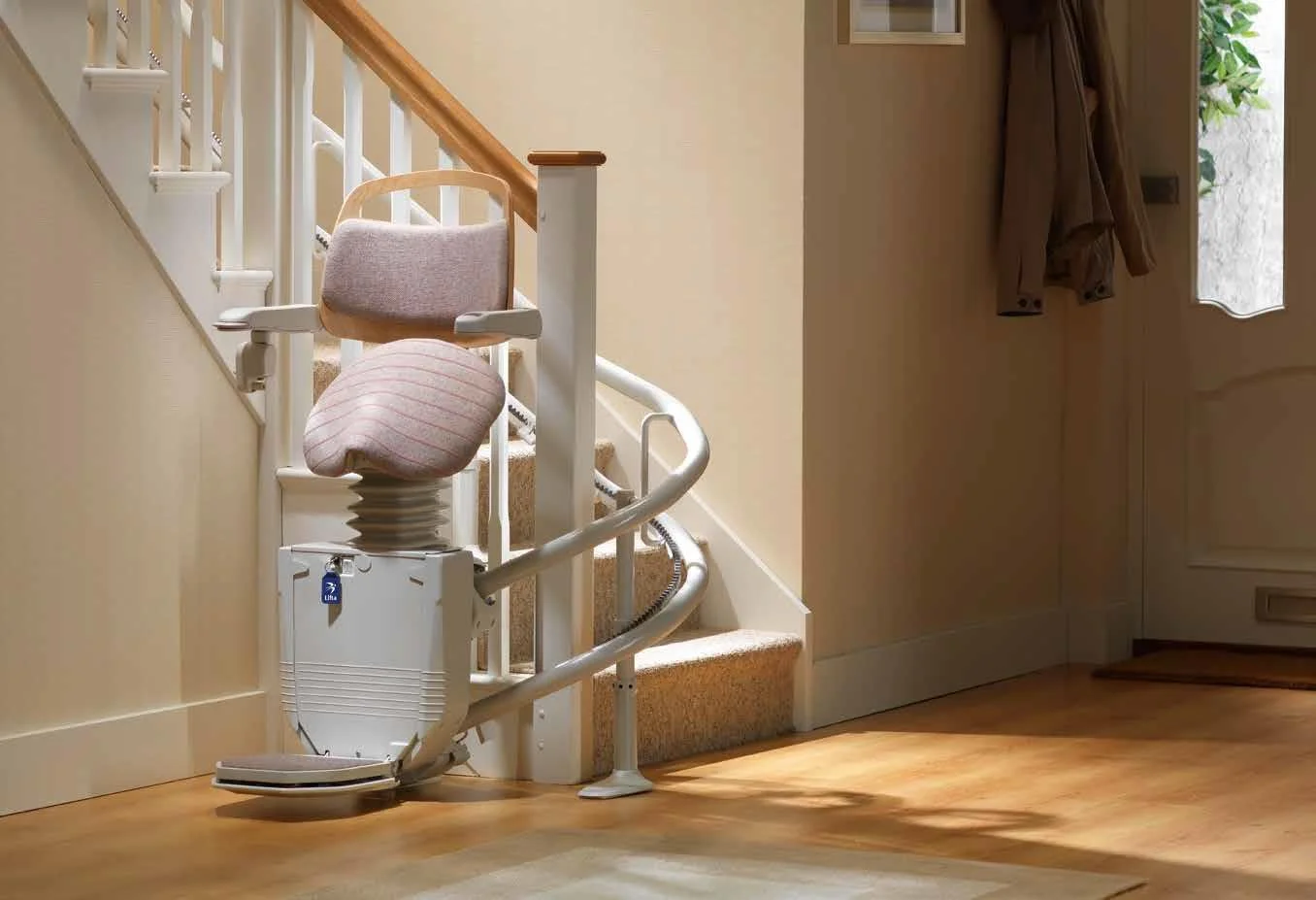
A meaningful share of homes in Brazil and the former mining-era towns date to the late 19th and early 20th century. These are usually multi-story houses built stairs-first, with the living space split between floors.
Older staircases are often narrower and steeper than modern ones, and some turn at a landing. A straight stair can take a straight rail lift, which is the simpler and less costly option. A stair that turns or has a landing midway needs a curved rail built to fit that exact staircase, so we measure before quoting either one.
Ranch-style homes built since the mining days usually keep daily life on one floor. The problem tends to be a basement laundry or the steps up to the front or back door, which is where an outdoor lift or a short platform lift can make more sense than an indoor rail.
Split-level homes have several short flights rather than one long one. Each flight can be handled on its own, so it helps to decide which levels you really need to reach every day. In low-rise buildings, check with the building owner before planning any install in a shared stairway.
Clay County has about 12,482 residents, and 18.9% are 65 or older. The median age is 41.8, so many of the calls come from adult children helping a parent stay in the family house.
About 68.6% of residents own their homes, which matters because owners can approve a permanent rail and some grants require ownership.
The most direct local route is Thrive West Central, the Area Agency on Aging for Clay County, at (812) 238-1561. Its environmental modifications list names chair lifts alongside ramps and handrails, and it is also the place to start for the Indiana PathWays for Aging Waiver for people 60 and older.
Several other programs are useful but do not pay for stair lifts. Ramp Up Indiana, the WILL Center ramp program and the VA HISA grant fund ramps and other fixed changes, which can still help with entry steps. Veterans can call the Clay County Veterans Service Office at (812) 448-9015 for free help filing VA housing grant claims. Each program is summarized below.
A Medicaid waiver for people 60 and older who meet nursing facility level of care, and it lists Home Modifications and Home Modification Assessment as covered services, which can include a stair lift. Apply through Thrive West Central at (812) 238-1561 and separately for Medicaid.
The Area Agency on Aging for Clay County names chair lifts among its home adaptation services, along with ramps and handrails, for older adults and adults with disabilities. Call (812) 238-1561 or use its online referral form.
A state program run by IHCDA and delivered in Clay County through Thrive West Central that funds exterior wheelchair ramps for homeowners; it does not cover stair lifts. Call (812) 238-1561.
A VA grant of up to $6,800 for service-connected disabilities or $2,000 for other disabilities that pays for permanent changes like ramping and roll-in showers, and it specifically excludes stair glides. The Clay County Veterans Service Office can help at (812) 448-9015.
VA grants for homeowners with qualifying severe service-connected disabilities, up to $126,526 for SAH and $25,350 for SHA in FY2026; the VA page does not specifically name stair lifts. Call (812) 448-9015 for help applying.
Veterans Service Officer Michael Holland offers free help with VA benefit claims, including housing grants, but the office does not fund modifications itself. The office is at 609 E. National Ave in Brazil, phone (812) 448-9015.
A Center for Independent Living serving Clay and nearby counties whose Ramps for Freedom Program builds ramps or low-rise steps; stair lifts are not covered. Call (812) 298-9455.
Older adults
2800 Poplar St., Suite 9A, Terre Haute, 47803
Veterans
609 E. National Ave, Room 104, Brazil, 47834
It can through the Indiana PathWays for Aging Waiver, which covers Home Modifications for people 60 and older who meet nursing facility level of care and the income limit. The state page does not name stair lifts specifically, so start with Thrive West Central at (812) 238-1561.
Yes, the former Aged and Disabled Waiver was split in 2024, and adults under 60 now go through the Health and Wellness Waiver. Thrive West Central also serves adults with disabilities, so it is a good first call.
The HISA grant does not, since the VA excludes stair glides as removable equipment. The SAH and SHA grants do not specifically name stair lifts, so ask the Clay County Veterans Service Office at (812) 448-9015 to review your case.
No. Both fund ramps, and the WILL Center also builds low-rise steps. They can still help if the front or back steps are the main barrier.
Usually, yes, but a stair that turns needs a curved rail made for that staircase. A straight stair takes a simpler straight rail, so the first step is measuring the stairs in person.
Thrive West Central is at 2800 Poplar St., Suite 9A in Terre Haute, and it serves Clay, Parke, Putnam, Sullivan, Vermillion and Vigo counties. The phone number is (812) 238-1561.
Tell us about the stairs in your home and we will explain which lift fits, what it costs and how installation works.
