Brown County is called the 'Little Smokies' for good reason. Between Nashville, Helmsburg and Cordry Sweetwater Lakes, the roads climb through nearly 90% forest cover, and the county reaches 1,058 feet at Weed Patch Hill, the third-highest point in Indiana.
Homes here were built to fit that ground. You find old frame houses, split-level and ranch-style homes, and rustic cabins and cottages that grew up around the Brown County Art Colony near Nashville. Many of them have steps at the door, steps inside, or both, and few were designed with accessibility in mind.
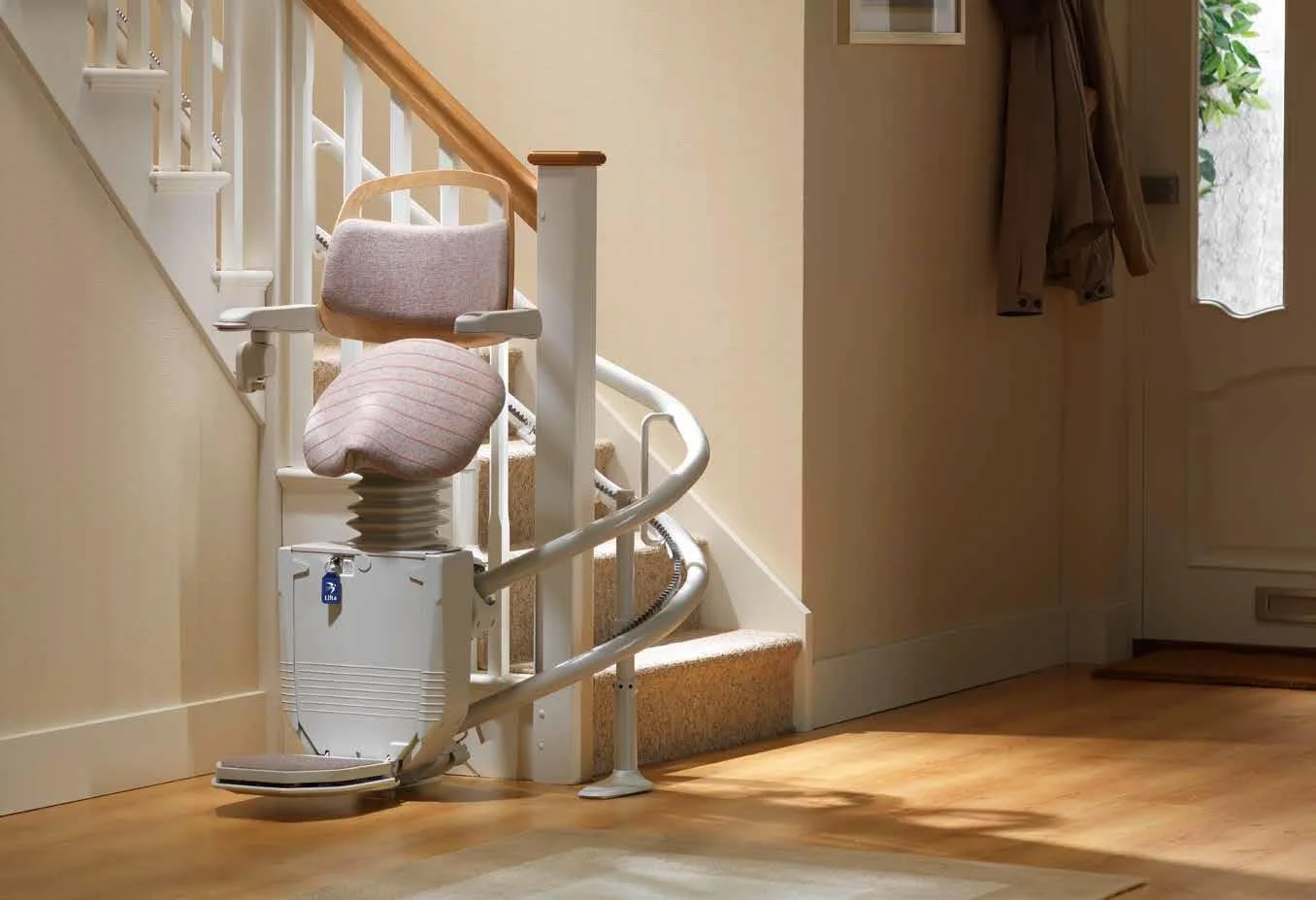
A house set into a slope often ends up with more than one level. Split-level homes are the common example: short flights between floors, sometimes with a turn or landing. A straight flight with no turns can usually take a straight stair lift, which is the simplest kind to install.
When a staircase turns, has a landing in the middle, or splits off in two directions, a curved lift built to that exact staircase is the usual answer. We measure every flight in person before recommending one, because older homes rarely have stairs that match a standard layout.
Ranch-style homes may look like they have no stairs at all, but on a hillside lot the trouble is often outside. Steps from the driveway or down to a walkout basement can call for an outdoor stair lift or, where a wheelchair is involved, a platform lift.
As of 2020, 22.3% of the county's 8,436 housing units were vacant, which reflects how many places here are seasonal or vacation cabins. If a family cabin is becoming a full-time home for a parent, the stairs that were fine on a weekend can become a daily problem.
Cabins often have steep, narrow stairs to a loft and steps on a porch exposed to weather. A visit lets us check the stair width, the wall and tread material, and whether there is power near the top and bottom of the flight. Those details decide what can be installed.
In the communities covered here, 35.1% of residents are 65 or older. With about 49.7 people per square mile, help is often a long drive away, so a fall on the stairs can turn into a long wait.
Most people here own the home they live in. As of 2020, 83.1% of homes were owner-occupied, which matters because several programs below, like the USDA repair grants and the VA housing grants, require the applicant to own the home.
Only two programs on this page say they cover stair lifts or home modifications outright: the Indiana Medicaid Aged and Disabled (A&D) Waiver, which lists Home Modifications as a service, and the Southern Indiana Center for Independent Living (SICIL), which helps people get home modifications through other programs. Others cover related work but do not name stair lifts, so ask directly before you count on them.
Thrive Alliance is the Area Agency on Aging for Brown County and the first call for the A&D Waiver and the CHOICE Program. You can reach their office at (812) 372-6918.
Veterans should know that the VA HISA grant specifically excludes stair glides. The Brown County Veterans Affairs Office at (812) 988-5600 can still help you look at the larger VA housing grants and file claims.
A Medicaid waiver for aged, blind or disabled people who meet a nursing-facility level of care, with Home Modifications listed as a covered service and no dollar cap stated, though slots are limited and there may be a waitlist. Apply through Thrive Alliance; the program phone is (866) 644-6407.
A state-funded, non-Medicaid program for people 60 and older or with a disability at any age who have trouble with daily activities; it lists environmental modification but does not mention stair lifts, and a sliding-scale cost-share applies. Call (800) 986-3505.
Thrive Alliance's housing services include home repairs and accessibility modifications for people who meet income and program guidelines, but stair lifts are not mentioned. Call (812) 376-9458.
A lifetime grant of up to $6,800 or up to $2,000, depending on disability status, for veterans enrolled in VA health care; it does not cover stair lifts, as the VA excludes stair glides and porch lifts. Questions can go to (812) 988-5600.
Grants of up to $126,526 (SAH) or $25,350 (SHA) for FY2026 for homeowning veterans with qualifying severe service-connected disabilities; the VA page names ramps and widened doorways but does not mention stair lifts. Call (812) 988-5600.
The county office helps veterans, dependents and survivors with benefits assessments, disability claims and appeals; it does not run a stair lift program but can help with the VA grants above. Call (812) 988-5600.
Loans up to $40,000 at 1% fixed interest and grants up to $10,000 for very-low-income homeowners in eligible rural areas, with grants limited to homeowners 62 or older; the source names ramps and grab bars but does not mention stair lifts.
Serves Brown County residents who self-declare a significant disability, with no documentation or income proof required, and helps with home modifications through programs such as USDA and partner organizations. Stair lifts are not named individually.
The local Habitat affiliate installs ramps through this program; stair lifts are not mentioned, so ask about the current scope. Call (812) 988-4926.
Older adults
1531 13th St., Suite G900, Columbus, 47201
Veterans
902 Deer Run Lane, Nashville, 47448
Usually, yes. Each straight flight can take its own straight lift, and stairs with a turn or landing need a curved lift built to fit. We measure on site before recommending anything.
Not through the HISA grant, which excludes stair glides. The SAH and SHA grants do not name stair lifts either, so call the Brown County Veterans Affairs Office at (812) 988-5600 to talk through your situation.
The Indiana Medicaid Aged and Disabled (A&D) Waiver lists Home Modifications as a covered service with no dollar cap stated. You must meet a nursing-facility level of care and income limits, and there may be a waitlist. Thrive Alliance handles applications.
The CHOICE Program accepts people with a disability at any age, and SICIL serves anyone who self-declares a significant disability. The USDA grant portion, by contrast, requires the homeowner to be 62 or older.
No. CHOICE is available regardless of income, but a sliding-scale cost-share applies and the state page lists an asset limit of $250,000. Call (800) 986-3505 for details.
Most of Brown County is rural, but eligibility has to be confirmed for each address using the USDA eligibility map. Household income must also be at or below the very-low-income limit for the county.
Tell us about the stairs in your home and we will explain which lift fits, what it costs and how installation works.
