Sparta is the county seat and the only incorporated city in Hancock County, and it came through the Civil War completely unscathed. That is why so many antebellum and Victorian-era homes still stand in the Sparta Historic District, including the Rossiter-Little House, the oldest surviving structure. Many of these are multi-story homes with staircases typical of their period.
Outside town, the county spreads across 479 square miles of east-central Georgia's Black Belt, with parts of the Oconee River and Ogeechee River basins running through it. As of the 2020 Census, 100.0% of residents lived in rural areas. When most people live on scattered properties far from the one service hub, getting safely up and down your own stairs matters more than it would in a city.
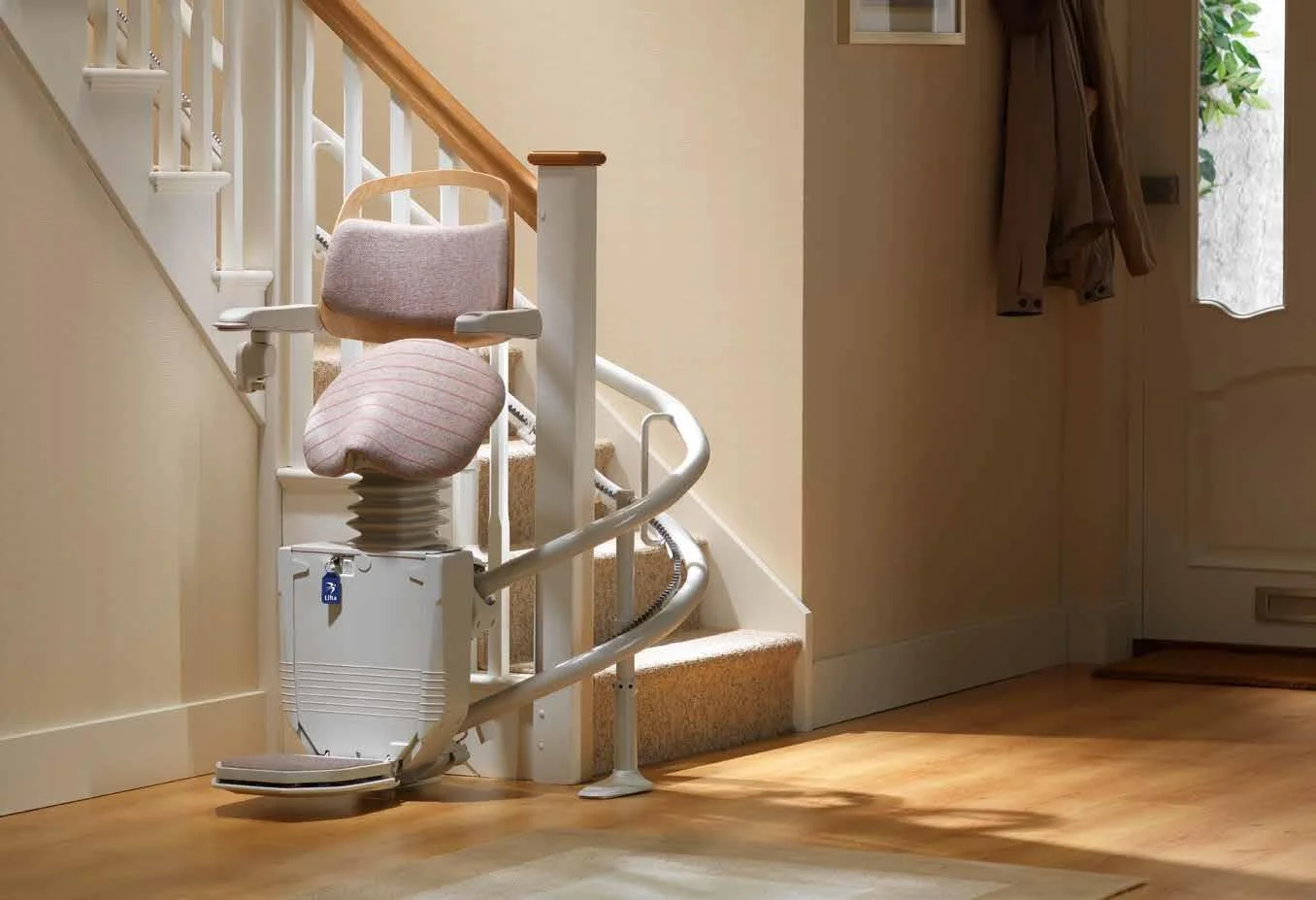
The two-story antebellum and Victorian homes around Sparta often have staircases that turn, narrow or land partway up. Those stairs usually call for a curved rail built to the shape of the staircase, not an off-the-shelf straight track.
A straight staircase in the same kind of house can take a simpler straight rail. Either way, we measure the treads, landings and the space at the top and bottom before recommending anything, because older staircases are rarely uniform.
Much of the county's housing is single-family and detached, including ranch-style homes and split-level homes. A ranch house may have no indoor stairs at all, but the steps up to the porch or door can still be the hardest part of the day. That is where an outdoor stair lift or a platform lift is worth a look.
Split-level homes bring short flights between levels. Sometimes one straight lift covers the flight used most, and sometimes a person needs help on two short runs. We sort that out on the walk-through.
About 37.7% of residents are homeowners. That matters because a stair lift attaches to the stairs, and some funding, like the USDA repair grants, requires the home to be owner-occupied. If you rent, talk with the owner before planning an installation.
VA home grants have specific rules about stair lifts, covered below, and the Georgia Department of Veterans Service field office in Milledgeville is the closest place to ask in person.
Budgets here are tight for many families. The median household income is $40,082, and about 30.6% of residents live in poverty, among the highest rates in Georgia. The median home value is $88,600, so few people want to pour savings into equipment.
Two Medicaid programs and one local nonprofit in the list below name home modifications in their covered services: the Independent Care Waiver Program, Money Follows the Person, and Walton Options. The USDA Section 504 program offers low-cost repair loans and grants for very-low-income rural homeowners, and the whole county is rural. VA grants are an option for qualifying veterans, with limits explained below.
For general aging services, the Central Savannah River Area Regional Commission AAA is at 3626 Walton Way Extension, Suite 300, Augusta, GA 30909, phone (706) 210-2018.
A state Medicaid waiver for adults ages 21-64 with severe physical disabilities or traumatic brain injury who can be served at home; its covered services include home modifications, and a waitlist applies. Call (800) 982-0411.
A state Medicaid waiver for people 65+ (or younger with a qualifying disability) who meet nursing-home level of care; its listed services such as personal care and home delivered meals do not mention stair lifts or home modifications. Call (866) 552-4464.
A Medicaid waiver with enhanced case management for people needing nursing-home level of care, and Hancock County is served by the On My Watch Augusta office; stair lifts and home modifications are not listed among its services. Call (800) 371-1352.
Helps Medicaid-eligible people who have lived in a nursing home or similar facility for at least 60 consecutive days move back home, and its one-time transition services include environmental modifications. Call (404) 651-9961.
Offers very-low-income rural homeowners loans up to $40,000 at 1% fixed interest, and grants up to $10,000 lifetime for homeowners age 62+; the source does not mention stair lifts specifically. Call (706) 546-2162.
Up to $126,526 for veterans with qualifying service-connected disabilities who own or plan to own the home; the VA describes adaptations like ramps and widened doorways but does not name stair lifts. Call (800) 827-1000.
Up to $25,350 for veterans with qualifying disabilities such as loss of use of both hands, and the home may be owned by the veteran or a family member; stair lifts are not named. Call (800) 827-1000.
A lifetime benefit of up to $6,800 or $2,000 for medically needed home modifications for eligible veterans. It does not cover stair lifts: the VA explicitly excludes porch lifts and stair glides.
A nonprofit serving people with disabilities in a 16-county area that includes Hancock County, with a named Assistive Technology & Home Modifications program decided case by case. Call the Augusta office at (706) 724-6262.
Older adults
3626 Walton Way Extension, Suite 300, Augusta, 30909
Veterans
2249 Vinson Highway, Milledgeville, 31061
Yes, possibly. The Independent Care Waiver Program serves Medicaid-eligible adults ages 21-64 with severe physical disabilities or traumatic brain injury and covers home modifications. Walton Options also serves people with disabilities in Hancock County.
The HISA grant does not; it excludes stair glides by name. The SAH and SHA grants cover home adaptations but do not name stair lifts, so ask directly at (800) 827-1000 or the Georgia Department of Veterans Service office at 2249 Vinson Highway, Milledgeville, (478) 445-6900.
In most cases, yes. Older staircases in the antebellum and Victorian homes around Sparta often turn or have landings, which usually means a curved rail made to fit. We measure the stairs in person before recommending a lift.
It is a big reason people choose a stair lift here. With every resident living in a rural area and Sparta as the only service hub, staying safe at home on your own stairs saves long trips.
The Section 504 grants are for very-low-income homeowners age 62+, up to $10,000 lifetime. Loans up to $40,000 at 1% are open to very-low-income rural homeowners of other ages. The home must be owner-occupied; call (706) 546-2162.
Money Follows the Person helps Medicaid-eligible people who have lived in a facility for at least 60 consecutive days return home, and it includes environmental modifications. Call (404) 651-9961.
Tell us about the stairs in your home and we will explain which lift fits, what it costs and how installation works.
