Rome was built across seven hills: Blossom, Jackson, Lumpkin, Mount Aventine, Myrtle, Old Shorter and Neely. In the late 1890s, city crews raised downtown Broad Street by roughly 15 feet to fight flooding, and the old ground-floor entrances of many historic buildings ended up as basements. Steps have been part of daily life here for a long time.
Outside the city, the story is similar in Lindale, Shannon, Cave Spring and around Berry College. Split-level homes, raised foundations and sloped lots with multi-step entries are common. When climbing those stairs gets hard, a stair lift can let someone keep living on every floor of the house they already own.
Floyd County sits where three river basins meet. Rome is at the confluence of the Etowah and Oostanaula rivers, which join to form the Coosa River. River-cut valleys and hills leave little flat land to build on.
That terrain puts a lot of houses on sloped lots with graded driveways and several steps just to reach the front door. Inside, split-level layouts mean short flights between living areas, and older multi-level buildings carry the legacy of Rome's hillside construction.
A single straight staircase, common in two-story single-family homes and townhouses, usually takes a straight stair lift. The rail mounts to the stair treads, not the wall, so it works in older homes too.
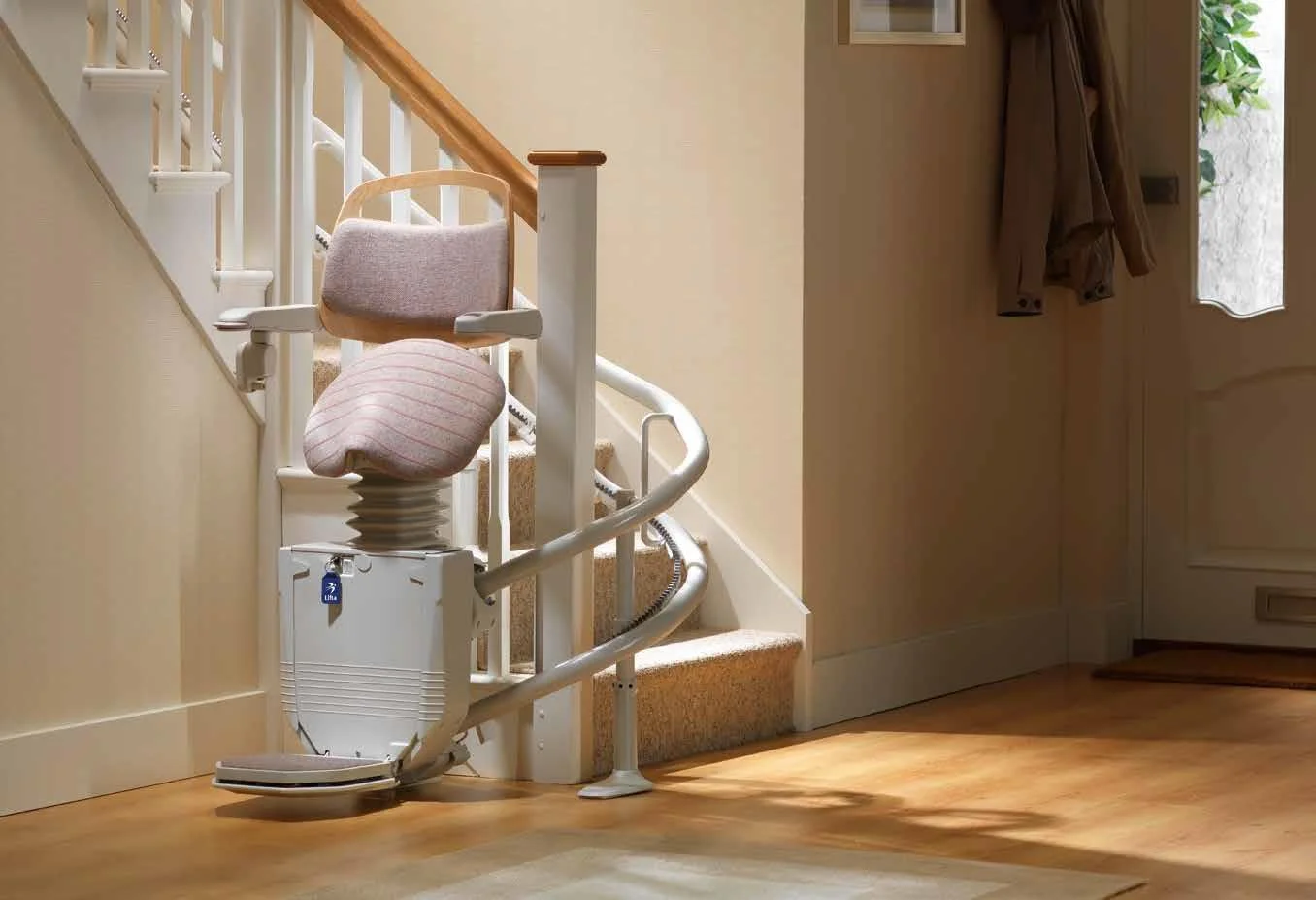
Split-level homes often have more than one short flight, or a landing with a turn. Those call for a curved lift with a custom rail, or separate straight units for each flight. We measure every run before recommending one or the other.
Many sloped lots in the county have steps up to the porch or a side door. An outdoor stair lift built for weather, or a platform lift for someone using a wheelchair, can handle that entry. Walk-up apartments and low-rise buildings need the building owner's permission first, so it helps to ask early.
For many families, that means a parent or spouse who wants to stay in a familiar house but is starting to avoid the stairs.
The local economy runs on healthcare, manufacturing and higher education, not high-wealth incomes. For a lot of households, help with the cost of a stair lift matters, which is why the next section is worth reading closely.
Be clear-eyed going in: none of the programs below names stair lifts as a covered item, and the VA's HISA grant specifically excludes stair glides. Several do fund home modifications in general, so it is still worth asking each one directly.
Two good first calls are both in Rome. The Northwest Georgia Regional Commission AAA at 1 Jackson Hill Dr. handles aging services for the county at (706) 295-6485. Veterans can reach the Georgia Department of Veterans Service Rome Field Service Office at 201 Calhoun Avenue, (706) 295-6026.
Rural homeowners with very low incomes may also look at USDA repair loans, though the property has to sit in a USDA-eligible area. The denser core of Rome is less likely to qualify than outlying unincorporated parts of the county.
Offers loans up to $40,000 at 1% fixed interest over 20 years, and grants up to $10,000 lifetime for homeowners age 62+, to very-low-income owners in USDA-eligible rural areas. The program description covers general repairs and health hazards and does not list stair lifts or accessibility changes.
Provides up to $126,526 for veterans with qualifying service-connected disabilities to adapt a home they own, with funds usable up to 6 times over a lifetime. The VA lists ramps and wider doorways as examples and does not mention stair lifts.
Provides up to $25,350 for structural adaptations for veterans with qualifying service-connected disabilities, and the home may be owned by the veteran or a family member. Stair lifts are not named in the program description.
Pays up to $6,800 or $2,000 lifetime, depending on disability status, for prescribed structural changes like ramps and roll-in showers. The VA explicitly excludes stair glides, so it does not cover a stair lift.
Serves Georgians 60 and older and their caregivers, and lists home modification and repair among its services, though stair lifts are not named. Call (866) 552-4464, or the Northwest Georgia Regional Commission AAA in Rome at (706) 295-6485.
A Medicaid waiver for older or disabled Georgians who meet nursing-facility level of care, covering services like personal care, adult day care and meals. Home modifications and stair lifts are not listed; call (877) 423-4746.
A Medicaid waiver for aged, blind or disabled Medicaid/SSI recipients needing nursing-facility level of care, offering care coordination, personal support and meals. Home modifications and stair lifts are not listed; call (877) 423-4746.
A Medicaid waiver for Georgians ages 21-64 with severe physical disabilities or traumatic brain injury, and it does list home modifications among its services, though stair lifts are not named. Call (800) 982-0411.
A state accessibility grant for Georgians with disabilities in owner-occupied homes, funding work like ramps, wider doorways and bathroom retrofits; stair lifts are not named. Call (770) 270-6860, and Floyd County applications route through the Northwest Georgia Center for Independent Living in Rome.
Based at 527 Broad Street in Rome, this center offers resources for ramps, wider doorways and bathroom changes for people of all ages with disabilities; stair lifts are not named. Call (706) 314-0008 to ask about an assessment.
Older adults
1 Jackson Hill Dr., Rome, 30161
Veterans
201 Calhoun Avenue, Rome, 30161
Yes. Split-level homes often have two or more short flights, which can be handled with separate straight lifts or one curved lift on a custom rail, depending on the layout.
Outdoor stair lifts are built for exterior steps, and platform lifts can serve someone in a wheelchair. Sloped lots with multi-step entries are common across Floyd County, so this comes up often.
The HISA grant explicitly excludes stair glides. The SAH and SHA grants fund home adaptations but do not name stair lifts, so ask the Rome Field Service Office at (706) 295-6026 about your situation.
Georgia's HCBS program serves people 60 and older and includes home modification and repair. The local office is the Northwest Georgia Regional Commission AAA at 1 Jackson Hill Dr., Rome, (706) 295-6485.
It depends on the address, since the home must be in a USDA-designated rural area. Homes in the denser core of Rome are less likely to qualify than those in outlying unincorporated parts of the county.
The Northwest Georgia Center for Independent Living, at 527 Broad Street, Suite 101 in Rome, offers home-modification resources. Call (706) 314-0008 to confirm the service area and how to request an assessment.
Tell us about the stairs in your home and we will explain which lift fits, what it costs and how installation works.
