In Unalaska, 59% of residents live on Amaknak Island, which makes up less than 3% of the census area's land. Homes there are packed onto hilly, volcanic ground that rises toward the 5,691-ft Makushin Volcano, so many houses sit on sloped or terraced lots with steps both inside and on the way to the front door.
St. Paul, out in the Pribilof Islands in the Bering Sea, faces its own version of the problem: no road connects it to Unalaska or anywhere else. This page walks through what that terrain and weather mean for choosing a stair lift, and which programs an Aleutians West household can call about paying for one.
Most housing here falls into a few types: single-family homes, detached houses, walk-up apartments and low-rise buildings. Unalaska had 776 housing units as of the 2020 census, and with so many built on sloped or terraced ground, the stairs are often not just between floors but also outside, climbing from the street to the door.
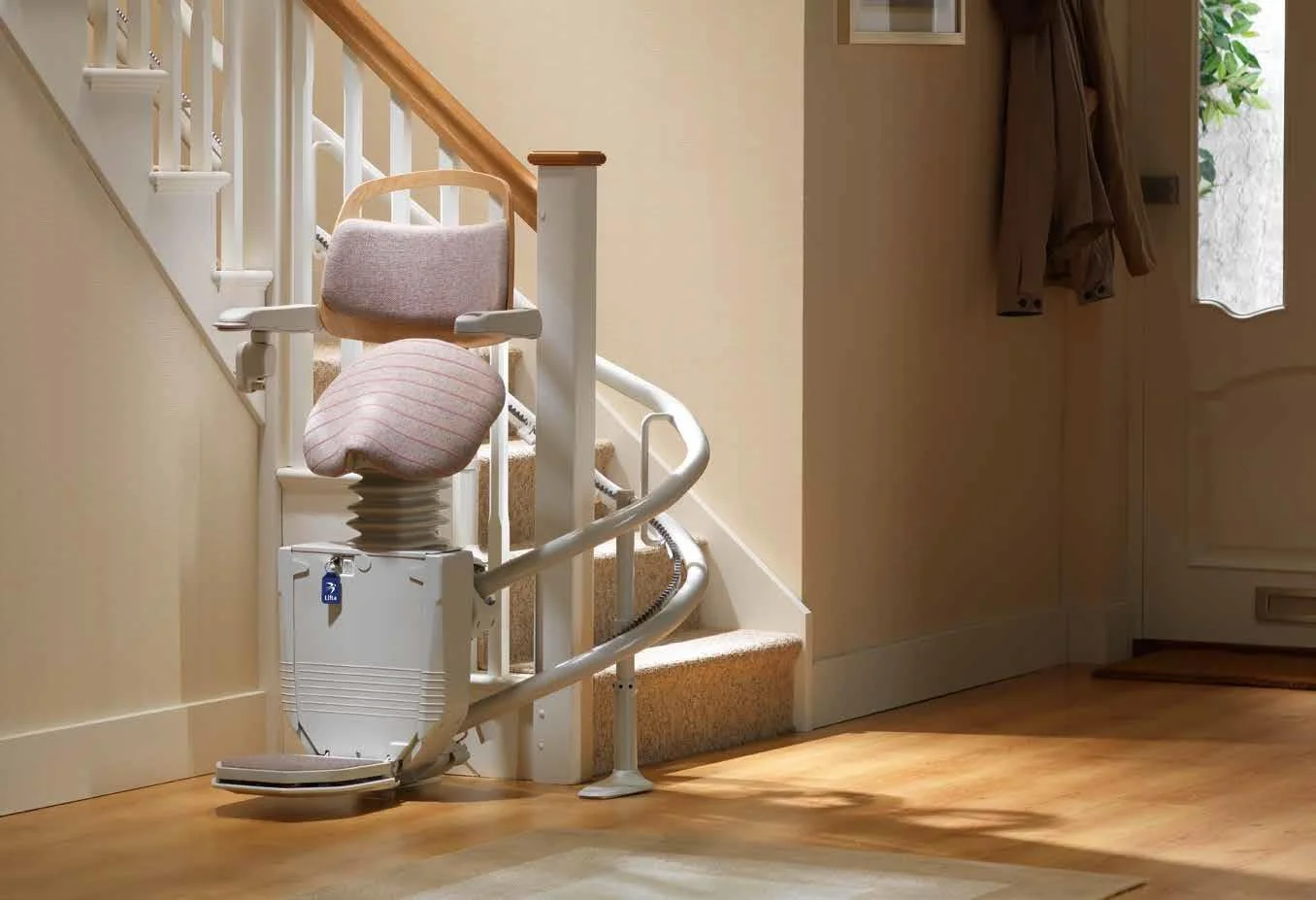
A straight indoor staircase is the simplest fit for a stair lift. Stairs that turn, split at a landing or wrap around a corner need a curved rail built to that staircase. When the hard part is the outside approach, an outdoor stair lift or a platform lift may make more sense than anything installed indoors.
Unalaska averages about 225 rainy days a year, among the rainiest totals in the United States. Add frequent fog, winter storms, high winds and over 81 inches of snow a year, and an outdoor set of steps becomes the most dangerous part of the house for someone with limited mobility.
An outdoor lift here has to be a unit built for exposure, not an indoor model moved outside. It also helps to plan where snow will pile up and how the rail and seat will be kept clear, since a lift that is buried or iced over does not help anyone get to the door.
Only 30.2% of residents are homeowners, so many people live in walk-up apartments or rented houses. Renters should get the landlord's agreement before any installation, and several of the funding programs below require that the applicant own the home.
That makes the VA grants worth checking, though it is important to know which ones name stair lifts and which one rules them out.
The local economy runs on commercial fishing and seafood processing, with Dutch Harbor in Unalaska among the largest fishing ports in the country by volume. That seasonal base limits local money for senior services and makes paying out of pocket hard for many households, so outside programs matter.
The practical first call is the Alaska Aging and Disability Resource Center at (877) 625-2372. It does not pay for a lift itself, but it is the statewide intake point for Medicaid waiver services and can screen you for other options. You can also ask about statewide programs such as the AHFC Senior Access Program (SAP) and HomeMAP – Home Modifications for Aging in Place.
For state aging services, the Alaska Commission on Aging / Senior & Disabilities Services is at (907) 465-3250. Veterans can reach the Alaska Office of Veterans Affairs at (907) 334-0874. Both offices are in Anchorage, so plan on handling most of the process by phone.
A federal grant of up to $126,526 for a permanent home (FY2026) for veterans with qualifying service-connected disabilities who own or plan to own the home. The VA source does not mention stair lifts by name, so ask the VA whether a lift can be part of your adaptation plan.
A federal grant of up to $25,350 for a permanent home (FY2026) for veterans or qualifying family members who own the home and have disabilities such as loss of both hands or severe burns. The VA source covers adaptations only generally and does not name stair lifts.
A lifetime grant of $6,800 for a service-connected disability or $2,000 for other disabilities, applied for through the local VA Prosthetic and Sensory Aids Service. HISA explicitly excludes porch lifts and stair glides, so it will not pay for a stair lift.
A 1% fixed-rate loan up to $40,000 and, for very-low-income homeowners 62+, a grant up to $10,000 for owner-occupied homes in eligible rural areas. Accessibility changes are listed only generally and stair lifts are not named, so confirm current terms with a local USDA Rural Development office.
For people 65+ who meet nursing-facility level of care, this waiver can fund home modifications up to $18,500 per 3-year period, submitted by a care coordinator. Stair lifts are not named in the source; start by calling (877) 625-2372.
Covers adults ages 21-64 who meet nursing-facility level of care, with the same E-Mod cap of up to $18,500 per 3-year period. Stair lifts are not named in the source; call (877) 625-2372 to begin.
Serves Alaska Native and American Indian elders in the APIA region, including Unalaska, with services such as durable medical equipment, case management and fall-prevention education. Home modification is not named on the program page, so ask the Elder Program Coordinator at (907) 222-9721 whether those funds can go toward a stair lift.
A free statewide information and referral service that screens seniors, adults with disabilities and caregivers and connects them to Medicaid waivers and in-home services. It does not pay for a stair lift itself; call (877) 625-2372.
Older adults
550 W. 7th Avenue, Suite 1600, Anchorage, 99501
Veterans
4600 DeBarr Rd, Suite 180, Anchorage, 99508
The HISA grant will not, because it explicitly excludes stair glides and porch lifts. The SAH and SHA grants cover home adaptations for veterans who own their homes, but the VA source does not name stair lifts, so ask the VA directly. The Alaska Office of Veterans Affairs is at (907) 334-0874.
Yes, possibly. The APDD Medicaid waiver covers adults ages 21-64 who meet nursing-facility level of care, with an E-Mod benefit up to $18,500 per 3-year period. Call the ADRC at (877) 625-2372 to be screened.
The Alaska Aging and Disability Resource Center at (877) 625-2372. It is the statewide entry point for Medicaid waiver services and can point you to other programs that fit your situation.
It needs to be a model built for outdoor use. With about 225 rainy days a year in Unalaska, over 81 inches of snow and high winds, an indoor unit will not hold up outside, and you should plan for keeping the rail clear of snow and ice.
The APIA Elders Program offers durable medical equipment and fall-prevention education, but its program page does not name home modifications. Call Ashley Withrow, Elder Program Coordinator, at (907) 222-9721 and ask whether those funds can be used for a stair lift.
You will need your landlord's agreement before installation. Keep in mind that the VA SAH and SHA grants and the USDA Section 504 program all require that the applicant own the home.
Tell us about the stairs in your home and we will explain which lift fits, what it costs and how installation works.
