Calhoun County sits in the Appalachian foothills of east-central Alabama, and the ground is hillier here than in the flat coastal plains to the south. That shows up in the homes. Houses in Anniston, Oxford, Jacksonville and Piedmont often have entry steps, split-level layouts or a second story, and a home out toward Ohatchee, Choccolocco or Nances Creek may sit on a sloped lot with steps just to reach the porch.
This page walks through what those homes mean for a stair lift and how people in the county's 13 communities can look for help paying for one. If you are weighing a lift for a parent in Weaver or for your own house in Saks, the sections below cover the stair types we see, the local numbers that matter, and the programs worth a phone call.
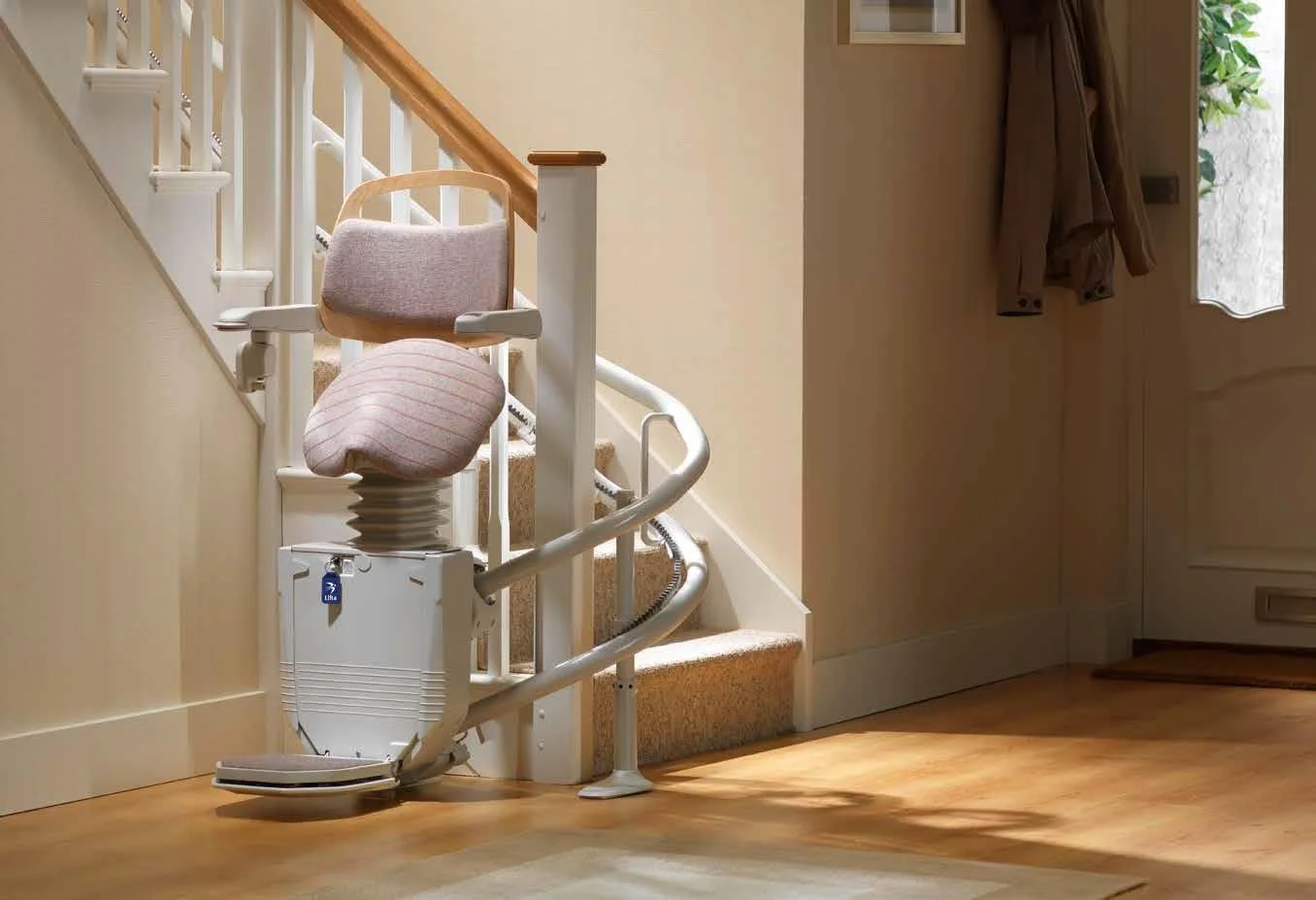
Much of the county's housing is older, typical of a historic industrial and railroad county. Single-family homes and detached houses make up a large share, along with townhouses, walk-up apartments and split-level homes. Each of these handles a lift a little differently.
A single flight with no turns, common in many two-story houses and townhouses, usually takes a straight stair lift. Stairs that turn at a landing, or a split-level with short flights that change direction, generally need a curved lift built to fit that staircase. In a walk-up apartment, the building owner has a say in what goes on a shared stairway, so that conversation comes first.
The county covers about 612 square miles, and about 36.5% of residents live in rural areas. Out past the Jacksonville and Oxford corridor, a house may have more steps outside than inside. An outdoor stair lift is built for weather and can carry someone from the driveway or yard up to the front door.
Where the climb is short but a wheelchair is involved, a platform lift may make more sense than a seat. During a home assessment we look at the slope, the number of steps and how the person gets around before suggesting a type.
About 17.6% of Calhoun County residents are 65 or older, and 67.7% of households own their home. Owning the house matters, because most lift installations and home modification programs assume the person living there owns it.
That makes the veterans programs below more than a side note for many families here, even though not every VA grant pays for a stair lift.
Budgets are tight for many households. The source we reviewed lists a median household income of $38,407 and 19.5% of the population below the poverty line, so outside help is often part of the plan.
The Alabama Elderly and Disabled (E&D) Medicaid HCBS Waiver lists home modifications as a covered service, and local intake runs through the East Alabama Regional Planning & Development Commission/AAA at 1130 Quintard Ave., Suite 300, Anniston, phone (256) 237-6741. Veterans should start with the Calhoun County Veterans Service Office at 1702 Noble Street, Suite 109, Anniston, phone (256) 241-2950.
Other statewide programs to ask about include the State of Alabama Independent Living (SAIL) Waiver, the Alabama Community Transition (ACT) Waiver, the Alabama Ability Loan Program (STAR / Southern Disability Foundation) and the Alabama Senior / Disabled Homestead Exemption (H-2 / H-3). The program list below explains what each local option says about stair lifts.
A Medicaid waiver for people 65 and older, or younger if disabled, who meet a nursing-facility level of care; home modifications are a covered service, though stair lifts are not itemized and no dollar cap is stated. Call (800) 243-5463, or the East Alabama Regional Planning & Development Commission/AAA at (256) 237-6741 for local intake.
Repair loans up to $40,000 at 1% interest for 20 years, and grants up to $10,000 for homeowners 62 and older in eligible rural areas who cannot repay a loan. The source names accessibility needs in general terms but does not list stair lifts, so confirm with USDA Rural Development.
A lifetime grant of up to $6,800 or $2,000 for medically necessary home changes, depending on disability status. The VA explicitly excludes stair glides and porch lifts, so HISA does not pay for a stair lift; the VA benefits line is (800) 827-1000.
Grants for veterans with qualifying severe service-connected disabilities, up to $126,526 for SAH and $25,350 for SHA in FY2026, that fund home modifications, which can include stair lifts. Call (800) 827-1000.
Helps Calhoun County veterans and dependents apply for VA benefits, including HISA and SAH/SHA; it is not a cash grant and does not list a stair lift benefit of its own. Call (256) 241-2950 or visit 1702 Noble Street, Suite 109, Anniston.
Its service area includes Calhoun County, but its structured Home Modification program is limited to the City of Birmingham and does not mention stair lifts. Call (205) 251-2223 to ask what help is available to Calhoun County residents.
Older adults
1130 Quintard Ave., Suite 300, Anniston, 36202
Veterans
1702 Noble Street, Suite 109, Anniston, 36201
Yes, possibly. The Alabama Elderly and Disabled (E&D) Medicaid HCBS Waiver accepts people younger than 65 if they are disabled and meet a nursing-facility level of care. The USDA grant portion, by contrast, is limited to homeowners 62 and older.
It depends on the grant. HISA excludes stair glides, so it will not. SAH and SHA grants fund home modifications for veterans with qualifying severe service-connected disabilities, and a stair lift can fall under that. The Calhoun County Veterans Service Office at (256) 241-2950 can help you apply.
Local intake for Calhoun County goes through the East Alabama Regional Planning & Development Commission/AAA at 1130 Quintard Ave., Suite 300, Anniston, phone (256) 237-6741. Ask them to confirm current covered services and any cap on home modifications.
For 2026, the monthly income limit is up to $2,982 for a single applicant and the asset limit is $2,000. Equity in your primary home is generally exempt up to $1,130,000.
The USDA Section 504 program serves owner-occupants in eligible rural areas, with loans up to $40,000 at 1% and grants up to $10,000 for homeowners 62 and older. Stair lifts are not named on the source, so check eligibility and covered repairs with USDA Rural Development.
Often, yes. An outdoor stair lift is made for exterior steps, and a platform lift can work when a wheelchair needs to go up a short climb. A home assessment looks at the slope and number of steps before recommending one.
Tell us about the stairs in your home and we will explain which lift fits, what it costs and how installation works.
