Walk through the older part of Sistersville and you can still see the boom years. The town grew from about 1,000 to 7,000 residents after the 1892 Polecat and 1894 Big Moses gas discoveries, and many of the multi-story Victorian-era homes from that time still stand, original staircases and all.
Up the road in Middlebourne, the county seat, and out in the hollows, the homes are more often two-story farmhouses and modest rural houses set into hillsides. This page covers what those homes mean for a stair lift and which programs can help Tyler County families pay for one.
Sistersville keeps a dense core of Victorian-era homes and commercial buildings, including the 1895 red-brick Wells Inn, listed on the National Register of Historic Places in 1972. Homes from that era were built with original staircases that are typical candidates for a stair lift retrofit.
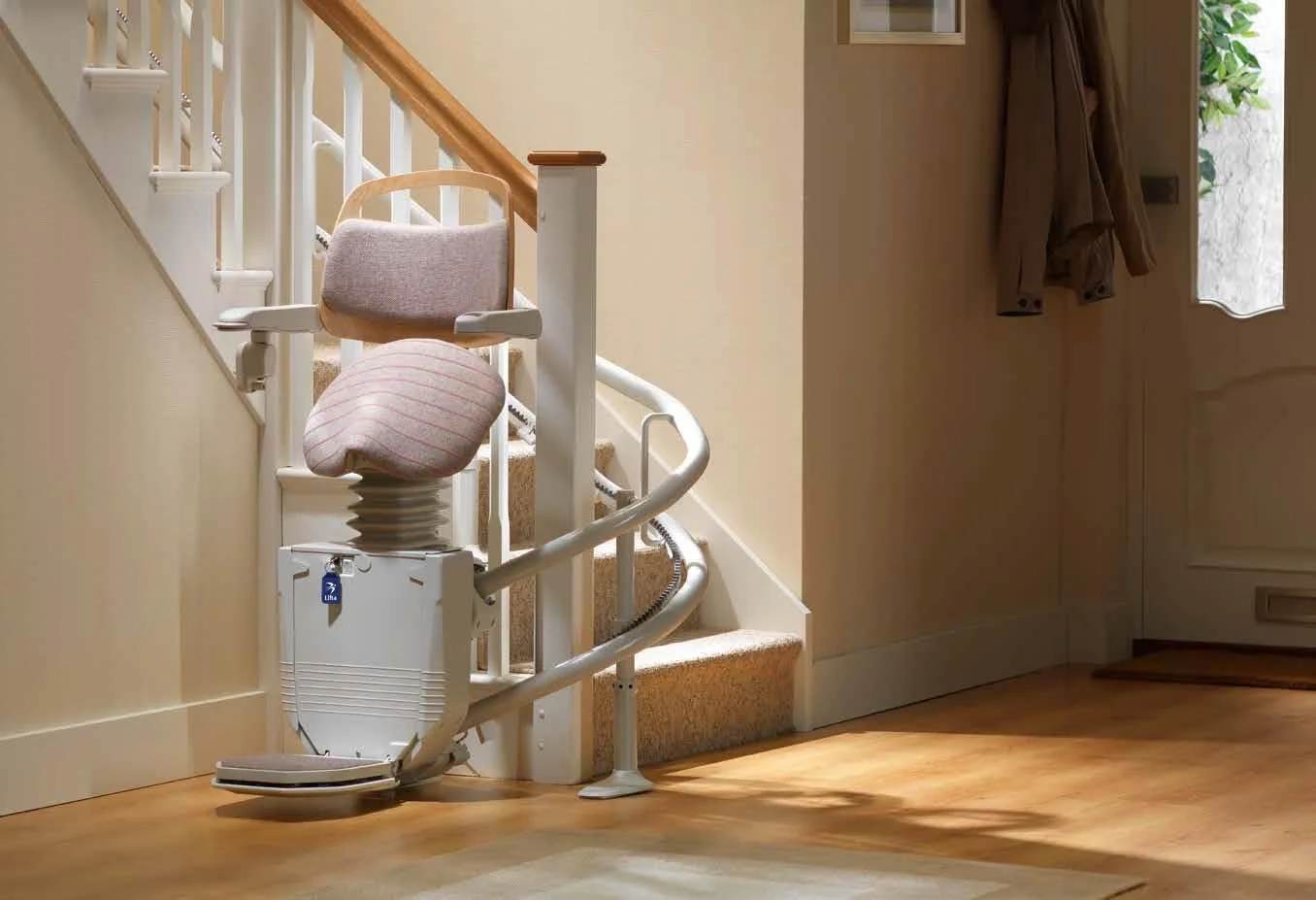
A straight run of stairs takes a straight rail, which is the simplest install. If the staircase turns at a landing or curves on the way up, it needs a curved rail built to fit that exact stair. We measure the steps, landings and width before recommending either one.
Tyler County covers about 261 square miles of the Appalachian Plateau, bordered on the west by the Ohio River. Elevation runs from 620 feet at Bens Run on the river to about 1,444-1,500 feet near Owlshead, and the land between is cut by narrow hollows and V-shaped valleys.
That terrain shapes the houses. Many farmhouses and hillside properties outside the river-bottom towns have several interior levels or entries reached by exterior steps. For those homes, an outdoor stair lift on the front or back steps can matter as much as one inside, and some families pair a lift with a ramp.
Split-level homes bring their own puzzle, with short flights between floors. Ranch-style homes may only need help at a basement stair or a few entry steps.
At the 2020 census, Tyler County had 8,313 residents and a median age of 47.5, with 23.8% of residents age 65 or older. About 75.2% of households own their homes.
In a rural, low-density county, moving to a single-story house is often not a realistic option. Fitting the stairs in the home a family already owns is usually the practical route.
Incomes here run lower than in many places; the 2010-era median household income was $33,496 and the poverty rate was 18.1%. That makes public and nonprofit help worth checking before paying out of pocket.
The West Virginia Aged and Disabled Waiver lists home modifications as a covered service, and the WV Bureau of Senior Services runs a Home Modification and Accessibility Program for people 60 and older. The Council of Senior Tyler Countians in Middlebourne is a good first local call.
The VA HISA grant does not pay for stair glides, so veterans should ask about other VA options. The West Virginia Department of Veterans Assistance - Parkersburg Benefits Office can be reached at (304) 420-4982. The West Virginia Technology-Related Assistance Revolving Loan Fund is another statewide program to ask about.
A statewide Medicaid waiver that lists home modifications as a covered service, and a stair lift can be included when documented as medically necessary in the service plan. Tyler County residents apply through the Region I Area Agency on Aging; call (866) 767-1575.
State-funded help with home modifications and accessibility devices for people age 60 or older who need them to live more independently, applied for by mail. Call (866) 981-2372.
The designated aging agency for Tyler County and the coordination point for ADW applications; its source does not list a stair lift benefit. Call (304) 242-1800.
The local senior center in Middlebourne, offering meals, transportation and other services; stair lifts are not listed, but it is the first local contact for connecting to aging-in-place funding. Call (304) 758-4919.
Loans up to $20,000 at 1% interest and grants up to $7,500 for homeowners 62 and older to repair homes or remove health and safety hazards; stair lifts are not named, so confirm with Rural Development at (304) 284-4860.
Pays for permanent alterations such as ramps and roll-in showers, up to $6,800 or $2,000 depending on disability status. It explicitly does not cover stair glides.
Grants of up to $126,526 (SAH) or $25,350 (SHA) in FY2026 for veterans with qualifying severe service-connected disabilities to adapt a home; stair lifts are not specifically named. Call (800) 827-1000.
Helps people with disabilities who meet income guidelines with items such as ramps, roll-in showers and grab bars, with a waiting list when funds are limited; stair lifts are not named. Call (304) 525-3324 to confirm Tyler County service.
Older adults
1900 Kanawha Blvd. East, Charleston, 25305
Veterans
1824 Murdoch Avenue Suite F101, Parkersburg, 26101
The Council of Senior Tyler Countians in Middlebourne at (304) 758-4919 is the first local point of contact. They can connect you to state and federal aging-in-place funding.
It can. Home modifications are a covered service, and a stair lift can be included when it is documented as medically necessary in the service plan. The waiver is not an entitlement, so waiting lists are possible.
For 2026, a single applicant can have income up to $2,982 per month. The asset limit is $2,000 for a single person and $3,000 for a couple, and the applicant must be 65 or older, or 18-64 and disabled, and need a nursing facility level of care.
Yes. The WV Bureau of Senior Services Home Modification and Accessibility Program starts at age 60. The ADW also accepts people age 18-64 who are disabled per an SSA determination.
No. The VA page excludes stair glides as removable equipment. HISA does cover permanent changes like ramps, which some hillside homes here also need.
Many Tyler County farmhouses and hillside homes have entries reached by exterior steps, and an outdoor stair lift is built for that. We would look at the steps on site to see if an outdoor lift or a ramp fits better.
Tell us about the stairs in your home and we will explain which lift fits, what it costs and how installation works.
