Keyser once had a Baltimore & Ohio Railroad roundhouse, and Piedmont grew up around B&O shops and machine facilities. Those rail towns left Mineral County with a lot of older, multi-level homes from the early 20th century, the kind with a steep interior staircase between the living room and the bedrooms.
Add the county's terrain, from low river valleys up to the Allegheny Front, and many houses in Carpendale, Fort Ashby, Wiley Ford, Ridgeley and the rest of the county sit on sloped lots with steps at more than one entrance. This page walks through what that means for a stair lift and where to look for help paying for one.
Two-story homes in Keyser and Piedmont often have a single straight run of stairs. That is usually the simplest and least involved stair lift to fit, because the rail runs in one line from the bottom step to the top.
Older staircases can be narrow, so we measure the width, check the landing at the top, and look at where a door or wall might get in the way of the seat. A rail mounts to the stair treads, not the wall, which matters in homes with old plaster.
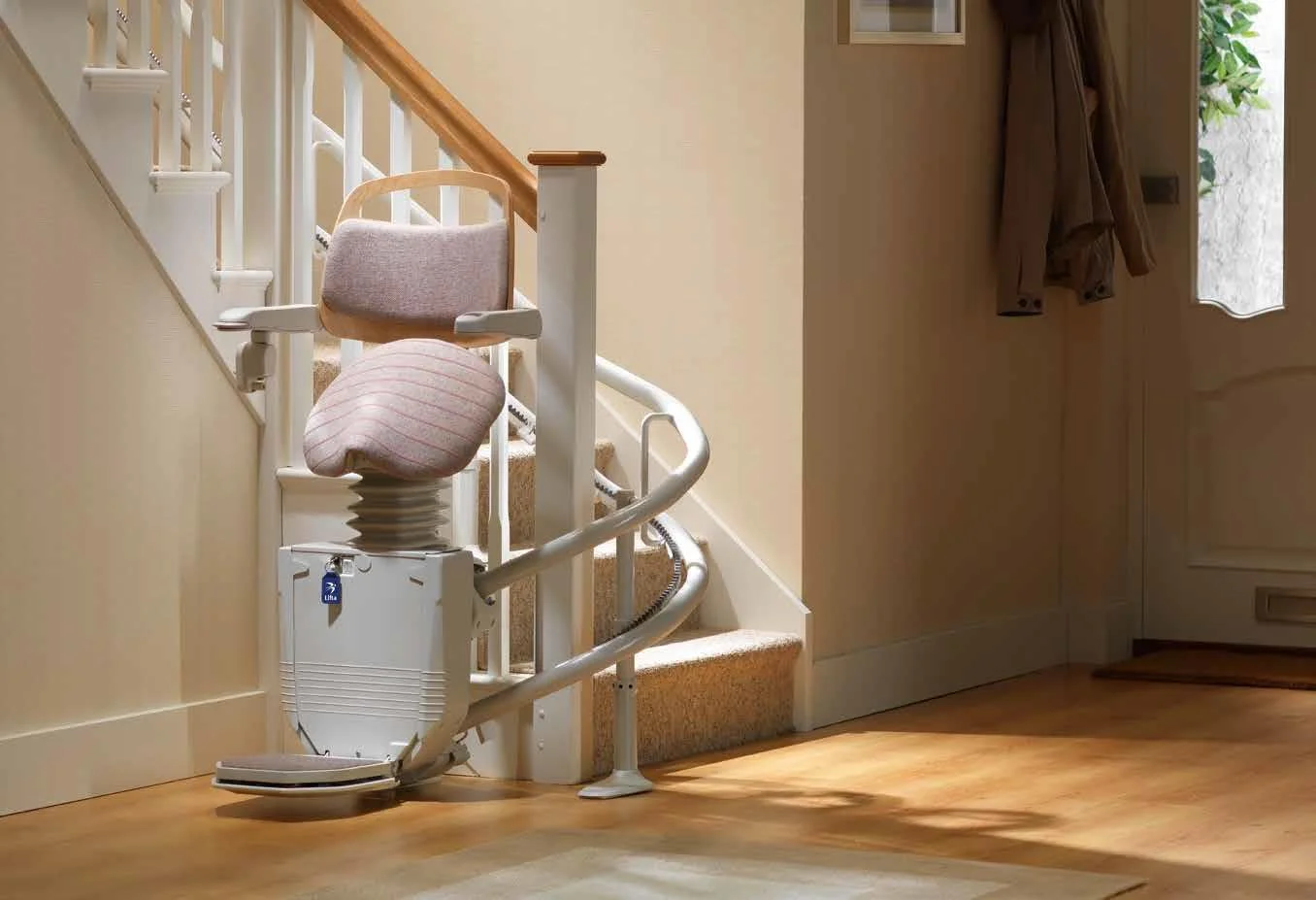
Split-level homes, townhouses and some detached houses have stairs that turn at a landing or come in short flights between floors. A straight rail will not follow a turn, so these homes often need a curved stair lift built to the shape of the staircase.
Short half-flights in a split-level are worth a close look. Sometimes one lift covers the main route, and sometimes a second short run makes more sense than a long custom rail.
Mineral County covers 329.3 square miles, and the Allegheny Front rises roughly 3,000 feet above the North Branch Potomac River along the Maryland line. On hillside lots, the hardest steps are often outside: from the driveway to the porch, or from the yard to a back door.
An outdoor stair lift is built to handle weather on exterior steps. Where the climb is short and a wheelchair is involved, a platform lift can be the better fit. We look at every entrance before recommending one.
The county's median age is 44.5 years, older than the national average, and many residents have lived in the same long-held homes for years. Staying in a familiar house often means solving the stairs rather than moving.
If that includes someone in your family, the VA programs below are worth checking, though each has its own rules about what it will pay for.
Two West Virginia programs list home modifications as covered: the Aged and Disabled Waiver and the Bureau of Senior Services home modification program. Both have eligibility rules, and the waiver may have a waiting list, so it helps to call early.
Federal options include USDA repair loans and grants for rural homeowners and several VA grants. One VA grant, HISA, specifically excludes stair glides. For local guidance, Aging and Family Services of Mineral County is at (304) 788-5467, and the Region IV - Eastern Panhandle AAA in Martinsburg is at (304) 263-0876. Veterans can reach the West Virginia Department of Veterans Assistance - Moorefield Field Office at (304) 538-2839.
A Medicaid waiver for West Virginians age 65+, or 18-64 with a physical disability, who need a nursing facility level of care; home modifications are a covered service, with a 2026 monthly income limit of $2,982 and enrollment slots that may have a waiting list. Call the Mineral County office at (304) 788-4150.
A state program for West Virginia residents age 60+ who need home modifications or accessibility devices to live more independently, and it is listed as covering stair lifts. Call (866) 981-2372.
Repair loans and grants combined up to $50,000 for very-low-income homeowners in eligible rural areas, with grants (up to $10,000 lifetime) for owners age 62+ who cannot repay a loan; the source does not mention stair lifts specifically. Call (304) 284-4868.
A VA grant of up to $6,800 or $2,000 lifetime for medically necessary home changes, but it explicitly excludes stair glides and porch lifts, so it will not pay for a stair lift. Call (800) 827-1000.
Grants for veterans with certain severe service-connected disabilities, up to $126,526 (SAH) or $25,350 (SHA) for FY2026; the source does not list stair lifts as a covered item. Call (800) 827-1000.
Offers a free 30-day assistive technology device loan so West Virginians with disabilities can try equipment; the source does not mention stair lifts or home modifications. Call (800) 642-8207.
Provides meals, in-home care, housekeeping and transportation for residents age 60+ and disabled residents 18+, and serves as a local intake point for state aging programs; no stair lift program is listed. Call (304) 788-5467.
Older adults
229 E. Martin St., Suite 3, Martinsburg, 25401
Veterans
225 North Main Street, Moorefield, 26836
Usually, yes. A straight run is the most common setup in older two-story rail-town homes, and the rail attaches to the stair treads. We still check the width and the top landing before recommending a model.
Yes. Many homes in the county sit on sloped lots with steps at more than one entrance, and an outdoor stair lift is designed for exterior steps. For a short climb with a wheelchair, a platform lift may fit better.
The Aged and Disabled Waiver covers ages 18-64 with a physical disability, and the Bureau of Senior Services home modification program starts at age 60. USDA Section 504 grants require age 62+.
The HISA grant explicitly excludes stair glides. The SAH and SHA grants do not list stair lifts as a covered item. Call the VA at (800) 827-1000 or the Moorefield field office at (304) 538-2839 to ask about your situation.
Aging and Family Services of Mineral County at (304) 788-5467 is a local intake point for state aging programs. For the Aged and Disabled Waiver, the Mineral County office is at (304) 788-4150.
Tell us about the stairs in your home and we will explain which lift fits, what it costs and how installation works.
