From Welch and Gary to Iaeger, Bradshaw and Anawalt, McDowell County's houses sit wherever the mountains left room: narrow river hollows, creek bottoms and steep hillsides. Many were built during the coal boom, set right into or against a mountainside, so getting from the road to the bedroom can mean several sets of steps.
That layout shapes what kind of stair lift works in a given house. It also shapes the budget, since home values and incomes here run low. This page walks through both: which lift fits the homes in War, Davy, Northfork, Kimball and the rest of the county, and which programs to call about paying for it.
McDowell County lies in the Cumberland Mountains, part of the Appalachian Mountains, and covers 534.899 square miles of rugged ground. Its highest point is on Flat Top Mountain, at about 1,036 m (3,399 ft). The flat land is mostly narrow valley bottoms, so a lot of houses stand on sloped lots.
On a sloped lot, the trouble often starts outside. A home in Berwind or Crumpler may have porch steps up from the road, then another flight inside. An outdoor stair lift, rated for weather, can handle the porch or yard steps, and a second lift can cover the inside staircase.
Some entries are too steep, too short or too oddly shaped for a chair. In those spots a platform lift is worth a look, especially for someone who uses a wheelchair.
Single-family homes with one straight staircase are the simplest case. A straight stair lift runs on a rail fastened to the stair treads, not the wall, and it usually goes in fastest.
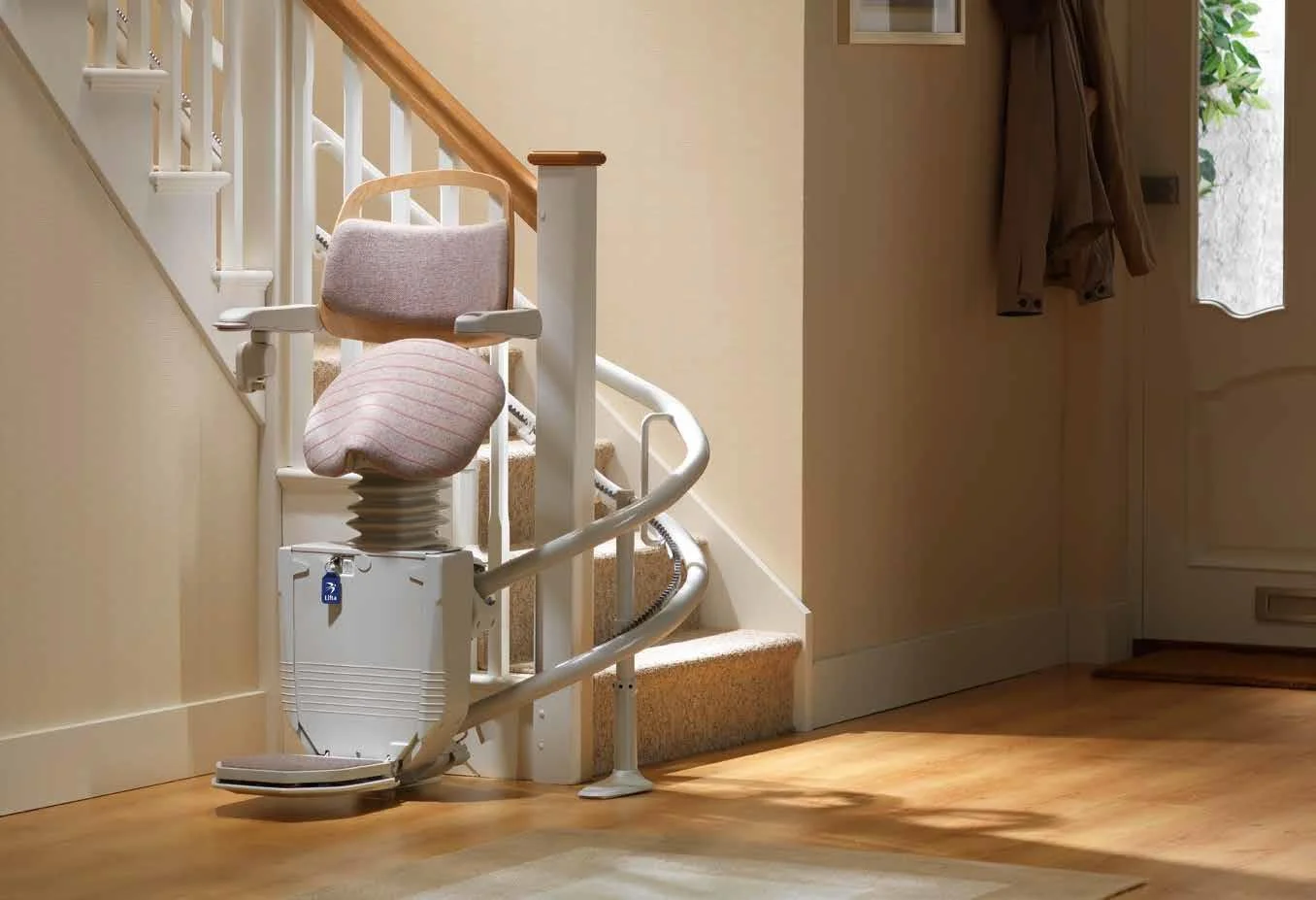
Split-level homes and older houses with landings or turns need a curved stair lift. The rail is built to follow that specific staircase, so it takes more measuring and more time to make.
Townhouses, walk-up apartments and low-rise buildings bring a different question: who owns the stairs. If the staircase is shared or the unit is rented, the owner or landlord needs to agree before anything is installed.
As of 2020 census data, 79.5% of occupied homes were owner-occupied, so most older residents own the house they live in.
Owning the home matters. You can approve the installation yourself, and several of the programs below, including USDA 504 and the VA housing grants, require that you own the home.
Home equity is thin here. The median home value was $57,096, and median household income in 2022 was $28,235. For many families, paying privately for a lift is hard, so lower-cost routes come first.
The main paths are the West Virginia Aged and Disabled Waiver, USDA Section 504 repair loans and grants, VA grants for eligible veterans, and Mountain State Centers for Independent Living. None of their sources name stair lifts as a covered item, and the VA HISA grant excludes stair glides outright. Call each one, describe the stairs, and ask directly.
For a first conversation, the McDowell County Commission on Aging at (304) 436-6588 is the local intake point. Veterans can reach the Princeton Veterans Assistance Office at (304) 425-5194, and the regional aging office, Region III - WVDA Southern AAA, is at (304) 340-3501.
A Medicaid waiver for adults 18+ who meet WV Medicaid financial rules and nursing-facility level of care; its EAA-Home service pays for physical adaptations to the member's home, though stair lifts are not named. Call (304) 558-3317.
The local starting point for aging services such as in-home care, meals, transportation and caregiver respite; it does not list home-modification funding but can steer you toward programs that do. Call (304) 436-6588.
Loans up to $40,000 at 1% for 20 years, and grants up to $10,000 for homeowners 62+ who cannot repay a loan, for very-low-income owners in rural areas like McDowell County. Accessibility modifications are covered, but stair lifts are not named in the source.
A VA grant of up to $6,800 or $2,000 depending on disability status for permanent changes like ramps and widened doorways. It does not cover stair glides or porch lifts.
Grants of up to $126,526 (SAH) or $25,350 (SHA) for homeowner veterans with qualifying severe service-connected disabilities, used to build, buy or remodel for accessibility. Stair lifts are not named among example modifications.
Helps people with disabilities in its service area, which includes McDowell County, stay home by coordinating home modifications and providing durable medical equipment; stair lifts are not itemized. Call (304) 255-0122.
Older adults
1900 Kanawha Blvd. East, Charleston, 25305
Veterans
195 Davis Street Suite 123, Princeton, 24739
No. The VA states that HISA does not cover stair glides or porch lifts. It does cover permanent changes like ramps, widened doorways and roll-in showers.
Its EAA-Home service pays for physical adaptations to the member's home, but the program does not mention stair lifts or a dollar cap. Call (304) 558-3317 and ask about your situation.
USDA Section 504 offers grants up to $10,000 over a lifetime for homeowners 62+ with very low income who cannot repay a loan. Younger owners may qualify for a 1% loan of up to $40,000.
An outdoor stair lift built for weather can run up exterior steps. If the steps are short or awkward, a platform lift may fit better, especially for a wheelchair user.
Call the McDowell County Commission on Aging at (304) 436-6588. Veterans can also call the Princeton Veterans Assistance Office at (304) 425-5194.
Tell us about the stairs in your home and we will explain which lift fits, what it costs and how installation works.
