Gilmer County spreads across 339.7 square miles of central West Virginia hill country, with Glenville as the county seat and home to Glenville State University. Outside town, houses sit scattered along the Little Kanawha River valley and up into the surrounding hills, often reached by U.S. Routes 33 and 119 or State Routes 5, 47 and 74.
Many of these homes are older, multi-story houses that still have their original stairways. That makes them common candidates for a stair lift retrofit. This page walks through what the local homes and terrain mean for choosing a lift, and which programs a Gilmer County family can call about paying for one.
Most housing here is single-family homes and detached houses, with split-level homes and ranch-style homes mixed in. The median home value is about $82,000, and the county has an older building base overall. Older stairways can be narrow or steep, so we measure the width, the pitch and what is at the top and bottom before recommending anything.
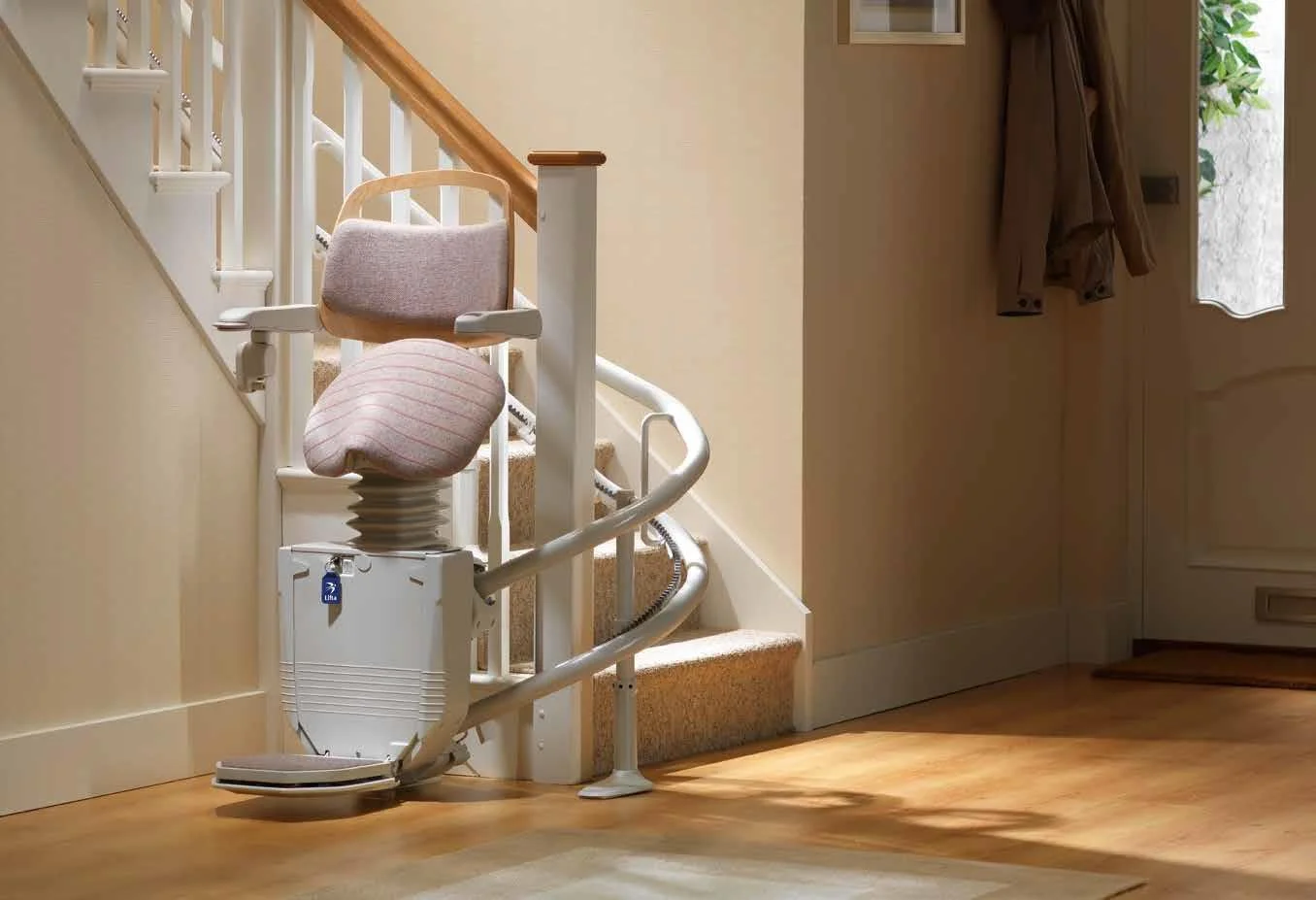
A single straight flight between floors is the simplest case and usually takes a straight stair lift rail. If the stairs turn at a landing or wrap around a corner, the rail has to be bent to fit, which means a curved lift. Split-level homes often have several short flights, and we look at whether one curved rail or separate straight lifts makes more sense for how the person moves through the house.
Hilly lots in central Appalachia often put the front door well above the driveway, with a run of outdoor steps or a steep porch. An outdoor stair lift is built for weather, and a platform lift can be the better choice when someone uses a wheelchair and cannot transfer to a seat.
The Little Kanawha River has flooded more than once, including a November 1985 flood that reached 13 feet above flood stage at Glenville. If your home sits low in the valley, it is worth talking through where the lift's motor and charging points go, especially on basement or lower-level stairs.
About 17.7% of Gilmer County residents are age 65 or older, and roughly 74.5% of homes are owner-occupied. That adds up to a lot of people who plan to stay in a house they own, on stairs they have climbed for years.
The county had 7,408 residents in 2020, about 21.8 people per square mile, which makes it one of the least populous counties in the state. Rural roads affect how quickly any contractor or in-home service can reach outlying homes, so it helps to plan an install and any follow-up service ahead of time rather than waiting for a fall.
Median household income in the county is about $45,870, below the West Virginia state average, so many families look for outside help before paying privately. Be aware that most of the programs below do not name stair lifts on their official pages. That does not always mean no, but you should ask directly and get any approval in writing before work starts.
A good first call is the Gilmer County Senior Center at (304) 462-5761, which can refer you to the Aged and Disabled Waiver and other aging services. Veterans can also reach the Spencer Veterans Benefits Office – West Virginia Department of Veterans Assistance at (304) 927-0980 for help sorting out VA options.
One firm answer: the VA HISA grant specifically excludes stair glides, so a veteran should not count on it for a stair lift. The USDA Section 504 program and the VA SAH and SHA grants are larger and worth asking about, depending on income, age and service-connected disability.
A Medicaid waiver for adults 18 and older who need a nursing-facility level of care; it includes Environmental Accessibility Adaptations for the home with no stated dollar cap, though stair lifts are not named. Call (304) 558-3317, or start through the Gilmer County Senior Center.
The Council of Senior Citizens of Gilmer County at 720 N Lewis St in Glenville offers in-home care, transportation, meals and referrals to benefit programs; stair lifts are not listed. Call (304) 462-5761 as a first stop for waiver applications.
Serves people with disabilities in a 13-county area that includes Gilmer County, with home modifications such as ramps, roll-in showers and grab bars decided case by case; stair lifts are not named. Call (304) 296-6091.
A short-term, 30-day device loan library that lets West Virginians with disabilities try equipment at home, with no disability documentation required; stair lifts are not named. Call (800) 841-8436.
Offers rural homeowners with very-low income loans up to $40,000 at 1% interest for 20 years, and grants up to $10,000 for those 62 and older who cannot repay a loan; accessibility work is covered, but stair lifts are not named. Call (304) 284-4860.
Pays up to $6,800 or $2,000 over a lifetime for medically necessary home changes for veterans in VA healthcare, but it specifically excludes stair glides and porch lifts. Call (304) 623-3461.
Grants for homeowning veterans with qualifying severe service-connected disabilities, up to $126,526 for SAH and $25,350 for SHA in FY2026; stair lifts are not specifically named. Call (304) 623-3461.
Helps Medicaid members who spent at least 90 consecutive days in a nursing facility, hospital or similar institution move back to a home, with deposits, household items and transition planning; home modifications are not itemized. Call (304) 720-6858.
Older adults
1900 Kanawha Blvd. East, Charleston, 25305
Veterans
216 Market Street, Suite 301, Spencer, 25276
No. The HISA grant's own rules exclude removable equipment such as porch lifts and stair glides. Veterans with a qualifying service-connected disability can ask about the SAH or SHA grants at (304) 623-3461, though those pages do not specifically name stair lifts either.
The Gilmer County Senior Center at (304) 462-5761 is a good starting point. It can refer you to the Aged and Disabled Waiver and other aging services in the county.
The USDA Section 504 program offers grants up to $10,000 over a lifetime to homeowners 62 and older with very-low income who cannot repay a loan, and loans up to $40,000 at 1% interest. Stair lifts are not specifically named, so ask the office at (304) 284-4860.
Split-level homes often have several short flights. Depending on the layout, that can mean a curved lift that follows the turns or separate straight lifts on each flight, which we decide after measuring.
WVATS runs a 30-day device loan library so you can try a device in your own home, with no disability documentation required. Call (800) 841-8436 to ask what is available.
Yes, but rural roads affect how quickly any contractor can reach outlying homes. Planning the install and service visits in advance helps.
Tell us about the stairs in your home and we will explain which lift fits, what it costs and how installation works.
