From the older streets of West Bend and Hartford to the subdivisions around Germantown and Richfield, Washington County homes come in a wide mix. The county seat and other historic communities like Slinger have older multi-story houses near their centers, while much of the growth in the late 20th century brought single-story suburban homes. That split matters a lot when a family starts asking whether a stair lift is needed at all.
The land itself plays a part too. Part of the Kettle Moraine State Forest sits in the county, and the glacial hills and moraines mean many lots slope, with steps at the front door, the back deck or the garage. Below we walk through how local homes and terrain shape the choice of lift, and which programs in Washington County can help with the cost.
Washington County had 58,311 housing units as of the 2020 census. In the historic cores of West Bend, Hartford, Slinger and Germantown, many of those are older multi-story homes where the bedrooms and the only full bath are upstairs. Those are the houses where a stair lift often decides whether someone can keep living there.
The newer single-story subdivisions built during the county's late-20th-century growth are a different story. If a ranch home has everything on one floor, the stairs that matter may only be the ones to the basement laundry or the steps at the entry. We look at which stairs a person actually uses every day before recommending anything.
Single-family homes are the most common setting, but split-level homes, townhouses and low-rise buildings are all part of the local housing stock. A split-level usually has short flights between levels, and a person may need to travel more than one of them to reach a bedroom and a bathroom.
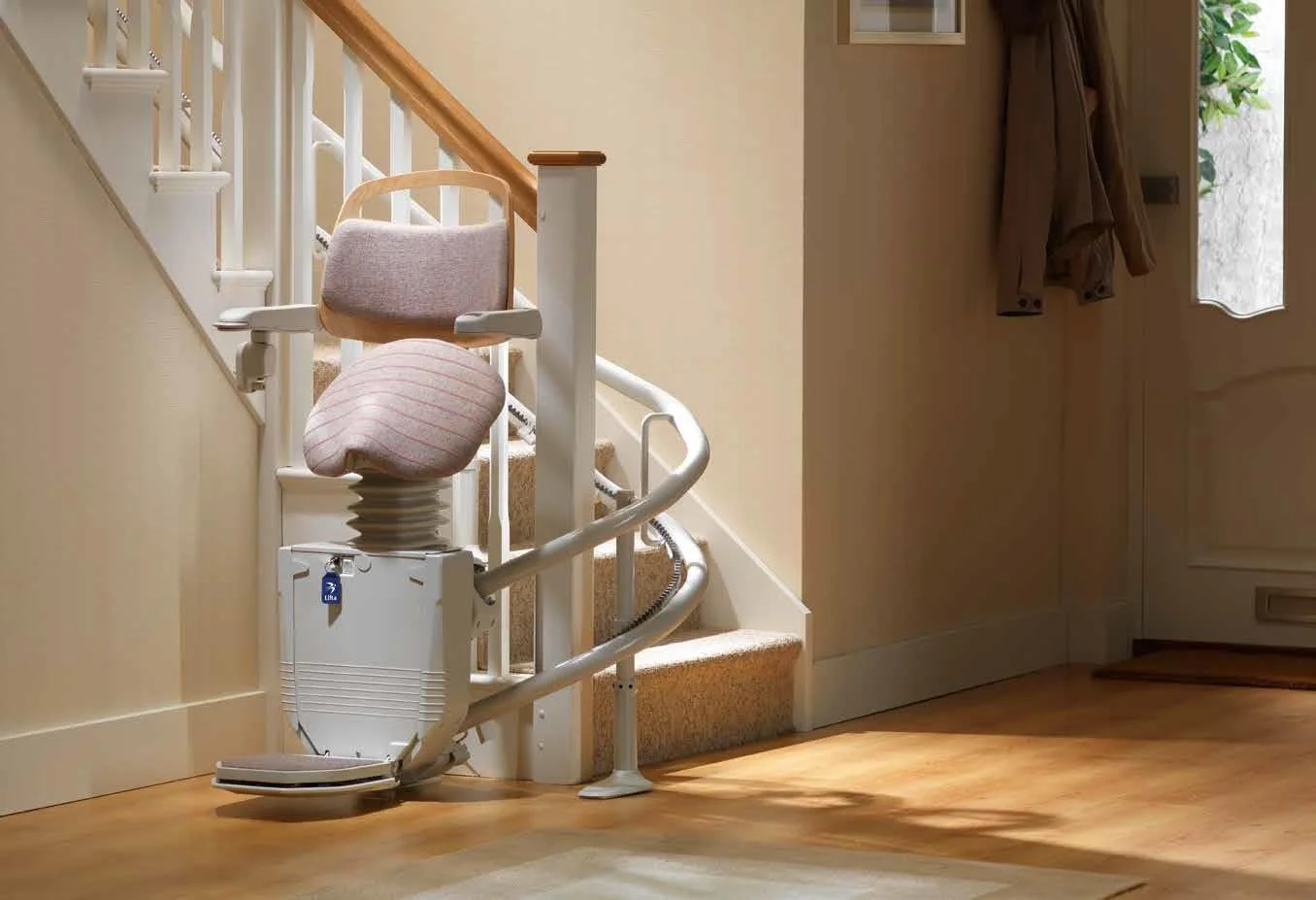
A straight staircase with no landing is the simplest fit for a straight rail. Stairs that turn, have a landing partway up, or connect several short flights call for a curved rail built to that staircase. In a townhouse or low-rise building, we also check who owns the stairway and whether permission is needed before anything is mounted.
Glacially formed terrain does not stay flat, and plenty of homes from Kewaskum to Jackson have a raised front porch or a set of steps down a slope. For those, an outdoor stair lift built for weather can be an option, or a vertical platform lift where a wheelchair needs to come along.
Outside the suburban areas near Milwaukee, the county gets more rural and hillier, with towns like Newburg and Allenton farther from the metro core. Homes there can be farther from service offices too, so it helps to plan an in-home visit that measures every set of steps at once, inside and out.
About 17.7% of Washington County residents are 65 or older, which is the age where the IRIS and Family Care programs open up without a disability requirement. Adults age 18 to 64 with a physical, developmental or intellectual disability can also qualify if they meet the level-of-care screening.
Washington County Veterans Services is at 333 E Washington Street Suite 3100 in West Bend, and you can reach them at (262) 335-4457 to sort out which VA benefits apply before spending on a lift.
The clearest source of help is the Wisconsin IRIS Medicaid Waiver, which explicitly lists stair lifts as a covered home modification within each person's self-directed budget. Enrollment goes through the Washington County ADRC at 333 E. Washington St., Suite 1100, West Bend, phone (262) 335-4497.
Other programs, like Family Care, the CDBG housing rehabilitation loan, USDA Section 504 and the Habitat for Humanity repair program, help with home repairs or modifications, but their materials do not name stair lifts. They are still worth a call. The VA HISA grant is different: it specifically excludes stair glides. The full list is below.
A self-directed Medicaid program for residents 65 and older, or 18 to 64 with a disability, who need a nursing facility level of care, and it explicitly lists stair lifts as a covered home modification. Enroll through the Washington County ADRC, or call (888) 515-4747.
Managed long-term care that covers home modifications such as grab bars, ramps and wider doorways within a member's care plan, though stair lifts are not named in the source. Call (800) 362-3002 and confirm with the managed-care organization what an individual plan can include.
The free local starting point for adults 60 and older and people with disabilities, offering counseling and enrollment help for IRIS and Family Care; it does not list a stair lift benefit of its own. Call (262) 335-4497.
A 0% interest, deferred-payment loan for income-qualified homeowners, repaid only when the home is sold or transferred; the program covers general home repairs and does not list stair lifts or accessibility work. Call (800) 552-6330.
Loans up to $40,000 at 1% interest, and grants up to $10,000 for very-low-income owners age 62 and older in eligible rural or small-town areas, for repairs and health and safety hazards. Stair lifts and accessibility modifications are not specifically named.
A VA grant of up to $6,800 or $2,000 lifetime for medically necessary permanent alterations like ramps and roll-in showers. It does not cover stair lifts; stair glides are specifically excluded.
Grants for veterans with qualifying severe service-connected disabilities, up to $126,526 for SAH or $25,350 for SHA in FY2026, for adaptations like ramps, wider doorways and accessible bathrooms; stair lifts are not mentioned. Washington County Veterans Services at (262) 335-4457 can help with applications.
A 0% interest repair loan for income-qualified homeowners who have lived in their home at least 2 years, covering items like accessibility ramps and step and handrail replacement; stair lifts are not mentioned. Call (262) 338-0690.
Independent-living services for people with disabilities of any age, including Alternatives in Mobility and Equipment Reuse & Exchange; no stair lift benefit is listed. Call the West Bend office at (414) 731-7834.
Below-market-interest loans for assistive technology for Wisconsin residents of any age with a disability, with no income requirement; the source does not specifically name stair lifts. Call (920) 490-0500 for current loan limits.
Older adults
333 E. Washington St., Suite 1100, West Bend, 53095
Veterans
333 E Washington Street Suite 3100, West Bend, 53095
Through the IRIS waiver, it can. IRIS explicitly lists stair lifts as a covered home modification within each participant's individualized budget. You apply through the Washington County ADRC at (262) 335-4497.
Yes, if they have a disability. IRIS and Family Care accept adults age 18 to 64 with a physical, developmental or intellectual disability who need a nursing facility level of care. WisLoan and IndependenceFirst also serve people with disabilities of any age.
No. IRIS is an entitlement program with no waitlist. For 2026 the monthly income limit for a single applicant is $2,982 and the asset limit is $2,000.
No. The VA excludes removable equipment such as porch lifts and stair glides from HISA. Veterans can call Washington County Veterans Services at (262) 335-4457 to look at other options.
The Washington County ADRC is at 333 E. Washington St., Suite 1100, West Bend 53095, phone (262) 335-4497. Its services are generally free regardless of income, and it is the intake point for IRIS and Family Care.
The Critical Home Repair Program lists handicap accessibility ramps and step and handrail replacement among its repairs, though not stair lifts. Homeowners in Washington County who meet income guidelines can call (262) 338-0690.
Tell us about the stairs in your home and we will explain which lift fits, what it costs and how installation works.
