In the city of Marinette, more than half of all homes (53%) were built before 1950, and 45% went up before 1940. That is roughly double the statewide rate of pre-1940 construction, and it traces back to the lumber boom that brought the city to 16,195 people in 1900. Many of those houses are multi-story wood-frame homes with full staircases to second-floor bedrooms and often a second set down to the basement.
Out past the county seat, homes in Peshtigo, Niagara, Crivitz, Coleman, Wausaukee, Pound and Pembine are spread across 1,399 square miles of forest, lakes and rivers. This page explains which kind of stair lift tends to fit the homes here, how distance and winter affect the job, and which county, state and VA programs are worth calling about before you pay out of pocket.
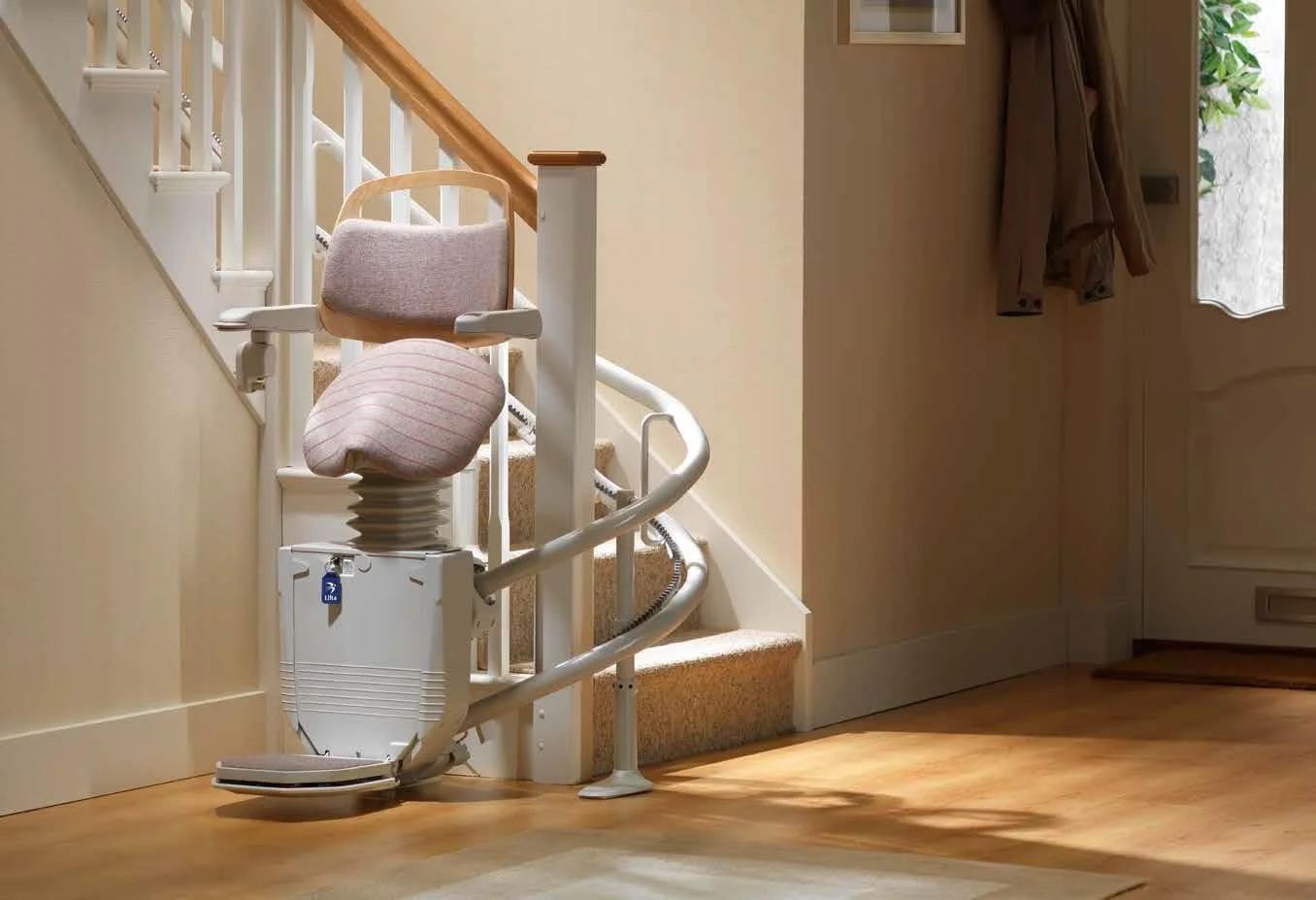
A full staircase from the front hall to the bedrooms is the most common job in a pre-1940 house. If that staircase runs straight from bottom to top, a straight stair lift is usually the simplest fit. If it turns at a landing or winds near the top, the rail has to be custom bent, which is a curved stair lift.
Basement stairs matter too. In a house where the laundry or the furnace is downstairs, a second lift on the basement steps can be as useful as the one going up. We measure both staircases on the same visit so you can see the whole picture.
Most housing across the county is single-family homes and detached houses, where the owner can decide on a lift and have it installed. In walk-up apartments and low-rise buildings, the stairs often belong to the building, so the landlord or owner has to approve any rail before work begins.
The 2020 Census counted 29,189 housing units in the county with a 35.8% vacancy rate, much of it seasonal and vacation housing. If a parent splits time between a home in town and a cabin on a lake, it makes sense to decide which house they will actually age in before buying a lift for either one.
Marinette County is the third-largest county in Wisconsin by land area, with about 29.9 people per square mile. Installers, ADRC outreach workers and program staff often cover long drives, and harsh winters can slow everything down. Starting paperwork and measurements early in the season helps.
Outdoor steps to a porch or deck take a lift built for the weather, and the cold here is a real test. Where a set of steps is short and the person uses a wheelchair, a platform lift may serve better than a seat. We talk through both options during the home visit.
About 20.6% of residents are 65 or older, and many of them live in the older houses described above.
In the city of Marinette, median household income was $31,700 against a state average of $43,800, and the median owner-occupied home value was $58,100 against $112,200 statewide. With numbers like that, it is reasonable to look at public and nonprofit help before assuming you have to pay the full cost yourself.
The best first call is the Marinette County ADRC, which is the local access point for Family Care and IRIS and has a Benefit Specialist. None of the programs below list stair lifts by name in the sources we reviewed, and the VA HISA grant specifically excludes stair glides, so ask each office directly what they will approve. The program list below gives the names and phone numbers.
A free information and assistance office for residents 60 and older and people with disabilities, and the access point for Family Care and IRIS; it does not list a stair lift benefit but has a Benefit Specialist and a Medical Equipment Loan Closet. Call (715) 732-3850.
A Medicaid managed long-term care program for frail elders 65 and older and adults 18 and older with qualifying disabilities; stair lifts are not listed in the source, so ask your case manager whether one can go in your service plan. Enrollment goes through the ADRC at (715) 732-3850.
A self-directed Medicaid long-term care option with the same eligibility as Family Care, where the member manages an individual budget; the source does not name stair lifts as a covered item. Enrollment goes through the ADRC at (715) 732-3850.
A VA grant of up to $6,800 for a service-connected disability or $2,000 for other disabilities, for medically necessary home changes; the VA explicitly excludes stair glides and porch lifts. Call (800) 827-1000.
VA grants for veterans with certain severe service-connected disabilities, up to $126,526 for SAH and $25,350 for SHA in FY2026; stair lifts are not named in the VA's examples. Call (800) 827-1000.
A HUD-funded rehab program for owner-occupied single-family homes with household income at or below 80% of County Median Income; it covers accessibility modifications in general, but stair lifts are not named. Call (608) 266-7531 to find the local HHR provider.
A deferred-payment, no-interest loan for low-to-moderate income households with an elderly or disabled member, repaid when the home is sold or no longer the main residence; it covers ramps and other home modifications, though stair lifts are not named. Call (920) 490-0500.
A statewide low-interest loan for Wisconsin residents with disabilities to buy equipment needed to live more independently; stair lifts and home modifications are not named in the source. Call (920) 490-0500.
Older adults
2500 Hall Ave., Suite B, Marinette, 54143
Veterans
1925 Ella Court, Marinette, 54143
No. The VA HISA page lists stair glides and porch lifts as excluded items. Veterans can still ask about SAH or SHA grants at (800) 827-1000, or visit the Marinette County Veterans Service Office at 1925 Ella Court, Marinette, (715) 732-7650.
Call the Marinette County ADRC. It serves residents 60 and older and people with disabilities, and it is the door into Family Care and IRIS. The program listing gives (715) 732-3850, and the office at 2500 Hall Ave., Suite B, Marinette lists (715) 732-7850.
The sources we reviewed do not list stair lifts for either program. In Family Care, ask the case manager whether a stair lift can be authorized in the service plan. In IRIS, ask whether it can be bought with the self-directed budget.
Yes, in some cases. Family Care and IRIS serve adults 18 and older with qualifying disabilities, and WisLoan is open to Wisconsin residents with disabilities. The ADRC also provides adult protective services for vulnerable adults under 60.
The building owner has to approve any lift on shared stairs. HHR only covers owner-occupied single-family homes, so renters should ask the ADRC and Options for Independent Living at (920) 490-0500 about other routes.
Each staircase needs its own rail. Many older Marinette homes have both, so we measure both on one visit and you can decide which one matters most first.
Tell us about the stairs in your home and we will explain which lift fits, what it costs and how installation works.
