Many houses in the City of Kenosha were built when Nash Motors and later American Motors Corporation drew workers to the lakefront. The city grew from 11,606 people in 1900 to 40,472 by 1920, and much of that growth became modest two-story homes, bungalows, and foursquare houses with interior stairways. Those stairs are where a stair lift usually goes.
Beyond the city, the county's 10 communities include Pleasant Prairie, Somers, Bristol, Salem Lakes, Twin Lakes, Paddock Lake, Powers Lake, Lily Lake, and New Munster. This page covers how local homes affect the kind of lift you need, and which county, state, and federal programs may help with the bill.
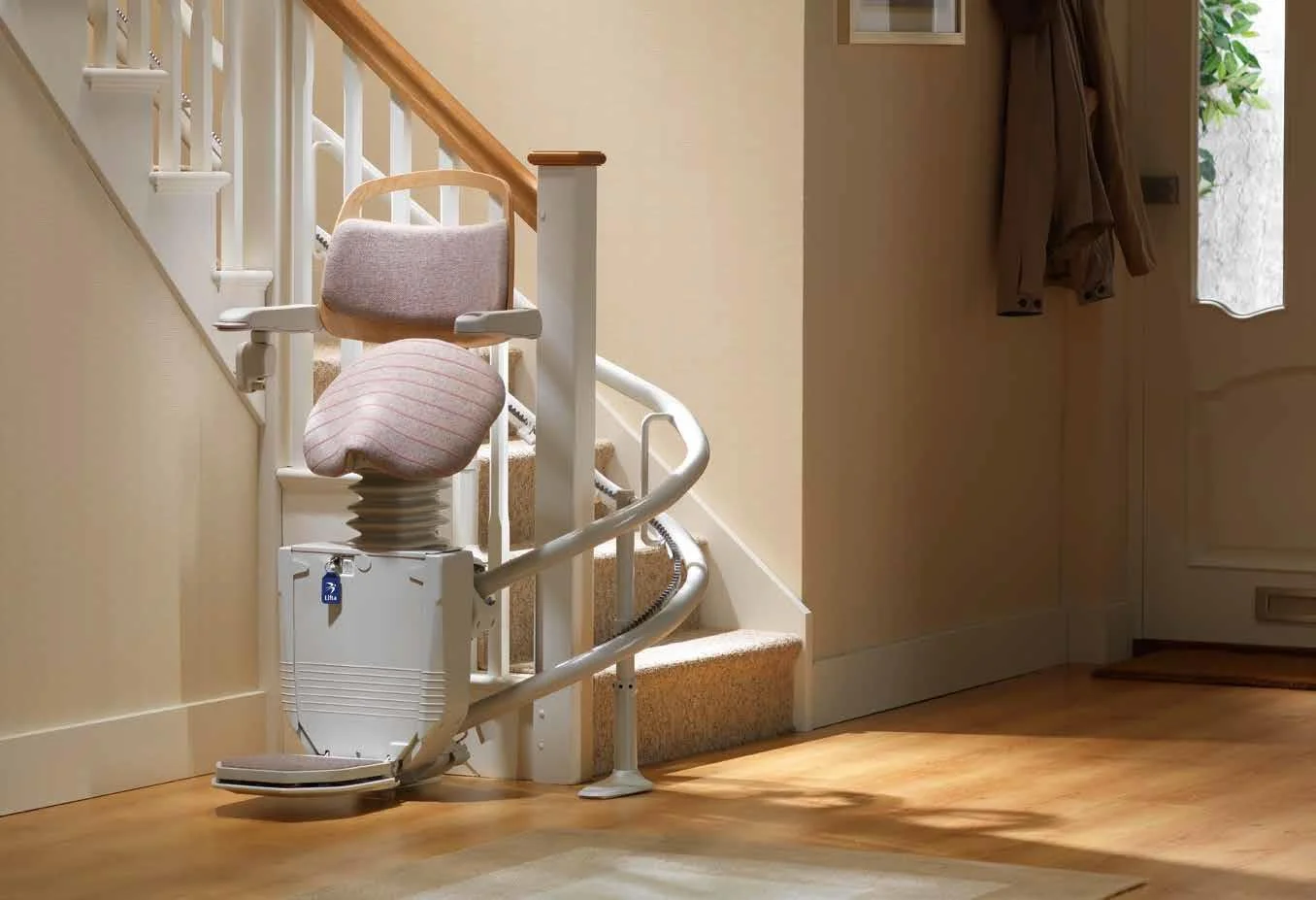
Kenosha's working-class neighborhoods from the factory boom are full of two-story homes, bungalows, and foursquares. In most of these, the bedrooms and often the only full bathroom are up a flight of stairs. A stair lift lets someone keep using the whole house instead of moving down to one floor.
A staircase that runs straight from bottom to top takes a straight rail, which is the simplest install. If the stairs turn at a landing or wind partway up, the lift needs a curved rail built to fit that staircase. We measure on site to tell you which one your home needs.
If your house sits in one of the city's National Register historic districts, such as Civic Center, Library Park, or Third Avenue, a stair lift mounts to the stair treads rather than the walls. That keeps changes to original woodwork small.
Housing in Kenosha County also includes townhouses, duplexes, detached houses, and low-rise apartments. In a townhouse or an upper duplex unit, the stairs are often the main way in and out, so a lift can matter for daily trips, not just bedtime.
Most of the county's land is a compact strip along Lake Michigan and the I-94 corridor. Only about 272 of its roughly 754 square miles are land, and much of the rest is water. Homes are close together, so many outside entries have a few porch or stoop steps.
Those outside steps can be handled with an outdoor stair lift built for weather, or with a vertical platform lift when someone uses a wheelchair. We look at both the inside stairs and the way into the house before recommending anything.
Kenosha County has about 160,249 residents, and 15.0% are 65 or older. About 66.5% of households own their home, which matters because most repair loans and grants listed below require that you own and live in the house.
Kenosha County Veterans Services at 8600 Sheridan Road, Suite 700, can help sort out which VA benefits apply; call (262) 605-6690.
None of the programs below name stair lifts by name in their sources, so coverage is never automatic. Several do cover home modifications, accessibility work, or safety repairs, and that is the opening to ask about. Start with the ADRC of Kenosha County at (262) 605-6646. It is a no-cost starting point and is also where you apply for IRIS and Family Care.
City of Kenosha homeowners can look at the city's rehabilitation loans, which list ADA modifications as an eligible improvement. Owners anywhere in the county may qualify for the Southern Housing Region program, a 0% interest loan you do not repay until you sell or move out.
For veterans, read the HISA details carefully: the VA source lists stair glides among removable equipment it does not cover. Statewide options you can also ask the ADRC about include the Community Options Program (COP) and the WHEDA Home Improvement Loan Program (HILP).
A self-directed Medicaid program for Wisconsin adults 18+ who are older or have a disability and meet the Long-Term Care Functional Screen; its budget categories include environmental accessibility adaptations (home modifications), though stair lifts are not named. Apply through the Kenosha County ADRC or call the IRIS line at (888) 515-4747.
A Medicaid long-term care program run through managed care organizations for adults 18+ with a long-term condition expected to last more than 90 days; the source does not list stair lifts or home modifications specifically. Enroll through the ADRC, or call Medicaid Member Services at (800) 362-3002.
A no-cost one-stop shop at 8600 Sheridan Road, Suite 500, offering options counseling, falls prevention, and a link to the Kenosha Area Loan and Supply Closet; stair lifts are not named. Call (262) 605-6646 or toll-free 800-472-8008.
A state loan for Wisconsin residents 18+ with a disability, or buying for someone with one, that covers home accessibility modifications and has no income limit; stair lifts are not named. No phone is listed; apply through a local independent living center or email [email protected].
Loans up to $40,000 at 1% over 20 years, and grants up to $10,000 for owners 62+, for very-low-income homeowners in eligible rural areas; stair lifts and accessibility work are not named. Much of Kenosha County is urban or suburban, so confirm your address qualifies at (800) 414-1226.
A lifetime benefit of $6,800 or $2,000, depending on disability status, for medically necessary home alterations for veterans. The source lists stair glides among removable equipment it does not cover; call (800) 698-2411 with questions.
Grants for veterans with qualifying severe service-connected disabilities, up to $126,526 for SAH and $25,350 for SHA in FY2026; examples given are ramps and wider doorways, and stair lifts are not named. Call (800) 698-2411.
Loans and grants for homeowners within Kenosha city limits, including a rehabilitation loan up to $45,000 that lists ADA modifications as eligible; stair lifts are not named. Call (262) 653-4030.
A 0% interest, deferred-payment loan for income-limited owner-occupants in 10 counties including Kenosha, with a $59,850 limit for a one-person Kenosha County household; accessibility work is listed for manufactured homes, but stair lifts are not named. Call (800) 552-6330.
Volunteer safety repairs, such as grab bars and porch rails, for homeowners 60 or older anywhere in Kenosha County, with limited funding and a possible waiting list; stair lifts are not named. Call (262) 658-3508.
Older adults
8600 Sheridan Rd., Kenosha, 53143
Veterans
8600 Sheridan Road, Suite 700, Kenosha, 53143
IRIS lists home modifications as a budget category, and Family Care arranges benefits through a care plan, but neither source names stair lifts. Ask the Kenosha County ADRC at (262) 605-6646 whether a lift can fit your plan.
The HISA grant source lists stair glides as equipment it does not cover. SAH and SHA grants do not name stair lifts either. Kenosha County Veterans Services at (262) 605-6690 can review what other VA benefits may apply.
Yes. KAFASI helps homeowners 60 and up anywhere in the county with safety repairs like grab bars and porch rails. Call (262) 658-3508, and expect a possible waiting list.
The Southern Housing Region program offers 0% interest loans repaid only when you sell the house or stop living there. It is income-limited and first come, first served; call (800) 552-6330.
No. The City of Kenosha rehabilitation loans are limited to properties inside city limits. Countywide options include the Southern Housing Region program, KAFASI, and the ADRC.
Usually, yes. A stair lift rail is fastened to the stair treads, not the walls, so it changes little of the original house. We confirm the fit during a home visit.
Tell us about the stairs in your home and we will explain which lift fits, what it costs and how installation works.
