From Watertown and Fort Atkinson to Lake Mills, Waterloo and the county seat in Jefferson, much of Jefferson County's housing grew up in 19th- and early-20th-century river towns. Older two-story homes and farmhouses with interior staircases are common here, and that staircase is often the one thing standing between a homeowner and staying put.
The county covers 583 square miles between Madison and Milwaukee, with people spread across 13 towns and townships instead of one big city. When the bedroom and bathroom are upstairs and the nearest relative lives a town or two away, a stair lift can be a practical way to keep using the whole house.
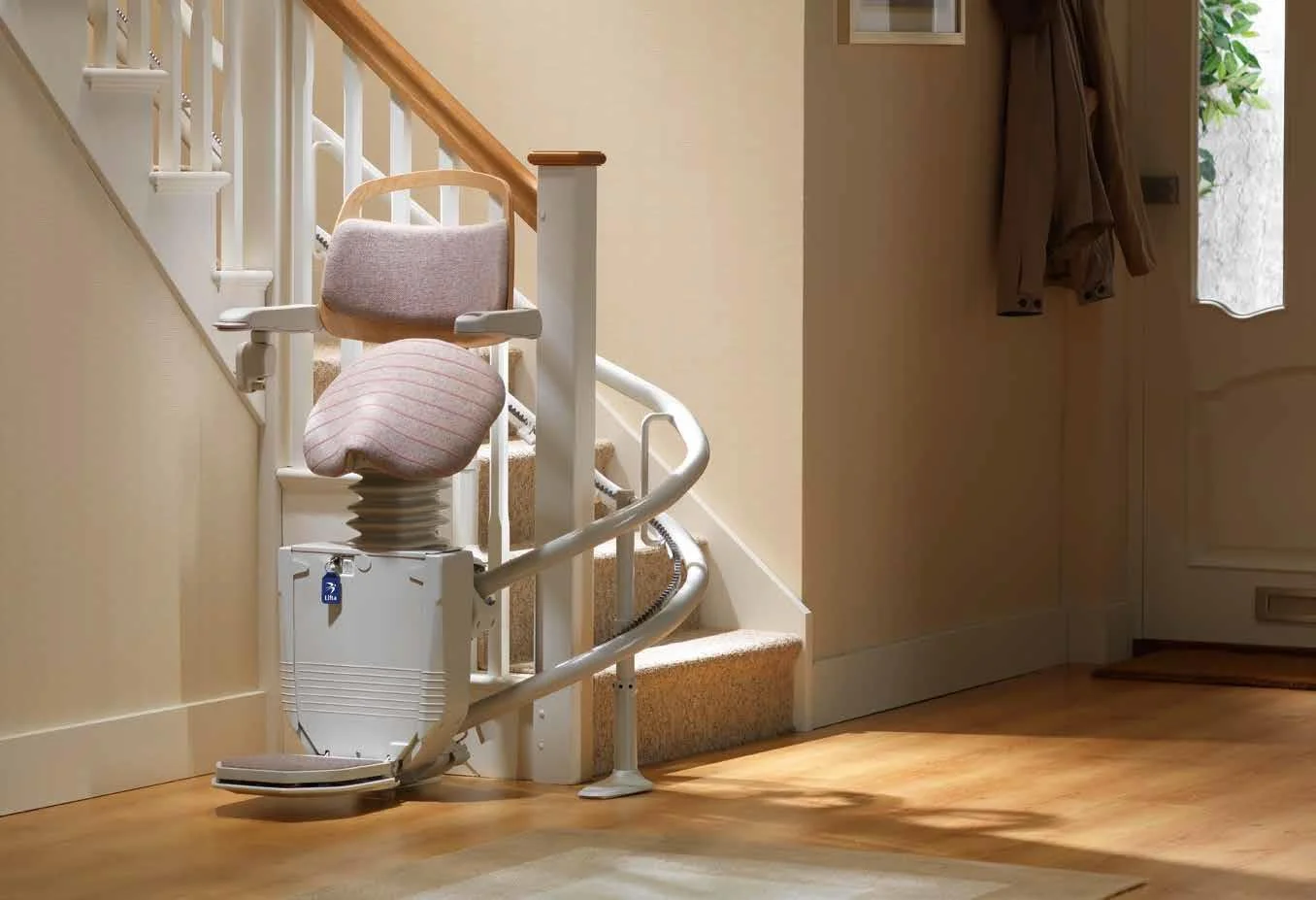
Many homes in places like Watertown, Jefferson and Fort Atkinson were built long before anyone planned for aging in place. Interior staircases in older two-story houses and farmhouses can be narrow, steep or turn partway up, so we measure each one before recommending anything.
A single straight run with no landing usually takes a straight stair lift, which is the simplest install. Stairs that turn at a landing or wind around a corner need a curved rail built to fit that specific staircase.
Split-level homes are part of the local mix, and they bring their own puzzle: short flights between several floors. The right answer depends on which levels the person actually needs to reach every day, and sometimes that means more than one lift.
Townhouses and low-rise buildings often have tighter stairwells. In a shared building, the owner or association may need to sign off before anything is mounted, so it helps to ask early.
Getting into the house can be as hard as getting upstairs, especially in a county where many older residents drive to appointments or use ADRC transportation help. Front porch steps and garage entries can sometimes take an outdoor stair lift built for Wisconsin weather.
For someone who uses a wheelchair, a seated lift may not be enough. A platform lift that carries the chair is the option to look at in that case, and it needs more space, so we check the entry layout first.
Jefferson County has a population of 65,553, and 17.9% of residents are 65 or older. About 67.4% of households own their homes, which matters because owners can usually make permanent changes like mounting a stair rail.
If someone in your family served, the county Veterans Service Office is worth a call before you pay out of pocket.
Two Wisconsin Medicaid long-term care programs, Family Care and IRIS, name stair lifts directly as a covered home modification. Both start with a screening through the ADRC of Jefferson County, which you can reach at (920) 674-8734 or at 1541 Annex Road in Jefferson.
Homeowners who don't qualify for Medicaid may look at the county's deferred-payment rehab loans or USDA Section 504 repair loans and grants, though neither names stair lifts specifically, so confirm with the administrator first. Other statewide options include the Community Options Program (COP), WisLoan (WisTech Alternative Loan Program) and the WHEDA Home Improvement Loan Program (HILP). Veterans should know that the VA HISA grant excludes stair glides, while the SAH and SHA grants do not mention stair lifts either way.
A Wisconsin Medicaid managed care program for adults 18 and older who need a nursing-home level of care, and stair lifts are named as a covered home modification, approved through the member's care plan. Call (866) 740-2372, with screening arranged through the Jefferson County ADRC.
A self-directed Medicaid waiver for people 65 and older, or 18 to 64 with a disability, who need nursing facility level of care; stair lifts are listed among covered home modifications. The 2026 income limit is $2,982 a month for a single applicant, and the IRIS Call Center is (888) 515-4747.
The county's information, assessment and referral office for older adults, people with disabilities and their caregivers, and the gateway into Family Care and IRIS. It is not a funding source and does not list stair lifts; call (920) 674-8734.
Zero-interest deferred loans, repaid when the home is sold or transferred, for homeowners at or below 80% of county median income; accessibility improvements are an eligible category, but stair lifts are not named. Call (920) 675-4607 to ask about your project.
Loans up to $40,000 at 1% and grants up to $10,000 for very-low-income homeowners in USDA-eligible rural areas, with grants limited to those 62 and older who cannot repay a loan. Stair lifts are not mentioned; call (800) 414-1226 and check whether your address qualifies.
A VA grant of up to $126,526 for FY2026 for veterans with certain severe service-connected disabilities to buy, build or change a home. The source does not mention stair lifts; start with the county Veterans Service Office at (920) 674-7240.
A VA grant of up to $25,350 for FY2026 for veterans with qualifying service-connected disabilities such as loss of use of both hands. Stair lifts are not named; call (920) 674-7240 for help applying.
A VA grant for medically necessary home changes, with a $6,800 or $2,000 lifetime maximum depending on the disability. Stair glides are specifically excluded from this benefit; call (920) 674-7240 with questions.
The local office that helps veterans and their families file VA and Wisconsin DVA benefit claims and appeals. It does not fund stair lifts itself but is the place to start for SAH, SHA and HISA; call (920) 674-7240.
Older adults
1541 Annex Road, Jefferson, 53549
Veterans
311 S. Center Avenue, Room 207, Jefferson, 53549
Family Care and IRIS both name stair lifts as a covered home modification for people who qualify for nursing-home level of care. Screening for both runs through the ADRC of Jefferson County at (920) 674-8734.
Yes. IRIS serves adults 18 to 64 with a physical, developmental or intellectual disability, and Family Care serves Medicaid-eligible adults 18 and older who need a nursing-home level of care.
No. The VA lists stair glides among the items HISA excludes. The SAH and SHA grants do not mention stair lifts either way, so call the Jefferson County Veterans Service Office at (920) 674-7240 to talk through options.
Possibly not. Parts of the county near Watertown, Fort Atkinson and Jefferson may fall outside the USDA rural boundary, while more rural townships may qualify, so check your address with USDA at (800) 414-1226.
Yes, eventually. Both county rehab programs are 0% deferred loans repaid when the home is sold or transferred, not grants. Call (920) 675-4607 to confirm a stair lift fits their accessibility category.
Usually, yes. Stairs with a turn or landing need a curved stair lift with a rail made for that staircase, so the first step is measuring the stairs in person.
Tell us about the stairs in your home and we will explain which lift fits, what it costs and how installation works.
