Iron County sits on Wisconsin's Gogebic Range along the Michigan Upper Peninsula border, with Hurley, Montreal and Mercer spread across 919 square miles of woods, water and old mining ground. Many houses here were built for iron miners and their families, and a lot of them still have the staircases they were built with.
Hurley sits in the Montreal River valley about 18 miles south of Lake Superior and averages over 160 inches of lake-effect snow per year. That means stairs are a concern both inside the house and out on the front steps. This page walks through what kind of lift fits local homes and which programs can help pay for one.
The Montreal Company Location Historic District, added to the National Register of Historic Places on May 23, 1980, is made up of mining-company buildings and employee houses built from 1907 to 1927. The layout was done by landscape architect Albert Davis Taylor.
Homes from that era came before modern accessibility standards. In former mining communities like Montreal and Hurley, many houses likely still have interior stairs from their original construction. Before quoting a lift, an installer should measure the width, the angle and any landings, because older stairs do not always follow today's patterns.
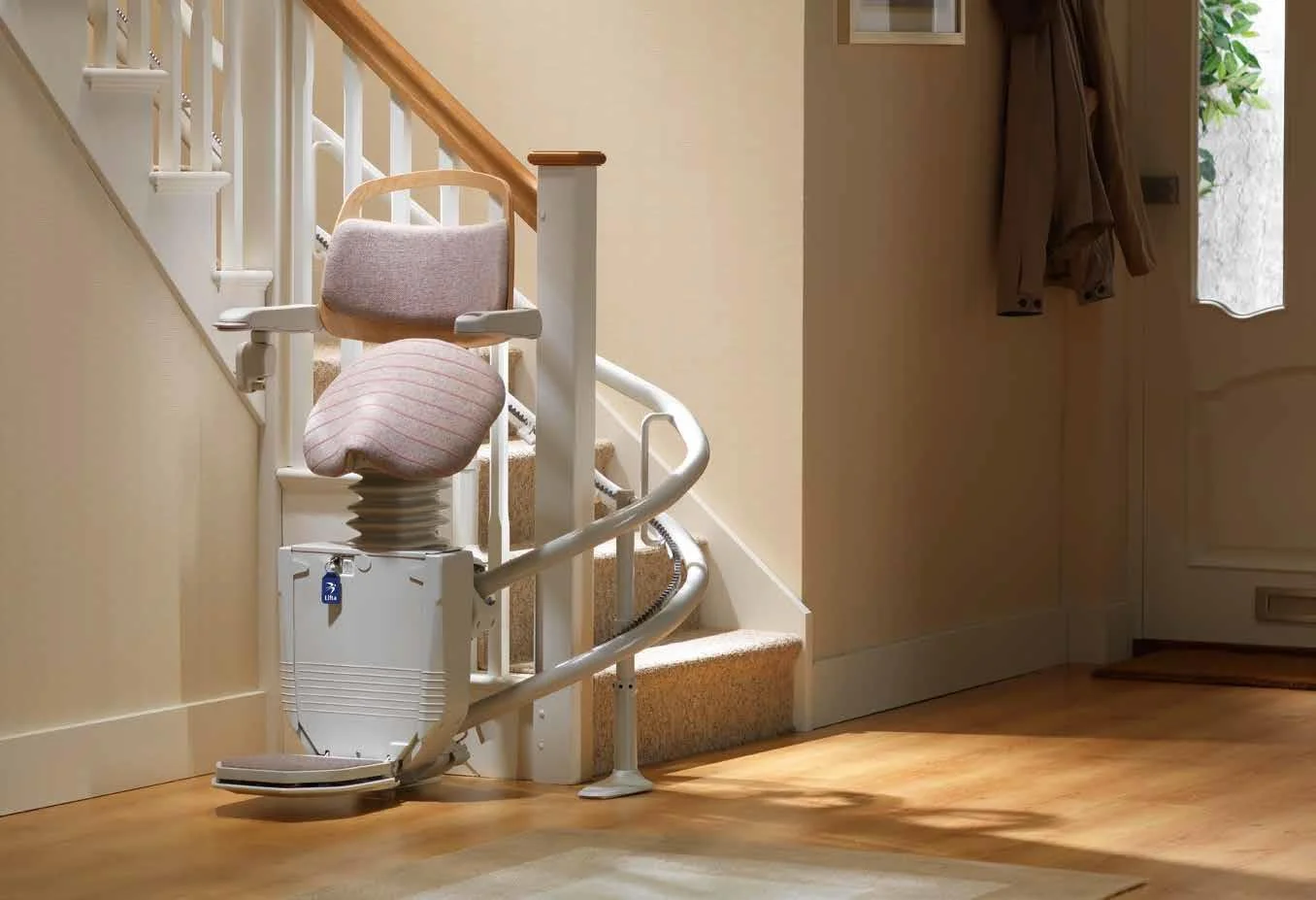
If the staircase runs in one straight line from bottom to top, a straight rail is usually the simplest and least costly choice. If it turns at a landing or winds, a curved rail built to that exact staircase is the usual answer.
Beyond the older mining houses, the county has single-family homes, detached houses, split-level homes and ranch-style homes. Each one raises a different question.
Split-level homes often have short flights between several levels, so the question becomes which flight matters most for daily life. Ranch-style homes may have everything on one floor, but stairs to a basement laundry or a few steps at the entry can still be a problem. A walk-through of the house shows where a lift actually helps.
Hurley is one of the snowiest cities in the United States, with roughly 192 days per year below freezing. Icy exterior steps are a real fall risk for older residents through a long season.
Outdoor stair lifts are built for weather and can serve porch or deck steps. Where someone uses a wheelchair, a platform lift may make more sense than a seat. In either case, plan for snow clearing around the rail and the landing areas.
As of the 2020 census, Iron County had 6,137 residents, with 31.9% age 65 or older and a median age of 56.4 years. Also, 18.4% of households had a resident 65 or older living alone, and 81.1% of housing was owner-occupied.
The USDA designates the county as a high-recreation retirement destination. Many people here own their homes and want to stay in them, which is exactly the situation a stair lift is meant for.
The clearest path is the Wisconsin IRIS Medicaid Waiver, which lists stair lifts by name under home modifications. Applications go through the Aging and Disability Resource Center (ADRC) of the North, which is the single point of entry for Iron County. Expect an in-person functional assessment and an approval process that can take 3+ months.
Other programs, including Family Care, USDA Section 504 and WisLoan, fund home modifications or accessibility work but do not name stair lifts in the sources reviewed. Ask each one directly. The VA HISA grant specifically excludes stair glides, so veterans should talk with the Iron County Veterans Service Office at (715) 561-2190 about other options.
For local help, the Iron County ADRC is at 300 Taconite St., Suite 108, Hurley, WI 54534, phone (715) 561-3636. Statewide options also include the Community Options Program (COP) and the WHEDA Home Improvement Loan Program (HILP).
A self-directed Medicaid waiver for people 65+, or 18-64 with a disability, who need nursing-facility level of care; stair lifts are explicitly listed as a covered home modification. Apply through the ADRC of the North at (866) 663-3607.
Managed long-term care where the managed care organization approves home modifications case by case; the source lists grab bars, ramps and doorway widening but does not name stair lifts. Call (800) 362-3002.
Free information, options counseling, benefits counseling and application help for adults 60+ and adults with disabilities, regardless of income; it does not list a direct stair lift benefit. Call (866) 663-3607.
A lifetime grant of $6,800 or $2,000 for medically needed home changes for veterans and service members. It does not cover stair lifts, since stair glides and porch lifts are excluded.
Grants for veterans with qualifying severe service-connected disabilities to buy, build or change a home for accessibility, with SAH up to $126,526 and SHA up to $25,350 for FY2026. The source does not name stair lifts as a covered item.
Loans up to $40,000 at 1% and grants up to $10,000 for very-low-income rural homeowners, with grants limited to those 62+. Accessibility work like ramps and walk-in tubs is covered; stair lifts are not named in the source.
Zero percent, deferred-payment home repair loans for income-qualified homeowners in a ten-county region that includes Iron County; listed repairs do not include accessibility work such as stair lifts. Call (715) 635-2197.
Benefits counseling and help applying for federal and state veteran benefits, including VA housing grants; it does not run its own stair lift benefit. Call (715) 561-2190.
Loans from $500 to $80,000 for Wisconsin residents 18+ with a disability who need assistive technology or home modifications; the source does not name stair lifts. Call (608) 242-8484.
Older adults
300 Taconite St., Suite 108, Hurley, 54534
Veterans
300 Taconite Street, Hurley, 54534
Yes, potentially. IRIS and Family Care both serve people age 18-64 with a physical, developmental or intellectual disability who meet nursing-facility level of care, and IRIS lists stair lifts as a covered home modification.
Not necessarily. For IRIS, home equity is exempt up to $752,000. The 2026 limits for a single person are about $2,982 per month in income and $2,000 in assets.
Approval can take 3+ months, and an in-person functional assessment is required. Starting early with the ADRC of the North at (866) 663-3607 helps.
The VA HISA grant excludes stair glides and porch lifts. The SAH, SHA and TRA grants fund accessibility changes but do not name stair lifts, so call the Iron County Veterans Service Office at (715) 561-2190 to talk through your case.
Outdoor stair lifts are made for exterior steps, and with over 160 inches of snow a year in Hurley they are a common question. Keep the rail and landings clear, and consider a platform lift if a wheelchair is involved.
The USDA Section 504 program offers grants up to $10,000 for very-low-income homeowners age 62+ in rural areas, which includes Iron County. The source lists ramps and walk-in tubs but does not name stair lifts, so ask before applying.
Tell us about the stairs in your home and we will explain which lift fits, what it costs and how installation works.
