Green County was settled in the 1830s and 1840s, and plenty of its rural homes are now more than a century old. Drive out of Monroe toward Brodhead, Juda or Browntown and you pass traditional Wisconsin farmhouses and two-story homes where the bedrooms sit at the top of a steep, narrow staircase.
Then there is New Glarus, founded in 1845 by 108 immigrants from the Canton of Glarus in Switzerland. Village code has required Swiss-style architecture in new construction and renovation since 1999, so many homes there are multi-story with their own distinctive stairways. Those stairs, and the farmhouse stairs elsewhere in the county, shape what kind of stair lift will work and what it takes to install one.
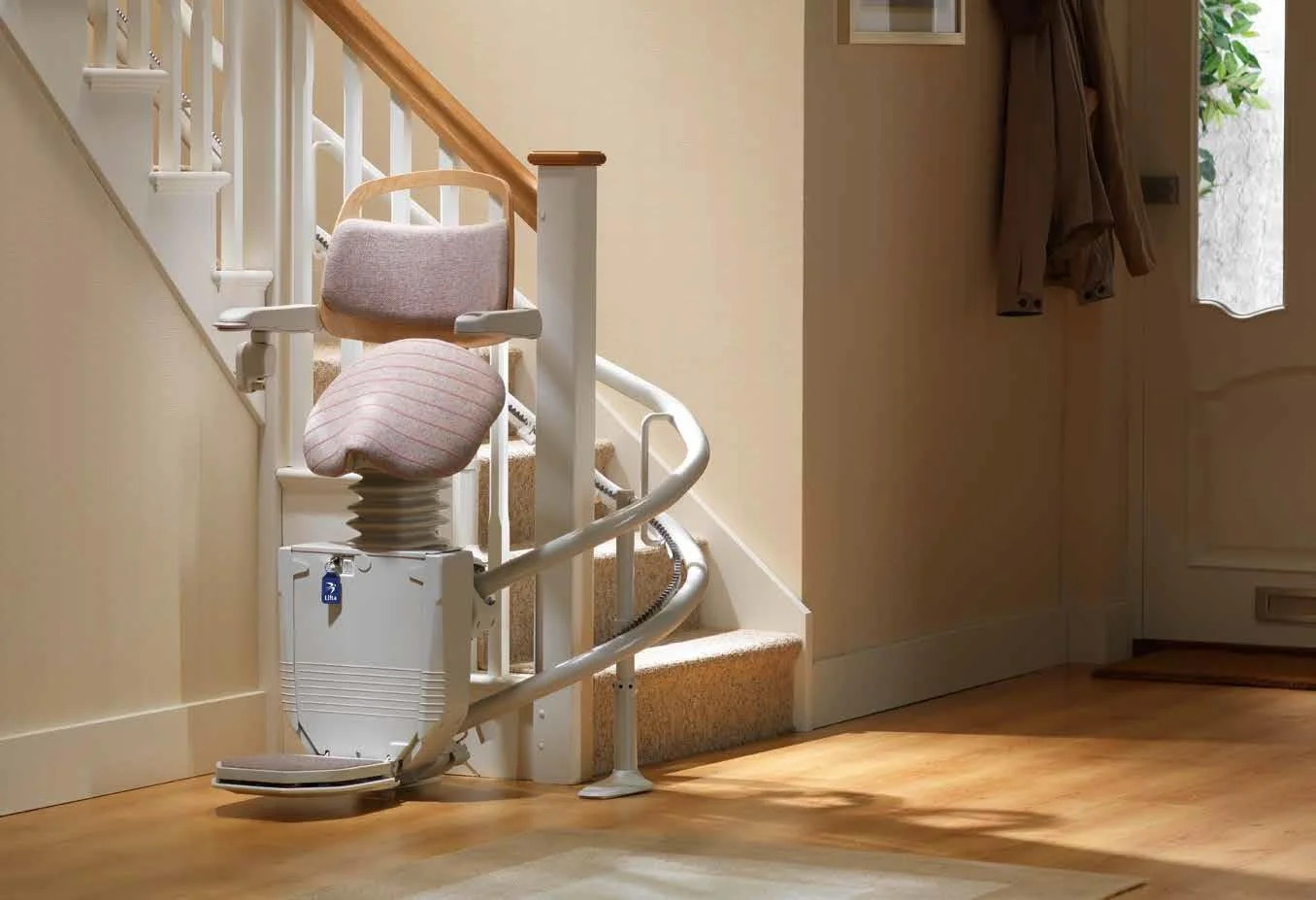
Older farmhouses often have stairs that turn at a landing, wind at the top or run narrower than newer construction. A straight stair lift is the simplest and quickest fit when the staircase runs in one line from bottom to top. When it turns, a curved lift with a custom-bent rail is usually the answer.
We measure every step, the landing and the headroom before recommending anything. In a home that has settled over a hundred years, small differences in step height and wall angle matter for a rail that has to follow the stairs closely.
Because New Glarus requires Swiss-style architecture in new building and renovation, homes in the village tend to be taller and multi-story, with characteristic stairways. A stair lift mounts to the stair treads, not the walls, so it changes the look of the home very little.
Multi-story homes sometimes need a lift on more than one flight. Some can be connected with one continuous curved rail; others need a separate lift per flight. We sort that out on the site visit.
Ranch-style homes in Monroe, Brooklyn, Monticello and Albany often have just a basement stair, which is usually a short straight run and a simple install. Split-level homes have several short flights, and each one may need its own lift.
Townhouses and walk-up apartments raise a different question: who owns the stairs. In shared stairwells, the owner or association typically has to approve the install before work starts. Outdoor steps to a porch or entry can take an outdoor-rated lift, and a platform lift is an option when someone needs to stay in a wheelchair.
Green County covers 584 square miles, and 71.1% of residents lived in rural areas as of 2020. That means aging services and home-modification help are spread across a wide area, and a phone call is often the fastest first step.
About 66.5% of households here own their homes, and many of the funding programs below require ownership.
The clearest public option is the Wisconsin IRIS Medicaid waiver, which names stair lifts among the home modifications it can cover. Family Care covers home modifications too, but stair lifts are not named on its source page, so ask directly.
The Green County ADRC at (608) 328-9499 is the local starting point for IRIS, Family Care and other long-term-care programs. Other statewide options worth asking about include the Community Options Program (COP), WisLoan (WisTech Alternative Loan Program) and the WHEDA Home Improvement Loan Program (HILP). Details on each program we have checked are listed below.
A self-directed Medicaid waiver for adults 18 and older who need a nursing-facility level of care, with a 2026 income limit of $2,982 a month for a single applicant and a $2,000 asset limit; stair lifts are listed as a coverable home modification. Call the IRIS Call Center at (888) 515-4747.
Medicaid managed care for people 65 and older, or 18 and older with a disability, who need a nursing-home level of care; it covers home modifications such as grab bars and ramps, but stair lifts are not mentioned on the source page. Call (800) 362-3002.
The local information and application point for IRIS, Family Care and other long-term-care programs, serving residents 60 and older and adults with disabilities; it does not mention stair lifts or offer a home-modification grant itself. Call (608) 328-9499.
Offers 0%, deferred-payment home repair loans to homeowners in Green and neighboring counties with income at or below 80% of County Median Income; accessibility for people with disabilities is a listed repair, though stair lifts are not named. Call (608) 943-6909.
Federal repair help for very low-income homeowners who cannot finance needed repairs elsewhere; the source reviewed does not mention stair lifts or accessibility. Call (202) 842-8600 for current amounts and eligibility.
Pays up to $6,800 or $2,000 over a lifetime for medically necessary changes to a veteran's primary residence, but the source lists stair glides among excluded equipment. Call (800) 827-1000.
Grants of up to $126,526 (SAH) or $25,350 (SHA) in FY2026 for homeowner veterans with qualifying severe service-connected disabilities; examples given are ramps and wider doorways, and stair lifts are not named. Call (800) 827-1000.
A center for independent living offering information, advocacy and home-accessibility assessments rather than cash grants; stair lifts are not mentioned, and whether it serves Green County is unconfirmed, so call (608) 242-8484 to ask.
Older adults
N3152 State Road 81, Monroe, 53566
Veterans
N3152 State Highway 81, Government Services Building, Monroe, 53566
Often, yes. A straight lift works for a single straight run, and a curved lift with a custom rail handles turns and landings. We measure the stairs in person because older homes vary so much.
The IRIS waiver lists stair lifts as a home modification it can cover within a participant's budget. You must need a nursing-facility level of care and meet the 2026 limits of $2,982 a month in income and $2,000 in assets for a single applicant. Call (888) 515-4747.
The Green County ADRC at (608) 328-9499. It is the local application point for IRIS, Family Care and other long-term-care programs.
The HISA grant lists stair glides as excluded equipment, and the SAH and SHA grants do not name stair lifts. The Green County Veterans Service at (608) 328-9415 can review what other VA benefits may apply.
Yes. IRIS serves adults 18 and older with physical, developmental or intellectual disabilities, and Family Care serves adults 18 and older with a physical or developmental disability, if they need a nursing-home level of care.
SWCAP offers 0%, deferred-payment home repair loans for homeowners at or below 80% of County Median Income, and accessibility is a listed repair. Stair lifts are not named, so call (608) 943-6909 to ask.
Tell us about the stairs in your home and we will explain which lift fits, what it costs and how installation works.
