Superior grew fast between 1888 and 1892, when the port was booming and architect-designed business blocks went up on Tower Avenue downtown. Many older neighborhoods from that era still have multi-story houses with their original interior stairways. Those stairs are often the reason a family starts asking about a stair lift.
Beyond Superior, the county stretches across about 1,304 square miles to towns like Lake Nebagamon, Solon Springs, Poplar and Oliver. About 38.6% of county residents live in rural areas, so plenty of older homeowners are some distance from the services clustered in Superior. This page covers how local homes affect the choice of lift and which programs may help with the cost.
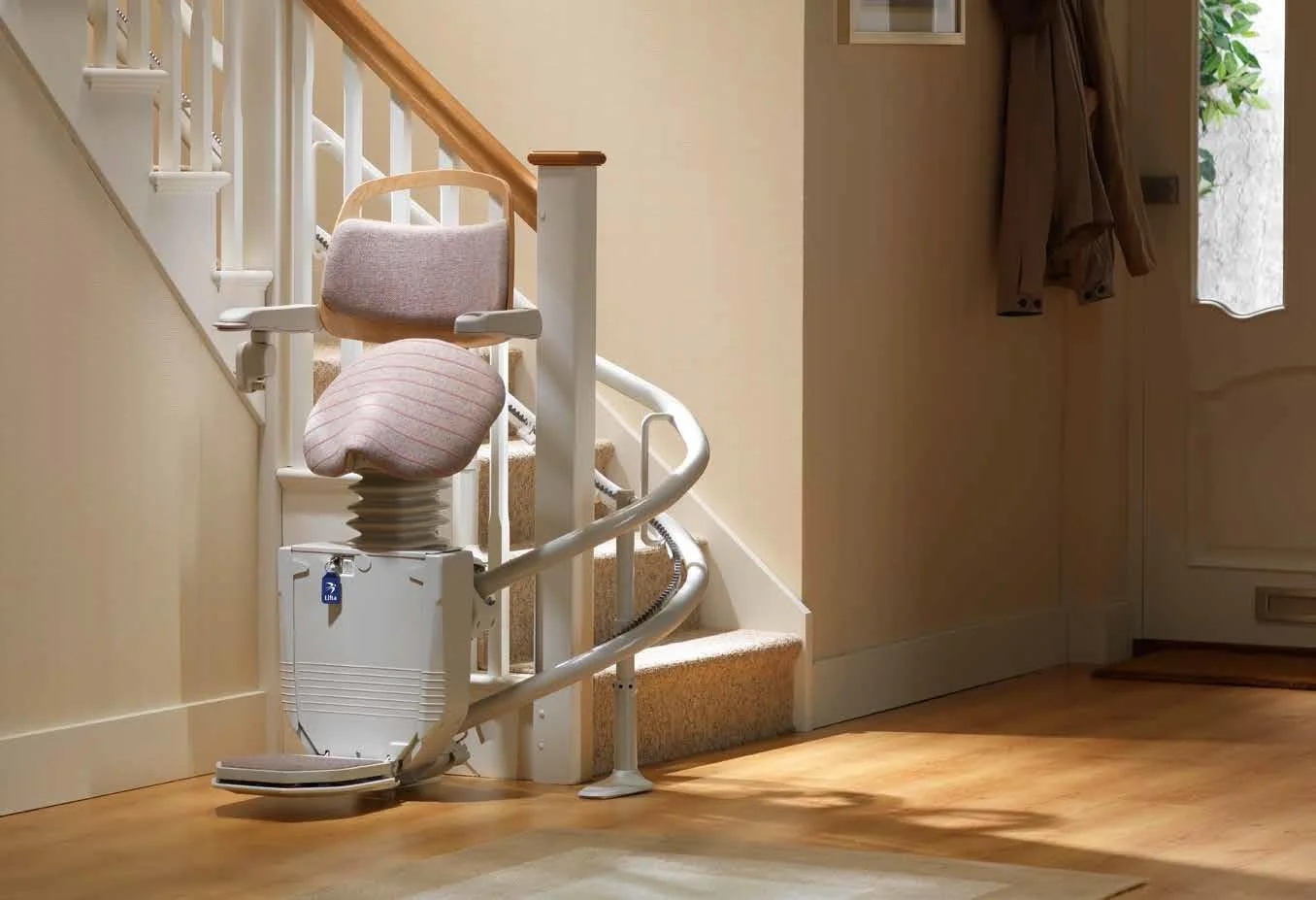
Homes built in Superior's late-19th and early-20th-century growth often have the original staircase between floors. If that staircase runs in one straight line, a straight stair lift is usually the simplest fit. If it turns at a landing or curves, a curved rail is built to follow that specific staircase.
Newer areas of the county have more single-story construction, where a stair lift may only be needed for a few steps to a basement or an entry. Split-level homes are a different case. They tend to have several short runs of stairs, so it helps to decide which levels the person really needs to reach before choosing a lift.
The county's housing includes single-family and detached houses, townhouses, low-rise apartments and split-level homes. A townhouse with a full flight between floors is usually a good candidate for a straight or curved lift inside the unit.
In a low-rise apartment building, the stairs are often shared space. Anything installed there needs approval from the owner or building management, so start that conversation before scheduling a measurement. When steps are few but a wheelchair is involved, a platform lift may be worth comparing to a chair-style lift.
Superior averages 14.1°F in January and gets about 56 inches of snow a year. Long winters make every trip up or down steps riskier, both inside the house and at the entry. Many families think about the front or back steps at the same time as the indoor staircase.
The good news is that Superior sits on fairly level ground that slopes gradually toward Lake Superior. That makes ramps and level entries easier to plan than in hillier parts of the state. Where outside steps remain, an outdoor stair lift or a platform lift is an option to talk through during the home visit.
About 17.5% of Douglas County residents are 65 or older, and 63.4% of residents own their homes. For homeowners, a stair lift can be one way to keep using the whole house instead of moving.
If someone in your family served, the Douglas County Veterans Service Office can help sort out which VA benefits apply, since some VA grants exclude stair lifts and others do not name them.
The most useful first call is usually the Douglas County ADRC at (715) 395-1234. It is the local intake point for Wisconsin Family Care and IRIS and does the functional screening those programs require. Family Care lists home modifications as a covered benefit, funded through an individual care plan.
Veterans should call the Veterans Service Office at (715) 395-1331 before applying for anything. The VA HISA grant specifically excludes stair glides, so it is important to know which VA program fits. Homeowners who plan to pay privately can look at the WHEDA Home Improvement Loan Program, though its materials do not list accessibility work among funded repairs. The programs below give more detail.
The ADRC offers information, long-term care options counseling and the functional screening needed to enroll in Family Care or IRIS for adults 60+ and adults with disabilities in Douglas County. Its materials do not list a stair lift benefit; call (715) 395-1234 or toll-free 866-946-2372.
This Medicaid program lists home modifications as a covered benefit, funded through an individualized care plan, for people 65+ or 18-64 with a disability who meet the nursing facility level of care standard. The 2026 income limit is about $2,982/month for a single applicant with a $2,000 asset limit; start through the ADRC at (715) 395-1234.
IRIS is a participant-directed Medicaid long-term care program in Wisconsin; the source reviewed does not list stair lift coverage or specific eligibility rules. Ask the ADRC at (715) 395-1234 how it compares to Family Care.
HISA helps veterans with medically necessary home improvements, up to $6,800 lifetime for service-connected disabilities or $2,000 for other qualifying disabilities. Stair glides and porch lifts are specifically excluded; call (715) 395-1331 for help with VA benefits.
These grants, up to $126,526 (SAH) or $25,350 (SHA) for FY2026, help veterans with certain severe service-connected disabilities adapt a home they own; stair lifts are not named among the examples. Call the Veterans Service Office at (715) 395-1331 to check eligibility.
This office provides benefits counseling and application help for veterans and dependents living in Douglas County; it does not list its own stair lift benefit. Call (715) 395-1331; walk-ins are welcome on Tuesdays and Thursdays.
NWCSA offers energy assistance, emergency furnace help and weatherization to low-income households in Douglas, Bayfield, Ashland, Iron and Price counties; stair lifts and accessibility work are not listed. Call (715) 392-5127.
HILP offers $10,000-$50,000 loans to Wisconsin homeowners with a credit score of 620+ and good mortgage payment history; program materials do not list accessibility modifications or stair lifts. Call (608) 266-7884.
Older adults
1316 N. 14th St., Suite 327, Superior, 54880
Veterans
Government Center 1316 N. 14th St., Room 385, Superior, 54880
Often, yes. Many older Superior homes have their original interior stairways, and a straight lift fits a single straight run while a curved rail is made to follow stairs that turn. A measurement at the home settles which type you need.
Family Care lists home modifications as a covered benefit, funded through an individualized care plan rather than a fixed cap. You need to qualify financially and meet the functional screen, which starts with the Douglas County ADRC at (715) 395-1234.
No. The HISA grant specifically excludes stair glides and porch lifts. The Veterans Service Office at (715) 395-1331 can help check whether other VA programs, such as SAH or SHA, might apply.
Processing can take up to 3 months, or even longer. There is no statewide waitlist reported, so the main wait is the application itself. It makes sense to call the ADRC early.
The ADRC and the Veterans Service Office are both at 1316 N. 14th St. in Superior and serve residents across Douglas County, including Lake Nebagamon, Solon Springs, Poplar and Oliver. You can start with a phone call before making the trip.
With about 56 inches of snow a year, entry steps are a real concern. Superior's fairly level ground makes ramps and level entries easier to plan, and an outdoor stair lift or platform lift can be discussed for steps that remain.
Tell us about the stairs in your home and we will explain which lift fits, what it costs and how installation works.
