Barron County stretches across about 890 square miles of northwestern Wisconsin, from Rice Lake and the county seat of Barron out to Cumberland, Chetek, Cameron, Turtle Lake and smaller places like Almena, Prairie Farm, Dallas and Haugen. Much of the housing in the older town centers went up during the logging and farming years of the late 1800s and early 1900s, long before anyone thought about accessibility.
That history shows up on the stairs. Multi-level homes with staircases that were never adapted are common here, and for someone who wants to keep living at home, a stair lift is often the simplest fix. This page covers which kind of lift fits which kind of house, and which local and state programs may help with the cost.
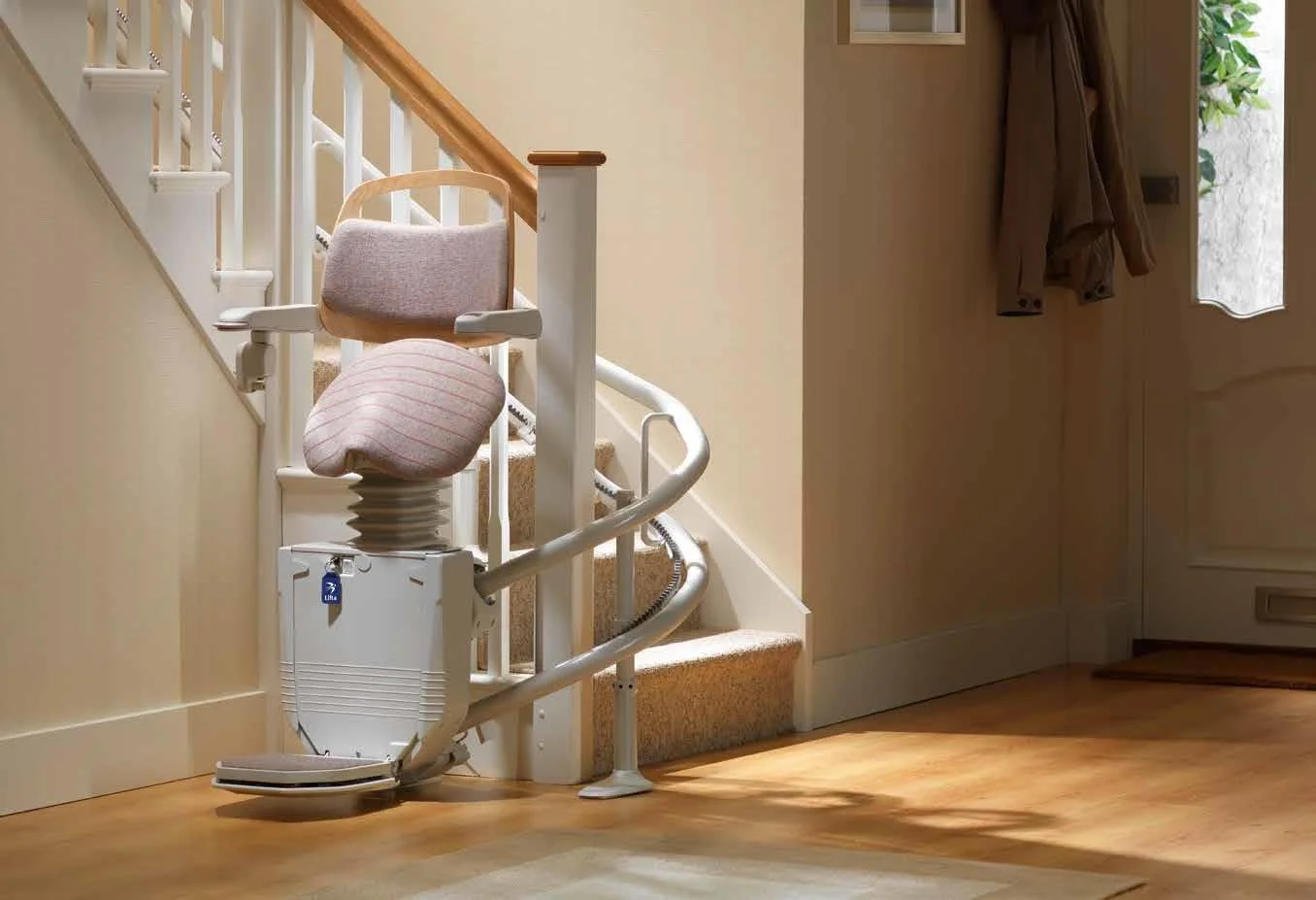
The town cores in Barron and Rice Lake hold a lot of housing that predates modern accessibility standards. In practice that means narrow staircases, steep rises and stairs that go straight up to a second floor with no bedroom or bathroom on the main level.
A straight stair lift is the usual answer for a single, uninterrupted flight. It mounts to the stair treads, not the wall, so plaster walls in an older house are left alone. If the staircase turns at a landing or winds near the top, a curved lift built to that exact staircase is the option.
Across the county you will find single-family homes, detached houses, ranch-style homes, split-level homes, duplexes and walk-up apartments. Each one raises a different question at the measuring visit.
Split-level homes tend to have several short flights instead of one long one, so the plan may involve more than one lift or a curved rail that runs through a landing. Ranch-style homes have most rooms on one floor, but any steps that remain at an entry can still be a barrier. In duplexes and walk-up apartments, the first thing to check is who owns the stairway and whether the owner will approve an installation.
Where steps sit outside, such as at a porch or side door, an outdoor-rated lift or a platform lift may make more sense than an indoor model. A platform lift is also the choice when the person uses a wheelchair and cannot transfer to a seat.
About 78.3% of Barron County residents live in rural areas, and the county averages roughly 54.1 people per square mile. Rail lines here carry freight, not passengers, so getting to services without a car is hard.
That spread-out setting is a big reason a home lift can be more practical than moving. The county's median age was 44.9 in 2024, compared with Wisconsin's roughly 40, and 22.1% of residents are 65 or older. Many families here are working through the same question about the stairs at the same time.
The clearest funding path in the list below is the IRIS Medicaid waiver, which names stair lifts among the home modifications it can pay for. The other programs either do not mention stair lifts in their published material or, in the case of the VA HISA grant, specifically exclude them.
A good first call is the Barron County ADRC at (715) 537-6225, located at 335 E. Monroe Ave., Room 338, in Barron. They handle enrollment for IRIS and Family Care and can point you to other help.
For loans, the USDA Section 504 program and the West Central Wisconsin CDBG Home Repair Program are worth asking about, especially for rural homeowners on tight incomes. Neither one lists stair lifts by name, so ask directly before you count on it.
A self-directed Medicaid long-term care program that lists stair lifts among the home modifications a participant's budget can cover, with no single statewide dollar cap published. Income must be up to about $2,982 a month and assets up to $2,000 for a single person; Barron County residents start at the local ADRC, and the IRIS line is (888) 515-4747.
Medicaid managed long-term care for adults 18 and older with a disability or people 65 and older who need a nursing-home level of care, funded through an individualized care plan. The source does not currently list stair lifts; call the ADRC at (715) 537-6225 to ask about eligibility and the benefit package.
A free, confidential information and referral center for older adults and people with disabilities, with resources on home modifications and adaptive equipment plus a Loan Closet. It is not a cash grant and does not name a stair lift grant; call (715) 537-6225.
Repair loans up to $40,000 at 1% fixed interest over 20 years, and grants up to $10,000 for very-low-income homeowners age 62 or older who cannot repay a loan, with a combined limit of $50,000. Stair lifts are not listed; rural Barron County addresses generally qualify, but confirm on USDA's eligibility site.
A 0% interest, deferred-payment loan for income-qualified homeowners, repaid only when the home is sold or no longer owner-occupied. Handicap accessibility is a qualified repair, though stair lifts are not itemized; contact Laura Rushmann at (715) 726-7801.
No-cost weatherization, energy-efficiency and home-safety work for households enrolled in the Wisconsin Home Energy Assistance Program (WHEAP). It is not a stair lift funding source; call (715) 598-4750.
Offers accessibility assessments, referrals to funding sources, a Device Loan Program and WisLoan low-interest loans for assistive devices, serving people with disabilities in Barron County. Stair lifts are not named in its material; call (715) 233-1070.
A lifetime grant of up to $6,800 or $2,000, depending on disability status, for medically needed changes to a veteran's primary home. Stair glides and porch lifts are specifically excluded, so it will not pay for a stair lift; the county Veterans Service Office is at (715) 537-6290.
Up to $126,526 (FY2026 maximum) for veterans with severe service-connected disabilities to build, buy or remodel an accessible home. Stair lifts are not specifically named; call the Veterans Service Office at (715) 537-6290.
Up to $25,350 (FY2026 maximum) to adapt a home owned by a veteran or qualifying family member with certain service-connected disabilities. Stair lifts are not specifically named; call the Veterans Service Office at (715) 537-6290.
Older adults
335 E. Monroe Ave., Room 338, Barron, 54812
Veterans
335 E Monroe Ave, Room 103, Barron, 54812
The Wisconsin IRIS Medicaid Waiver lists stair lifts as a covered home modification within a participant's budget. You need to meet Medicaid limits, about $2,982 a month in income and $2,000 in assets for a single person, and be screened as needing nursing-facility level of care. Start with the Barron County ADRC at (715) 537-6225.
No. The VA's own material lists stair glides and porch lifts among the items HISA does not fund. Veterans with severe service-connected disabilities can ask the Barron County Veterans Service Office at (715) 537-6290 about the SAH and SHA grants, though those pages do not name stair lifts either.
The USDA Section 504 program offers grants up to $10,000 to very-low-income homeowners age 62 or older who cannot repay a loan, to remove health and safety hazards. Stair lifts are not listed by name, so confirm with USDA before planning around it.
Often, yes. Split-level homes usually have short flights between levels, so the fix may be a straight lift on one flight or a curved rail that carries through a landing. An in-home measurement decides which one fits.
The Barron County ADRC is at 335 E. Monroe Ave., Room 338, in Barron, 54812. The phone number is (715) 537-6225, and its services are free and confidential.
The West Central Wisconsin CDBG Home Repair Program offers 0% interest deferred loans to income-qualified homeowners, repaid when the home is sold or no longer owner-occupied, and handicap accessibility is a qualified repair. Call Laura Rushmann at (715) 726-7801 to ask whether a stair lift would count.
Tell us about the stairs in your home and we will explain which lift fits, what it costs and how installation works.
