From Lunenburg and Guildhall along the Connecticut River to Island Pond, Brighton and Canaan near the Quebec line, Essex County's 9 towns hold some of the oldest small-town and rural housing in the Northeast Kingdom. Many of these homes have a full flight to a second floor, a raised entry, or both.
Essex County is Vermont's least populous county, with about 5,920 residents per the 2020 Census. That small, spread-out population shapes everything from which lift suits your stairs to how you pay for it and how long an installer takes to reach you.
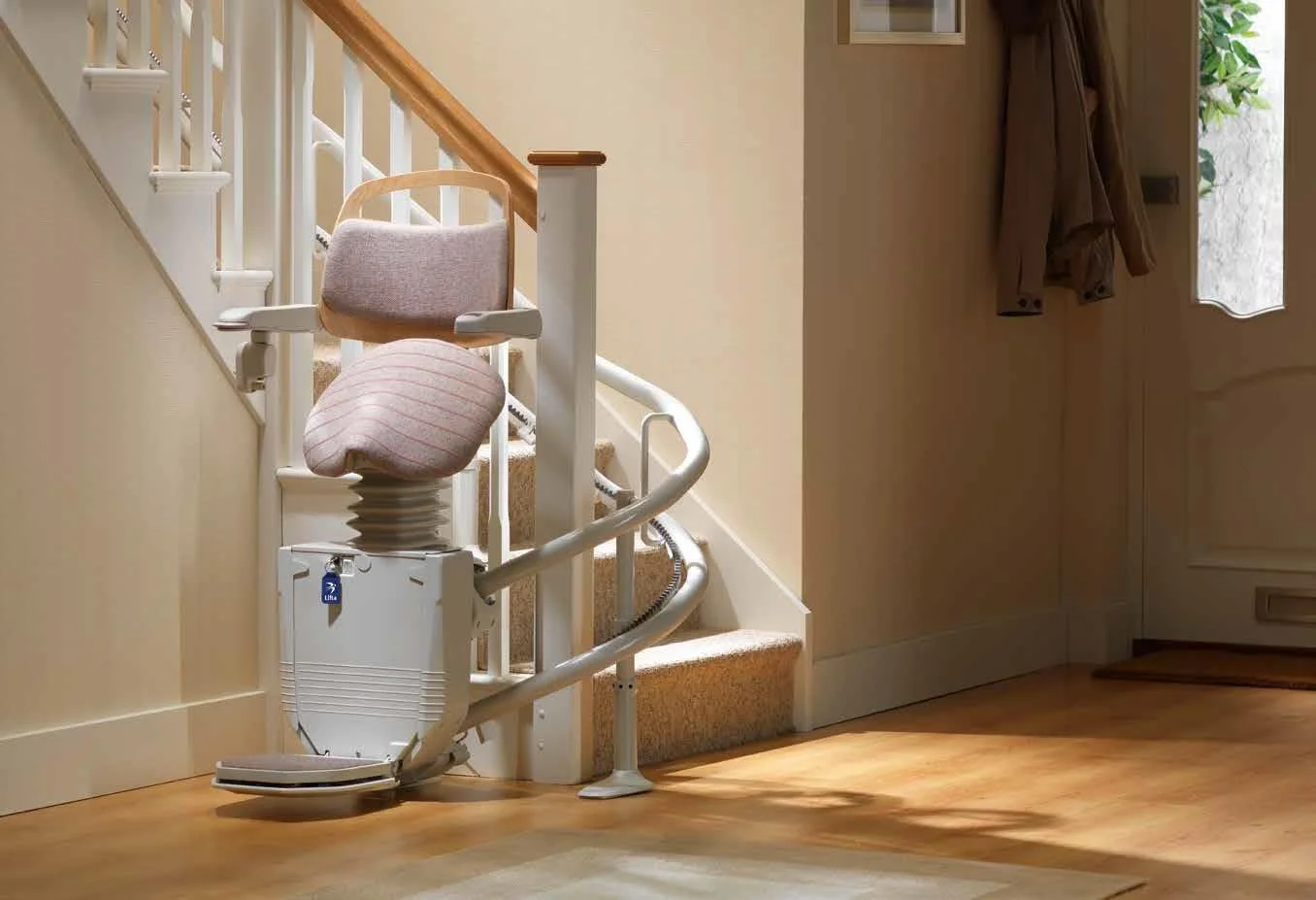
Most homes here are single-family homes and detached houses, and older ones often have one straight run of stairs to the bedrooms. A straight stair lift is usually the simplest fit for that layout. If the staircase turns at a landing or winds near the top, a curved lift built to that staircase is the usual answer.
Split-level homes bring short flights between levels, so it helps to decide which floors a person truly needs to reach. Ranch-style homes may have no inside stairs at all but still sit on a raised entry. For steps up to the door, an outdoor lift or a platform lift is often the practical choice.
Walk-up apartments are a different case. The stairway may be shared, so the building owner needs to be part of the conversation before any lift goes in.
Essex County covers 675 square miles, bordered by the Connecticut River and New Hampshire to the east and Quebec to the north. With only about 8.77 people per square mile, homes can be far apart and far from the nearest contractor.
The land runs from river-valley meadows near Guildhall to continuous forest and mountainous interior elsewhere. That terrain affects contractor availability and travel time, so plan for the measuring visit and the install to take some scheduling. Starting early is better than waiting for a fall or a hospital discharge.
About 26.5% of county residents are 65 or older, and 77.9% own their homes. That means a lot of people planning to stay in a house they already own, often one with stairs that get harder every year.
If that includes your family, read the VA program notes below carefully, because one common VA grant specifically excludes stair glides.
Essex County has the lowest average household income in Vermont, about $30,490. Many families here face real cost barriers even when the need is obvious, which is why income-based programs matter so much.
The programs below include Medicaid Choices for Care, RuralEdge's Home Repair Program, USDA Section 504 and the VCIL Home Access Program. None of their sources name stair lifts specifically, so ask each one directly whether your project qualifies.
A good first call is the Northeastern VT AAA (NEK Council on Aging) at (802) 748-5182, 481 Summer St., Suite 101, St. Johnsbury, 05819. Veterans can also reach the Vermont Office of Veterans Affairs at (802) 828-3379, 118 State Street, Montpelier, 05620-4401.
A Medicaid waiver run by Vermont DAIL for residents 65+ or adults 18+ with a physical disability, with flexible funds that can go toward home modifications and assistive devices; the source does not mention stair lifts. Call (800) 642-5119.
For people who meet Nursing Facility Level of Care, this waiver covers home modifications such as ramps, grab bars and doorway widening; stair lifts are not mentioned in the source. Call (800) 479-6151.
A free statewide program from the Vermont Center for Independent Living for low-income residents with a physical disability, focused on home-entry and bathroom modifications; the source does not mention stair lifts. Call (802) 229-0501.
Low-interest rehab loans and grants for Essex County homeowners at or below 80% Area Median Income, aimed at health and safety repairs; the source does not mention stair lifts. Call (802) 535-3555.
Federal loans and grants up to $50,000 combined for very-low-income rural homeowners, with grants for those 62+ capped at $10,000 lifetime; the source does not mention stair lifts. Call (802) 461-6051.
A VA grant of up to $6,800 for medically necessary home improvements, but the VA explicitly excludes porch lifts and stair glides, so it does not cover stair lifts.
VA grants for veterans with severe service-connected disabilities, up to $126,526 for SAH or $25,350 for SHA in FY2026, for permanent changes like ramps and doorway widening; the source does not mention stair lifts.
The free Area Agency on Aging for Caledonia, Orleans and Essex Counties, offering referral, options counseling and case management rather than direct funding; its source page does not mention stair lifts. Call (800) 642-5119.
Older adults
481 Summer St., Suite 101, St. Johnsbury, 05819
Veterans
118 State Street, Montpelier, 05620-4401
No. The VA explicitly excludes porch lifts and stair glides from HISA-funded improvements. Veterans with severe service-connected disabilities can ask about the SAH, SHA and TRA grants, or call the Vermont Office of Veterans Affairs at (802) 828-3379.
Section 504 grants are reserved for applicants 62 and older, though younger very-low-income homeowners may qualify for the loans. Choices for Care accepts adults 18+ with a physical disability, and VCIL Home Access serves low-income Vermonters with a physical disability at any adult age listed in its rules.
The VCIL Home Access Program accepts renters with landlord acknowledgment and a doctor's note. RuralEdge and USDA Section 504 are for homeowners who live in the home.
The sources do not name stair lifts. The Highest Needs Group lists ramps, grab bars and doorway widening, and the Moderate Needs Group has flexible funds for home modifications and assistive devices, so ask DAIL directly whether a lift qualifies.
RuralEdge's Home Repair Program serves homeowners in Caledonia, Orleans and Essex Counties with household income at or below 80% Area Median Income, and applications are rolling. Call (802) 535-3555 to ask about your project.
Call the NEK Council on Aging at (802) 748-5182. It offers free referral and options counseling for older adults and caregivers in Essex County and can point you toward the right program.
Tell us about the stairs in your home and we will explain which lift fits, what it costs and how installation works.
