Surry County sits on the south bank of the James River in Virginia's Tidewater, and its homes span more than three centuries. Bacon's Castle, built in 1665, still stands here. So do Colonial, Federal and Classical Revival houses, older multi-story farmhouses, and newer ranch-style and split-level homes around Claremont and Dendron.
That range matters when someone in the family starts having trouble with the stairs. A staircase in a plantation-era farmhouse and a staircase in a split-level built decades later call for very different stair lifts. This page walks through what fits which kind of home, and which programs Surry County residents can call about paying for one.
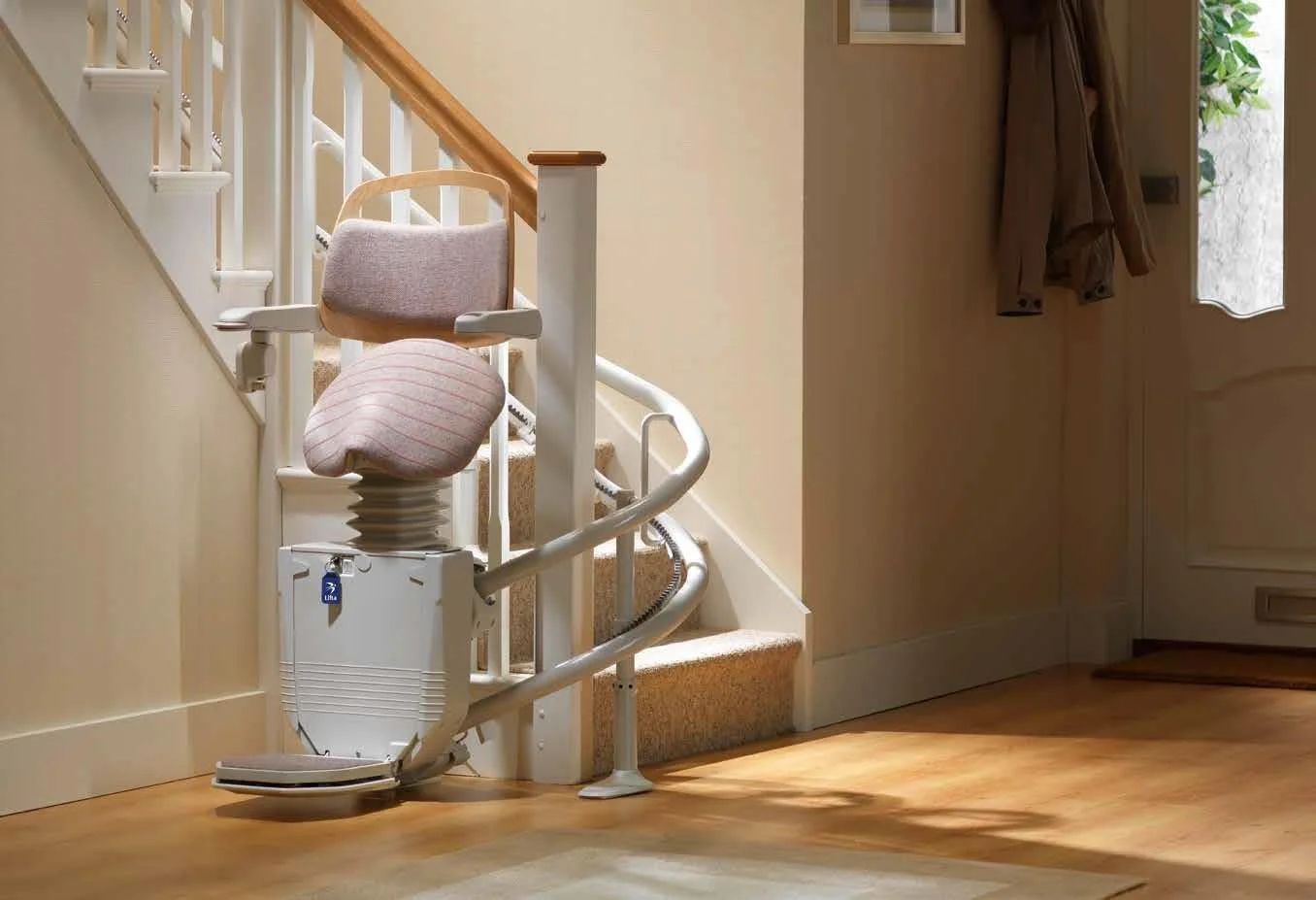
Many Surry County houses went up long before anyone planned for a stair lift. Period staircases in Colonial and Federal homes tend to be narrower and steeper than modern ones, and that can complicate an installation.
A narrow or steep stair does not rule out a lift, but it does shape the choice. We measure the width, the pitch and any turns or landings before recommending a model. Where the stair turns or winds, a curved stair lift built to the exact shape of the staircase is usually the answer.
Newer single-family homes in the county usually have a straight run of stairs, which is the simplest and most common stair lift job. A straight rail mounts to the stair treads, not the wall, so plaster and trim stay untouched.
Split-level homes are different. They often have several short flights between levels rather than one long staircase. Depending on how the floors connect, the fix may be a short straight lift on the flight used most, a curved rail, or a platform lift.
Ranch-style homes are often one floor inside but can still have steps up to the porch or down to a basement. Outdoor stair lifts are built to handle weather and can make the front or back entrance usable again.
Surry County had 6,561 residents at the 2020 census, with a median age of 51.5 years and 23.9% of residents age 65 or older. Both figures are well above state and national averages.
Most people here own their homes, at 82.0%, so staying put and adapting the house is often the practical choice. Every resident lives in a rural area, which means contractors and aging services have long drives to reach some homes. Planning ahead and making calls early helps.
No single program here pays for stair lifts by name, so it helps to know what each one actually says. The VA HISA grant specifically excludes stair glides. The CCC Plus waiver, USDA Section 504 and the VA SAH and SHA grants cover home modifications or repairs, but their sources do not list stair lifts, so ask directly before you plan on them.
The Crater District Area Agency on Aging at (804) 732-7020 is a good first call for adults 60 and older. It can coordinate care and point you toward other funding. Statewide, you can also ask about the Virginia Livable Home Tax Credit (LHTC) and the Assistive Technology Loan Fund Authority (ATLFA). Veterans can contact the Petersburg Office at Virginia Community Resource Center 22 West Washington Street, Petersburg, at (804) 431-3260.
Virginia's Medicaid waiver for people age 65+ or disabled who meet nursing-facility level of care covers home modifications such as doorway widening, grab bars and ramps, but stair lifts are not listed. Call (844) 374-9159, or apply through a local Department of Social Services or Area Agency on Aging.
The designated aging agency for Surry County and adults 60+ offers case management, homemaker help, respite care and other services; it does not list a stair lift or home-modification program. Call (804) 732-7020 for care coordination and referrals.
Very-low-income rural homeowners can get repair loans up to $20,000 at 1% over 20 years, and owners 62+ who cannot repay a loan may get grants up to $7,500 to remove health or safety hazards; stair lifts are not specifically named. Call USDA Rural Development at (804) 287-1500 to confirm current limits.
This VA grant pays up to $6,800 or $2,000 lifetime for permanent alterations like ramps and roll-in showers, but it explicitly does not cover stair glides. Call (800) 827-1000.
Homeowning veterans with qualifying severe service-connected disabilities can get up to $126,526 (SAH) or $25,350 (SHA) to build, buy or remodel for accessibility; stair lifts are not specifically named. Call (800) 827-1000.
Older adults
23 Seyler Drive, Petersburg, 23805
Veterans
Virginia Community Resource Center 22 West Washington Street, Petersburg, 23803
Often it can, but period staircases in older homes tend to be narrower and steeper, which can complicate installation. We measure the stair first, and a curved rail built to the staircase is common where the stair turns.
The HISA grant does not; it explicitly excludes stair glides. The SAH and SHA grants fund accessibility remodeling but do not name stair lifts, so ask the VA at (800) 827-1000 before counting on them.
For anyone 60 or older, start with the Crater District Area Agency on Aging at (804) 732-7020. It serves Surry County from 23 Seyler Drive in Petersburg and can refer you to other funding.
The CCC Plus waiver covers environmental modifications such as doorway widening, grab bars and ramps, but its source does not list stair lifts. Call (844) 374-9159 to ask about your situation.
USDA Section 504 offers grants up to $7,500 for owners 62+ who cannot repay a loan, for removing health or safety hazards. Stair lifts are not named, so confirm with USDA Rural Development at (804) 287-1500.
Split-levels often have short flights between floors. Depending on the layout, a short straight stair lift, a curved rail or a platform lift may fit best.
Tell us about the stairs in your home and we will explain which lift fits, what it costs and how installation works.
