Salem sits at roughly 1,175 feet in the Roanoke Valley, and much of the city was built before anyone thought about aging in place. About 35.2% of homes here went up between 1940-1969, and another 41.9% between 1970-1999. Only 9.9% were built in 2000 or later.
That means most Salem houses still have their original stairways, and many sit on sloped lots with steps up to the front door. If a parent is struggling with those stairs, a stair lift is often the most direct fix. This page covers how local homes affect the choice of lift and which programs may help with the cost.
Single-family detached homes make up 69.8% of the city's housing units. In houses of this age, the main staircase is usually a straight run, and a straight stair lift is the simplest and least expensive kind to fit.
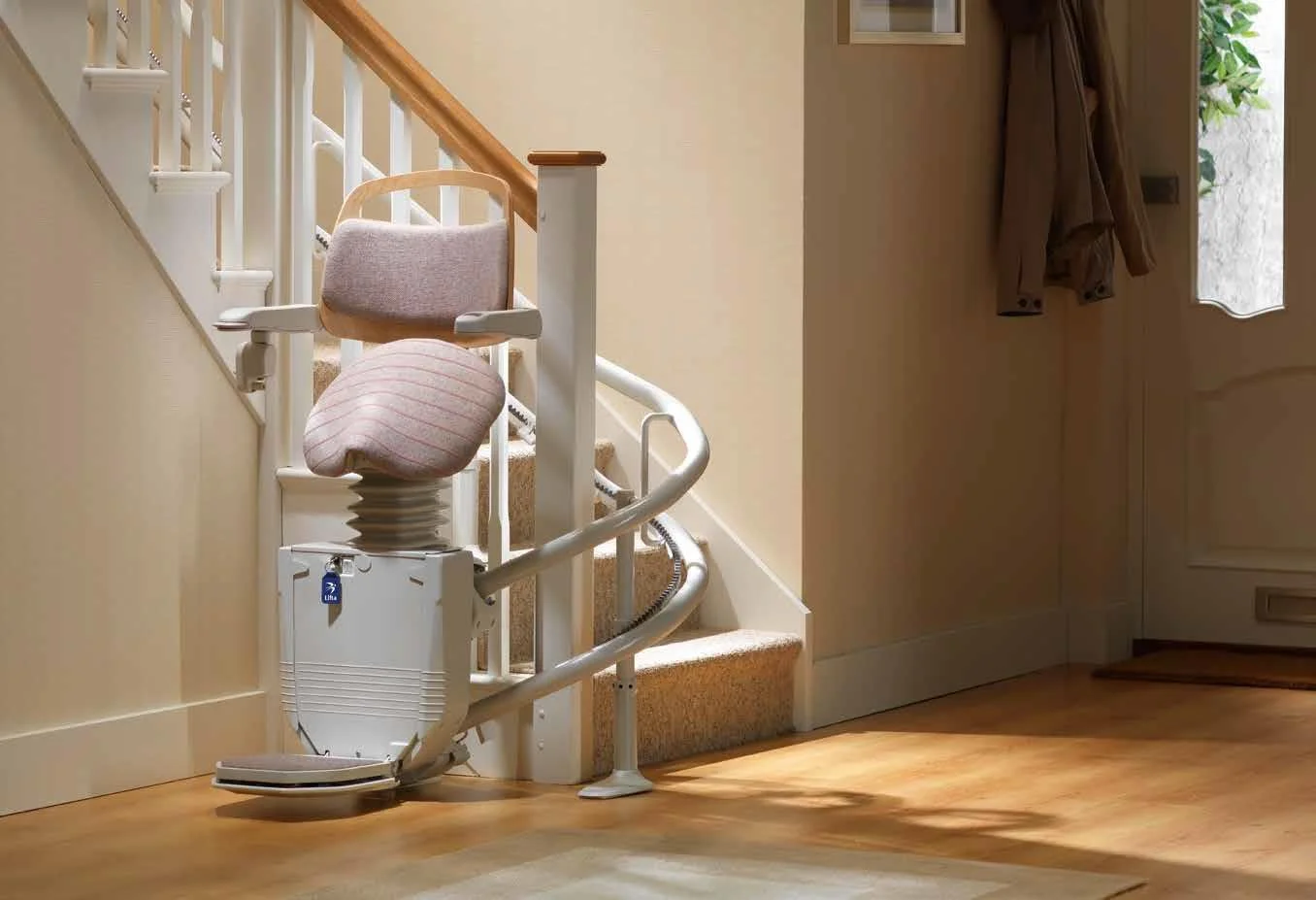
Older stairways can still bring surprises. A landing partway up, a turn at the top or a narrow width will change what we recommend. When the stairs turn, a curved lift with a rail built to that staircase is the usual answer.
Townhouses, row houses and walk-up apartments also show up in Salem. These often have tighter, steeper stairs between floors, so we measure width and clearance carefully before suggesting a model.
The Roanoke Valley is hilly, and many homes have steps from the driveway or sidewalk up to the porch. Getting inside can be as hard as getting upstairs.
An outdoor stair lift is built to handle weather on exterior steps. For someone who uses a wheelchair, a platform lift may make more sense than a seat-style lift. We look at both the inside and outside stairs during a visit so you can see the full picture.
Salem has 25,477 residents, and 19.5% are 65 or older. About 63.5% of households own their homes, which matters because most grant programs and permanent installs work best when the owner is on board.
Some VA programs help with home changes, though not every one covers stair lifts, as explained below.
The clearest source of help is the Virginia Housing accessibility grants, which name chairlifts as an eligible use and offer up to $10,000 per grant with no repayment. Income limits apply, and applications go through an approved local agent found with the program's locator tool.
Other programs may help depending on your situation. Medicaid's CCC Plus Waiver covers environmental modifications as a category, and EHARP offers up to $4,000 for accessibility repairs, but neither names stair lifts directly, so ask before counting on them. Virginia also has the Virginia Livable Home Tax Credit (LHTC) and the Assistive Technology Loan Fund Authority (ATLFA) as statewide options worth asking about.
For veterans, note that the VA HISA grant specifically excludes stair glides. The SAH and SHA grants do not mention stair lifts either way. The Roanoke Benefits Office at (540) 597-1730 can talk through your options.
True grants of up to $10,000 that list installing chairlifts as an eligible modification, for veterans with a service-connected disability at or below 80% Area Median Income, or for owner-occupied and rental households at or below 60% Area Median Income. Call (877) 843-2123 or use the program's agent locator to find an approved local agent.
A Medicaid waiver for people who meet a nursing-facility level of care that covers environmental modifications and assistive technology, though stair lifts are not named in the source. Ask your MCO care coordinator or call (833) 522-5582.
The information and referral hub for adults 60 and older and family caregivers in Salem and neighboring localities; its published services do not list stair lifts or home modifications. Call (540) 345-0451.
A center serving people with disabilities in the 5th Planning District that lists equipment as one of its services, though stair lift coverage is not listed. Call (540) 342-1231 and ask whether it currently helps with Virginia Housing grant applications.
Up to $4,000 per applicant at no cost for homeowners, or tenants with homeowner approval, at or below 80% of Area Median Income; the source describes accessibility changes like ramps but does not name stair lifts. Call (804) 371-7000 to find the local provider.
A VA grant for medically necessary structural changes, with a $6,800 or $2,000 lifetime maximum depending on disability status; it explicitly does not cover stair glides. Call (800) 827-1000.
Larger VA grants for homeowners with severe service-connected disabilities, up to $126,526 for SAH and $25,350 for SHA in FY2026; stair lifts are not mentioned in the source. Call (800) 827-1000.
Older adults
4932 Frontage Road NW, Roanoke, 24019
Veterans
210 Franklin Road, Suite 810, Roanoke, 24011
Yes. The Virginia Housing accessibility grants list installing chairlifts as an eligible modification, with up to $10,000 per grant and no repayment. Call (877) 843-2123 or use the agent locator to start.
The HISA grant does not, since it explicitly excludes stair glides. Veterans with a service-connected disability may qualify for the Virginia Housing Granting Freedom grant instead, which does cover chairlifts.
The Local Office on Aging serves adults 60 and older. For younger adults with a disability, Blue Ridge Independent Living Center serves people with disabilities in Salem at (540) 342-1231.
Some programs allow it. RUAM is aimed at rental units, EHARP accepts tenants with the homeowner's approval, and HISA applies to owned or rented primary residences, though HISA does not cover stair lifts.
Often, yes. Outdoor stair lifts are built for exterior steps, and a platform lift may suit someone who uses a wheelchair. We check those steps during the same visit as the indoor stairs.
The CCC Plus Waiver covers environmental modifications and assistive technology, but the source does not name stair lifts. Ask your MCO care coordinator or call (833) 522-5582 before planning around it.
Tell us about the stairs in your home and we will explain which lift fits, what it costs and how installation works.
