Russell County covers about 477 square miles of southwestern Virginia, from Lebanon and Honaker to Castlewood, Dante and Cleveland. Beartown Mountain, the fourth-highest peak in Virginia, sits inside the county line. In country like this, plenty of houses step up from the driveway and have stairs inside too.
Almost all of the county is rural. The 2020 Census counted 12,754 housing units, and 99.4% of residents lived in rural areas. Most homes here are standalone houses spread across the hills, so each stair lift job starts with a look at that one staircase and that one entry.
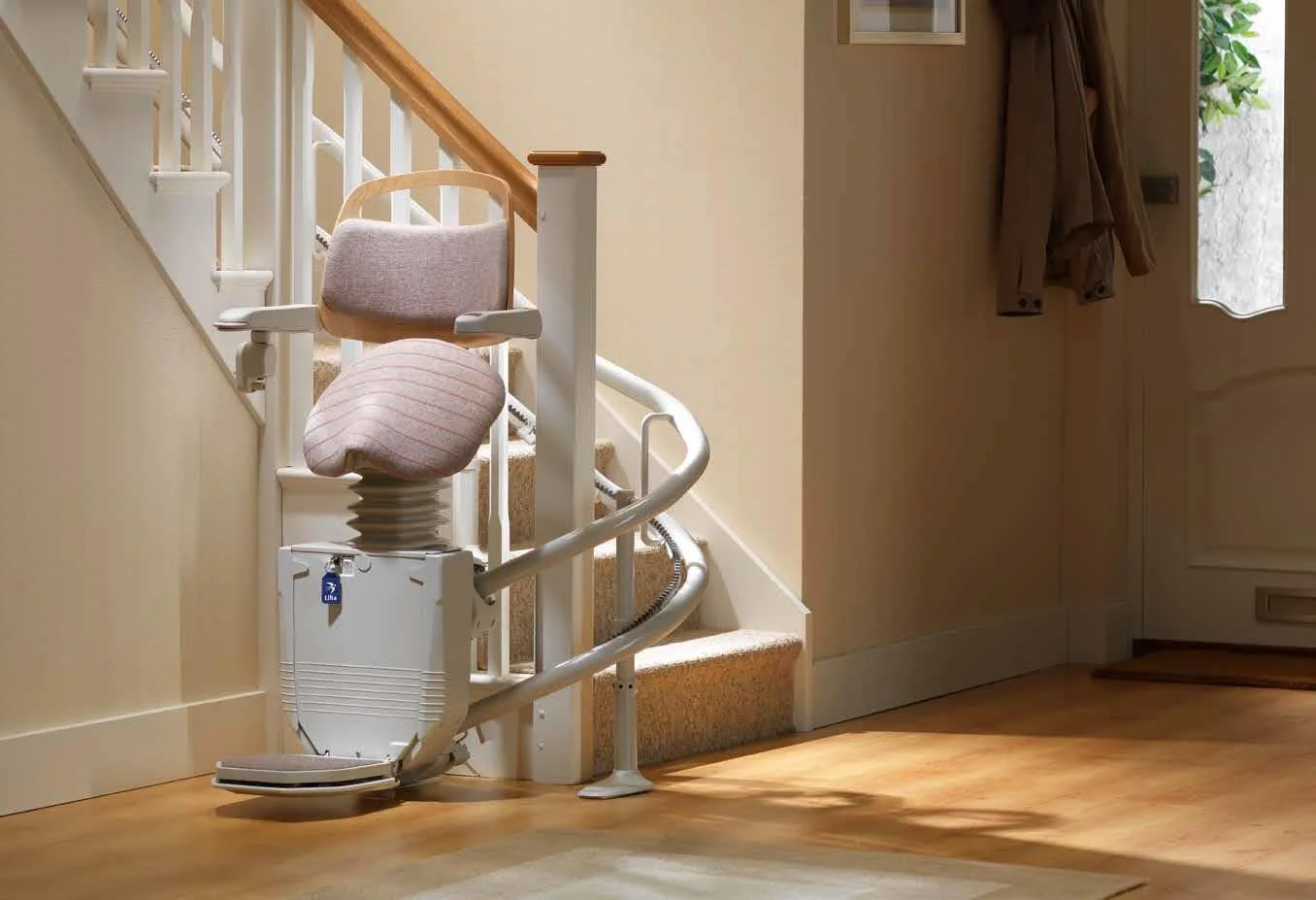
Single-family homes and detached houses make up much of what we see here. When the staircase runs straight from bottom to top, a straight stair lift is usually the simplest fit. It mounts to the stair treads, not the wall.
Split-level homes are different. They often have a few short flights instead of one long one, so the right answer may be a lift on the flight that matters most, or a curved rail that follows a turn or landing. We measure every flight before suggesting anything.
Townhouses tend to have narrow, steep stairs. The width of the stairway and the space at the top and bottom decide which models will fold out of the way for everyone else in the house.
On mountain lots, the hardest stairs are often outside: porch steps, a long run up from the parking spot, or a back entry set into the slope. An outdoor stair lift is built for weather and can handle those runs.
Where a wheelchair has to come along, a platform lift may make more sense than a seat. It carries the person and the chair together. We can talk through both options on site.
About 32.3% of Russell County residents are 65 or older, and 70.1% own their homes. That adds up to a lot of people who want to stay in a house they already own as the stairs get harder.
Renters in walk-up apartments face a different question, since any lift needs the owner's approval.
Median household income in the county was $50,012 in 2024, roughly half the statewide median, so cost is a real question for many families. No program listed here names stair lifts outright, and one VA grant rules them out. Several still cover home modifications or accessibility repairs, and it is worth calling before you decide.
A good first call for anyone 60 or older is the Appalachian Agency for Senior Citizens at (276) 964-4915. Their care coordination can help sort out the CCC Plus waiver, EHARP and other options. Statewide, you can also ask about the Virginia Livable Home Tax Credit (LHTC) and the Assistive Technology Loan Fund Authority (ATLFA).
A Medicaid home and community-based waiver for people 65 and older, or under 65 and disabled, who need nursing-facility level of care; Environmental Modification and Assistive Technology are named services, but stair lifts are not listed. Fee-for-service members can email [email protected], and managed-care members should contact their MCO care coordinator.
A VA grant for medically needed home improvements with a $6,800 or $2,000 lifetime maximum depending on disability status. It does not cover stair lifts, since VA excludes stair glides and porch lifts; the Tazewell Benefits Office is at (276) 988-3761.
Grants for veterans with permanent and total service-connected disabilities, up to $126,526 for SAH and $25,350 for SHA in FY2026. VA describes adaptations like ramps and wider doorways, but stair lifts are not listed.
Rural repair loans up to $20,000 at 1% interest, and grants up to $7,500 for homeowners 62 and older with income at or below 50% of area median income, to remove health or safety hazards. Stair lifts are not listed, so confirm details with the USDA Rural Development Virginia field office.
A Virginia DHCD program offering up to $4,000 per applicant for households at or below 80% of area median income, including wheelchair ramps and other accessibility modifications; stair lifts are not listed by name. Call DHCD at (804) 371-7000 to find the local administrator for Russell County.
A community action agency serving Russell County with housing programs for low-income homeowners; no stair lift program is listed. Call the Abingdon headquarters at (276) 623-9000, or the Lebanon office at (276) 619-9000, to ask what repair help is current.
The area agency on aging for residents 60 and older, offering care coordination and in-home care; stair lifts and home modifications are not listed. Call (276) 964-4915 for help finding other funding.
A Grundy-based center serving people with disabilities in Buchanan, Dickenson, Russell and Tazewell counties; stair lifts are not listed in the source reviewed. Call (276) 935-6088 to ask about current equipment and modification help.
Older adults
216 College Ridge Road, Tazewell, 24609
Veterans
657 Main Street, Tazewell, 24651
No. VA lists stair glides and porch lifts among the items HISA cannot fund. A veteran with a qualifying service-connected disability can ask the Tazewell Benefits Office at (276) 988-3761 about the SAH or SHA grants instead, though those do not name stair lifts either.
The CCC Plus waiver includes people under 65 who are disabled and need nursing-facility level of care. Clinch Independent Living Services serves people with disabilities in Russell County at (276) 935-6088. EHARP is based on income, not age.
Only with the property owner's approval. EHARP lets tenants apply with homeowner approval, so ask your landlord first and then call DHCD at (804) 371-7000.
No. It usually means looking at each flight separately, and sometimes using a curved rail where the stairs turn. We measure every flight before recommending one setup.
For anyone 60 or older, the Appalachian Agency for Senior Citizens at (276) 964-4915 is a good start. Their office is at 216 College Ridge Road in Tazewell, and care coordination can point you toward CCC Plus, EHARP and other programs.
Tell us about the stairs in your home and we will explain which lift fits, what it costs and how installation works.
